
Daedalus and Icarus Quiz
How the Scales are Structured
Who Usually Takes This Test?
See How You Compare
Below is a preview of how scores are typically distributed across each scale.
Example Questions From the Test
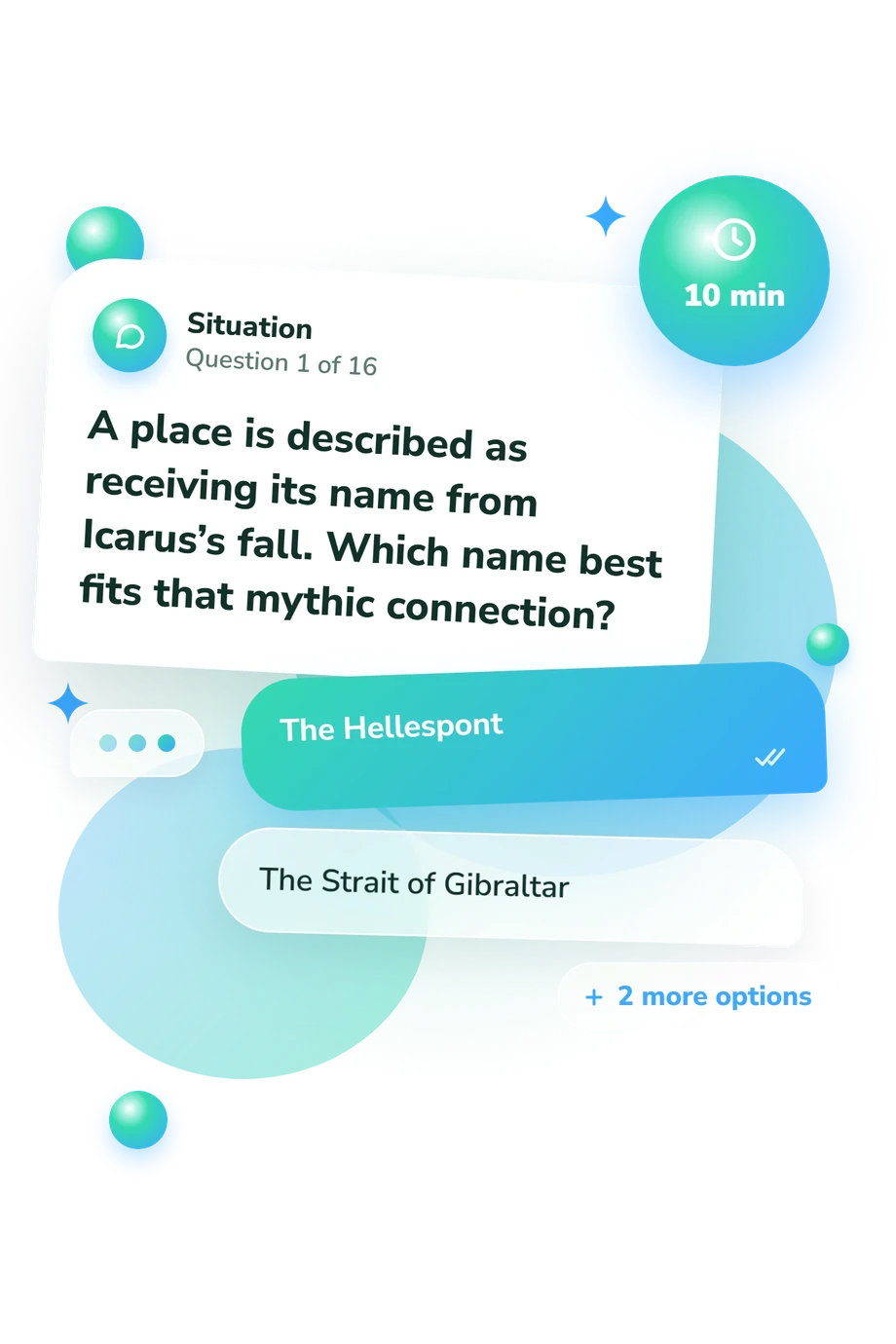
- The Hellespont
- The Strait of Gibraltar
- The Gulf of Corinth
- The Icarian Sea
- The Minotaur
- The Cyclops Polyphemus
- The bronze giant Talos
- The Nemean Lion
- The two are soldiers sent by King Minos
- They are gods capable of traveling through the sky
- They are spirits returning to the underworld
- They are sailors lifted by a violent storm
Daedalus and Icarus Quiz - Description and methodology of the test
Readers returning to the myth for study, classroom preparation, or personal curiosity can use the Daedalus and Icarus Quiz to check recognition of its narrative and literary details. It suits anyone interested in how invention, judgment, obedience, and consequence interact in the story. The quiz turns broad familiarity into a clearer Daedalus and Icarus knowledge profile, showing which parts of the narrative the reader recognizes.
What This Assessment Explores
This assessment measures knowledge of the Daedalus and Icarus narrative, not personality or intellectual ability. It covers characters, the Labyrinth, Minos’s control, wing construction, escape, warning, fall, and grief. Some questions about the Daedalus and Icarus story address events and places, while others ask what a warning, contrast, or sequence means.
The result appears on the Daedalus and Icarus Knowledge scale (0-16), with three bands describing knowledge shown by these items:
- Foundation to Build (0-6) indicates recognition of central elements, with room to revisit key events.
- Developing Knowledge (7-12) shows the main narrative and several details, with literary context to refine.
- Strong Knowledge (13-16) reflects reliable command of the myth’s sequence and major themes, not intelligence or expertise.
Methodology and Evidence Base
Each item presents four alternatives with one intended answer. The format combines factual recall with interpretation: a reader may identify a creature, location, source, or event, then consider a warning or the contrast between invention and judgment. The result is a numerical summary on the displayed knowledge scale; the questionnaire presents it as an unvalidated quiz summary covering narrative recall and literary interpretation.
The content is conceptually consistent with Ovid’s Book VIII account and Hoefmans’s analysis, while Apollodorus and Morford, Lenardon, and Sham provide relevant mythological context for the Labyrinth, escape, and consequences. The questionnaire is not an adaptation of those works. This online questionnaire uses a focused knowledge format, selecting details about characters, places, sequence, and interpretation rather than reproducing every ancient version.
Interpretation should stay close to what the items test. A higher score indicates stronger recognition of this narrative and its literary details; it does not establish expertise. Familiarity with a retelling or classroom discussion can influence performance. Read the result as a snapshot of knowledge of the version represented here.
- Ovid. Metamorphoses: A New Verse Translation. Translated by David Raeburn, with an introduction by Denis Feeney. Penguin Classics, 2004.
- Hoefmans, Marjorie. “Myth into Reality: The Metamorphosis of Daedalus and Icarus (Ovid., Metamorphoses, VIII, 183-235).” L’Antiquité Classique 63 (1994): 137-160. 10.3406/antiq.1994.1187
- Apollodorus. The Library of Greek Mythology. Translated with an introduction and notes by Robin Hard. Oxford University Press, 1997.
- Morford, Mark P. O., Robert J. Lenardon, and Michael Sham. Classical Mythology. 11th ed. Oxford University Press, 2018.
Updated: