
Chemistry Glassware Quiz
How the Scales are Structured
Who Usually Takes This Test?
See How You Compare
Below is a preview of how scores are typically distributed across each scale.
Example Questions From the Test
- Watch glass
- Evaporating dish
- Petri dish
- Crystallizing dish
- Florence flask
- Erlenmeyer flask
- Round-bottom flask
- Volumetric flask
- Erlenmeyer flask
- Volumetric flask
- Round-bottom flask
- Florence flask
Chemistry Glassware Quiz - Description and methodology of the test
Students, trainees, and curious home learners can use this assessment to connect familiar laboratory shapes with their intended functions. The chemistry glassware quiz emphasizes recognition and practical selection rather than hands-on performance, making it useful for introductory revision and equipment familiarization. The result from this lab glassware quiz can show which distinctions deserve closer study before further laboratory work.
What This Assessment Explores
These questions test whether a learner can infer a vessel’s function from shape, markings, closure, material, or apparatus connections. They cover measuring, transferring, heating, containing, separating, filtering, and cooling. Learners can use this glassware identification quiz to identify common equipment and distinguish similar pieces during revision.
The result groups recognition into these practical areas:
- Measurement and delivery distinguish approximate, fixed, and variable volumes.
- Heating and reaction vessels connect form with boiling, reflux, swirling, or direct heating.
- Storage and separation use stoppers, amber glass, side arms, and liquid layers as clues.
- Cooling and general-purpose equipment identify water jackets, pouring lips, and broad openings.
Chemistry Glassware Knowledge runs from 0-16: Foundations to build (0-6), Developing identification (7-12), and Strong knowledge (13-16). The bands summarize how consistently design features are linked with appropriate laboratory uses.
Methodology and Scientific Basis
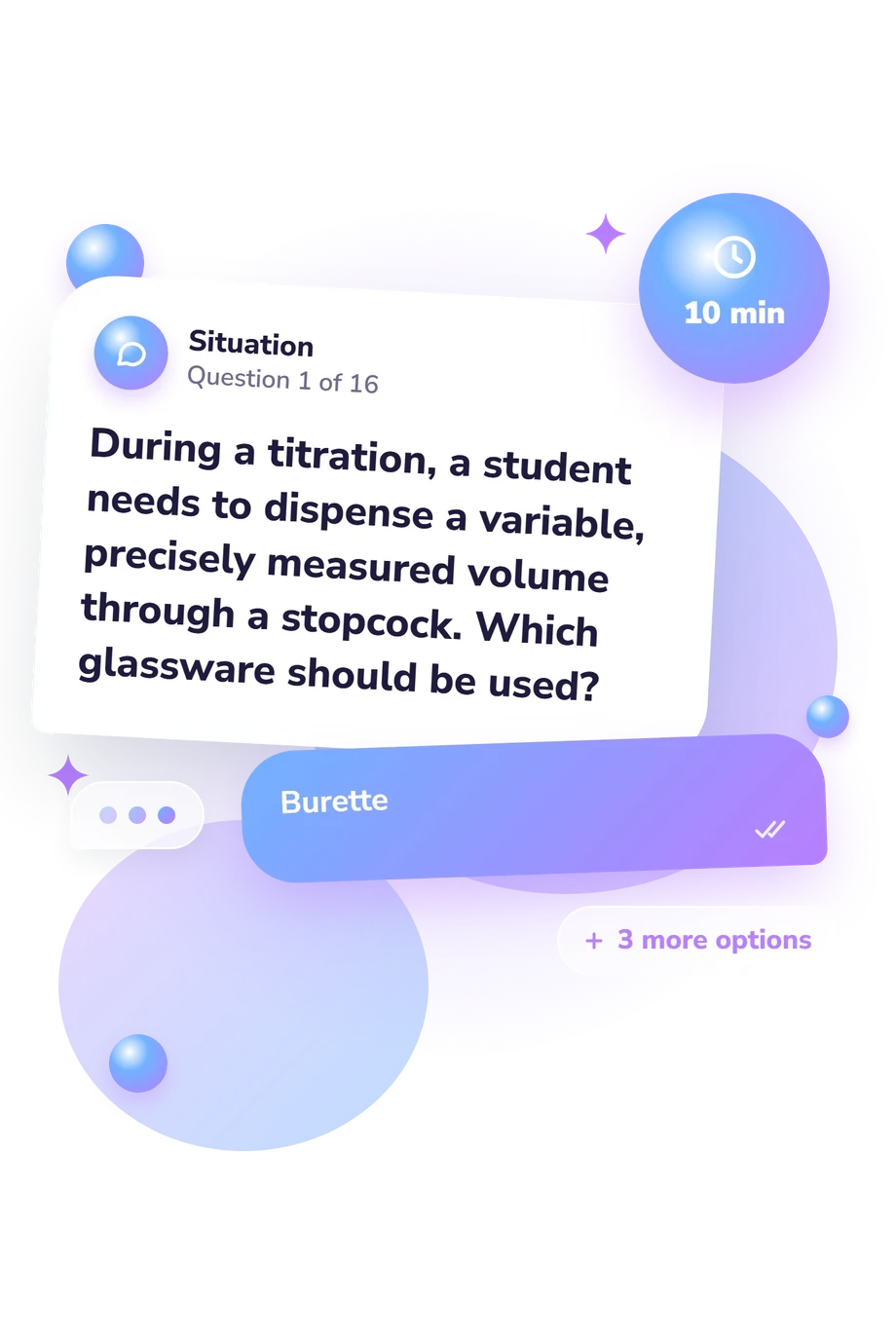
Each item presents a scenario or equipment description followed by four answer choices. The learner selects the best match using clues such as calibration marks, stopcocks, bulbs, necks, bases, side arms, or water jackets. Learners taking this chemistry lab equipment quiz identify equipment by matching visual and functional clues rather than manipulating it hands-on.
The result displays one overall scale, and the questionnaire does not specify how individual responses are converted into points.
Content is conceptually consistent with the 2011 study by Bektas and colleagues, whose work examined knowledge of laboratory equipment and functions. Law's 2021 laboratory manual supports conventional apparatus use in experimental chemistry, while the 2025 American Association of Chemistry Teachers activity reflects classroom practice in identifying equipment. These sources support the questionnaire’s content focus, not its adaptation or validation.
The questionnaire has no reported standardization, reliability estimate, population norm, or formal pass standard. Responses can be influenced by attention, terminology, guessing, and the learner’s prior exposure. The result is an educational summary, so it cannot establish safe assembly, handling, or laboratory competence.
- Bektas, O., Tuysuz, M., Kirbulut, Z. D., & Cetin-Dindar, A. (2011). Pre-service chemistry teachers’ knowledge regarding laboratory equipment and their functions. Procedia - Social and Behavioral Sciences, 15, 510-514. 10.1016/j.sbspro.2011.03.132
- Law, Y. K. (2021). IU East Experimental Chemistry Laboratory Manual. Indiana University East.
- American Association of Chemistry Teachers. (2025). Lab Equipment Card Sort & Scavenger Hunt. American Chemical Society.
Updated: