
Causative Quiz
How the Scales are Structured
Who Usually Takes This Test?
See How You Compare
Below is a preview of how scores are typically distributed across each scale.
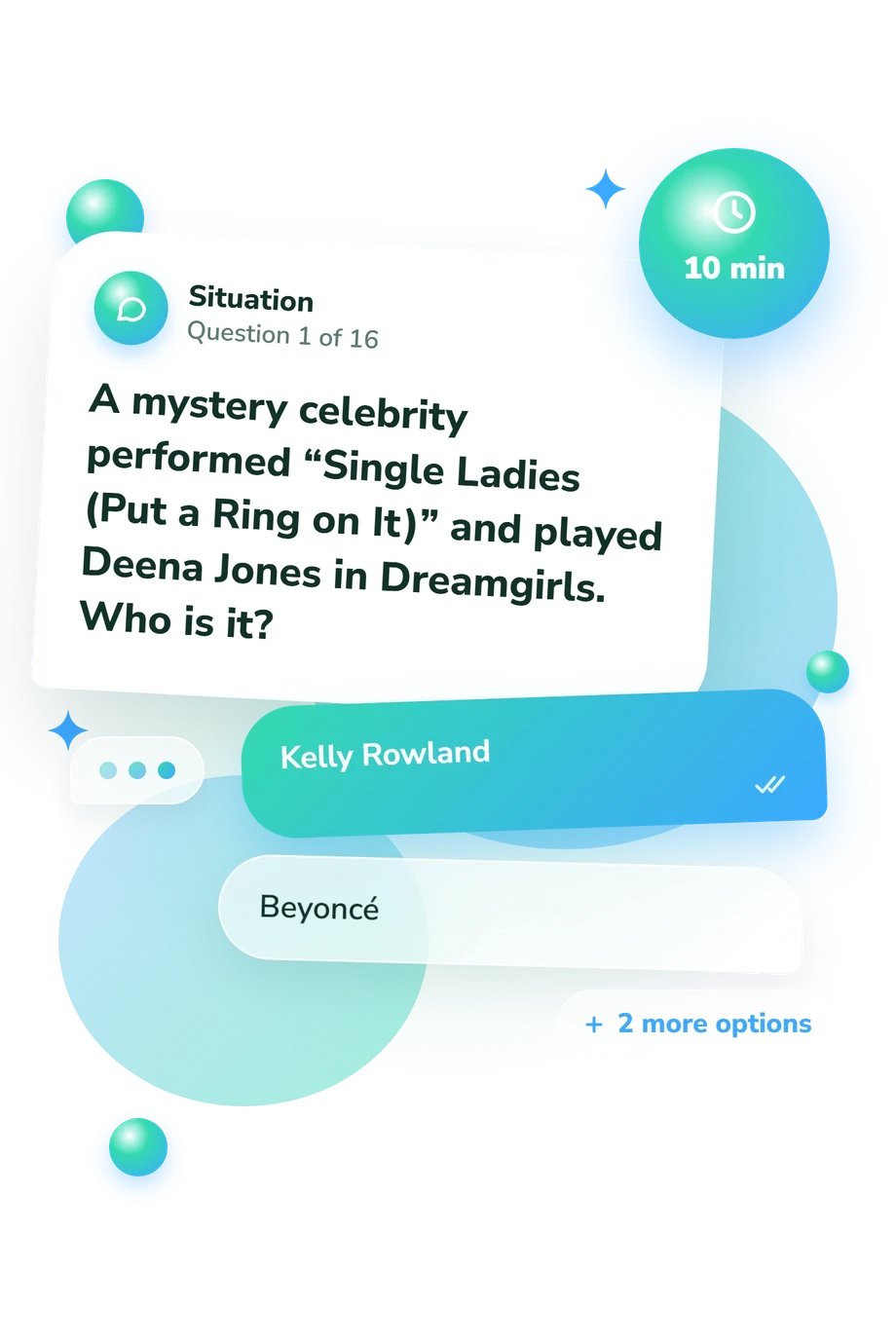
Example Questions From the Test
- Kelly Rowland
- Beyoncé
- Alicia Keys
- Jennifer Hudson
- Katy Perry
- Miley Cyrus
- Ariana Grande
- Lady Gaga
- Elton John
- Freddie Mercury
- David Bowie
- George Michael
Causative Quiz - Description and methodology of the test
Readers who enjoy a light challenge can use this assessment to gauge how readily familiar entertainment knowledge comes together under pressure. The celebrity eyes picture quiz gives you a single performance snapshot by asking which performer best fits each set of cultural references. As a celebrity recognition quiz, it suits readers who want a light challenge built from familiar media knowledge rather than a personality profile.
What This Assessment Explores
It measures recognition of public figures through cross-media associations, not knowledge of one narrow entertainment field. Each prompt combines anchors such as songs, roles, characters, films, series, or biographical details, then asks you to select the celebrity who connects them. The celebrity picture quiz format makes the answer a contextual task: the selected person must fit several clues at once.
The result uses one catalogue scale:
- Celebrity Knowledge (0-16) shows how many clue combinations you matched correctly. Starting Lens (0-6) means some major names were recognized while many combinations remained unfamiliar; Developing Recognition (7-12) reflects broad but incomplete links between celebrities and signature work; Spotlight Expert (13-16) indicates consistent matching across film, television, and music.
That score describes recognition of celebrity-work associations under forced-choice conditions. It does not separate film knowledge from music knowledge, so the total cannot show which medium supported or weakened your performance.
Methodology and Scientific Basis
Each item uses a four-option, forced-choice format. You select one celebrity from clues that cross music, film, television, and character roles; the displayed total is the number of correct answers, and the descriptive bands label the result. This makes the test a famous faces quiz driven by associations rather than a self-rating scale.
The evidence base is conceptual. Hanley, Pearson, and Howard (1990) found that how famous faces and names are encoded affects later memory, supporting the relevance of meaningful links between identity and biographical information. Jenkins, Dowsett, and Burton (2018) examined familiar-face knowledge, while Young and Burton (2017) describe recognition as relying on stored representations of familiar identities. The questionnaire is conceptually consistent with these findings, but it is not presented as an adaptation or standardized version of any of these measures.
Read the score as a snapshot of performance in this clue set. The displayed bands are descriptive labels for performance on this clue set, and results can shift with cultural exposure, celebrity familiarity, wording, attention, and guessing. A strong result reflects effective recognition of these entertainment associations; a lower result may reflect limited exposure rather than a general weakness in memory.
- J. Richard J. Hanley, Norma A. Pearson, and Louise A. Howard. "The Effects of Different Types of Encoding Task on Memory for Famous Faces and Names." Quarterly Journal of Experimental Psychology, 42(4), 741-762 (1990). 10.1080/14640749008401247
- Rob Jenkins, Andrew James Dowsett, and Anthony Michael Burton. "How many faces do people know?" Proceedings of the Royal Society B: Biological Sciences, 285(1888), 20181319 (2018). 10.1098/rspb.2018.1319
- Andrew William Young and Anthony Michael Burton. "Recognizing faces." Current Directions in Psychological Science, 26(3), 212-217 (2017). 10.1177/0963721416688114
Updated: