
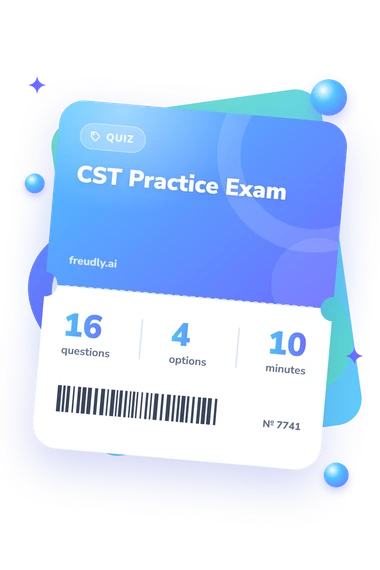
CST Practice Exam Quiz
How the Scales are Structured
Who Usually Takes This Test?
See How You Compare
Below is a preview of how scores are typically distributed across each scale.
Example Questions From the Test
- Enveloped virus
- Vegetative bacterium
- Bacterial endospore
- Fungal yeast cell
- Razor shaving the night before surgery
- Clipping the hair as close as practical to the procedure time
- Applying depilatory cream after the skin preparation
- Pulling individual hairs after the sterile drapes are placed
- Condensation washes microorganisms off instrument surfaces
- Pressure physically crushes microbial cell walls
- Steam removes all oxygen needed for microbial survival
- Moist heat denatures and coagulates cellular proteins
CST Practice Exam Quiz - Description and methodology of the test
Designed for students and surgical technologists reviewing foundational perioperative knowledge, the CST Practice Exam Quiz offers a focused way to check how comfortably you recognize common safety, asepsis, instrumentation, positioning, and tissue-handling principles. As a CST quiz, it turns missed concepts into practical study targets while keeping the result tied to the knowledge areas represented by the questions.
What This Assessment Measures
The questionnaire tests applied knowledge for students and surgical technologists, providing CST exam practice through scenarios that ask you to choose the action that protects the patient, preserves asepsis, supports teamwork, or handles instruments and specimens safely.
The practical areas represented by the items are:
- Asepsis and infection prevention measure recognition of safe cleaning, medication, and sterile-field practices.
- Positioning and patient safety measure decisions that reduce procedural risk.
- Instruments and counts measure identification, handling, and accountability.
- Sterilization and disinfection measure knowledge of microbial control and processing.
- Wounds, specimens, and equipment measure responses to tissue handling, pathology, and electrosurgery.
Results appear on the CST Practice Exam Knowledge scale (0-16). Foundations to review covers 0-6, Developing exam knowledge covers 7-12, and Strong exam knowledge covers 13-16. The bands identify study priorities within the sampled content, not a fixed judgment about competence.
Methodology and Evidence Base
Each item presents a short perioperative situation with four answer choices and asks for the single best response. The method is a content-referenced knowledge check: it tests recognition and application rather than asking for a written explanation. Examples include preparing hinged instruments, using a neutral zone for sharps, and sending fresh tissue for frozen section.
Results summarize performance across the sampled content. No item-weighting formula is specified, so the displayed total should not be used to infer how any one response is scored. Missed questions are most useful when reviewed by topic.
The topics are conceptually consistent with the CST Candidate Handbook (NBSTSA, 2025), the 2023 NBSTSA job analysis, the Association of Surgical Technologists' core curriculum, and Raymond's 2001 work on examination content specification. This questionnaire is not an adaptation of any one of these sources.
As an online practice questionnaire, it covers instrument handling, infection prevention, tissue management, and operating-room safety; its explicitly unvalidated score is an educational summary and cannot establish certification readiness or clinical competence. For surgical technology exam preparation, use the result to guide broader review, remembering that performance may vary with current study, attention, and familiarity with the wording.
- National Board of Surgical Technology and Surgical Assisting. CST Candidate Handbook: National Examination for the Certified Surgical Technologist. 2025 1st ed. Littleton, CO: NBSTSA; 2025.
- National Board of Surgical Technology and Surgical Assisting. Job Analysis Report-NBSTSA CST. February 2023. Littleton, CO: NBSTSA; 2023.
- Association of Surgical Technologists, with Angie Burton as revision-panel contributor. Core Curriculum for Surgical Technology. 7th ed. Littleton, CO: Association of Surgical Technologists; 2021. ISBN 978-0-926805-72-9.
- Raymond, Mark R. Job Analysis and the Specification of Content for Licensure and Certification Examinations. Applied Measurement in Education. 2001;14(4):369-415. 10.1207/S15324818AME1404_4
Updated: