
Does Jeff the Killer Like You Quiz
How the Scales are Structured
Who Usually Takes This Test?
See How You Compare
Below is a preview of how scores are typically distributed across each scale.
Example Questions From the Test
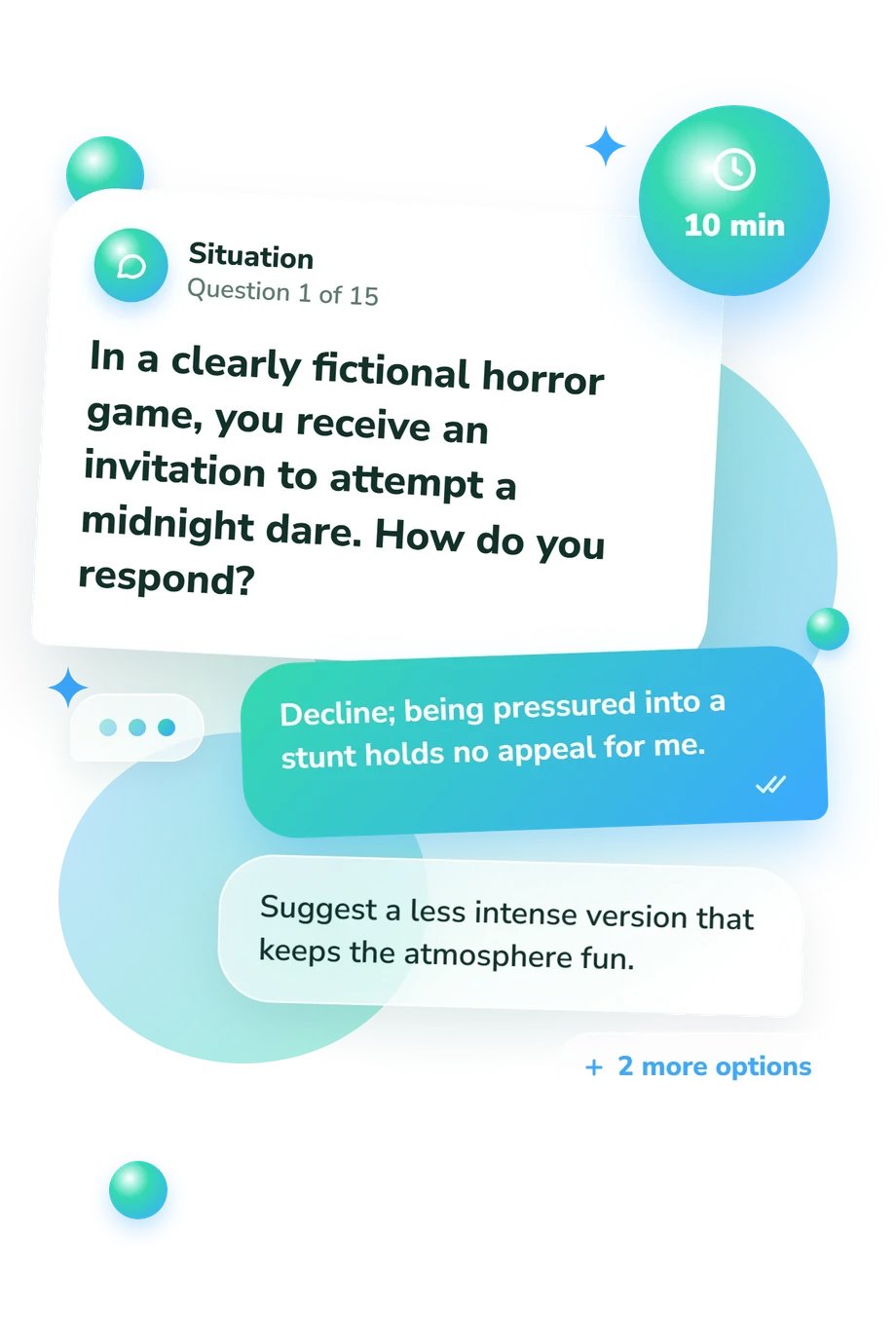
- Decline; being pressured into a stunt holds no appeal for me.
- Suggest a less intense version that keeps the atmosphere fun.
- Join after studying the setting and the people involved.
- Accept and add a theatrical twist nobody expects.
- Demand that he explain himself immediately.
- Make a provocative joke to test his mood.
- Quietly note the exits before deciding whether to speak.
- Acknowledge that I see him without approaching or escalating.
- Dependable and unlikely to make a reckless move.
- Quietly observant of details other people miss.
- Direct enough that people rarely wonder what I think.
- Unpredictable enough that people cannot anticipate my next move.
Does Jeff the Killer Like You Quiz - Description and methodology of the test
Fans of fictional horror and creepypasta can use this playful questionnaire to explore how their instincts might shape an encounter with Jeff, rather than to judge real-world character or conduct. The Does Jeff the Killer Like You Quiz turns choices about pressure, control, secrecy, humor, and confrontation into a story-based profile. The result from this what does Jeff the Killer think of you quiz offers a leading or blended fictional dynamic.
What This Assessment Explores
These hypothetical encounters map choices onto fictional outcomes, not stable traits. Responses can emphasize observation, negotiation, protection, resistance, humor, or unpredictability in a horror-story role. This Jeff the Killer fan quiz invites playful exploration of that role.
The three profile dimensions are:
- Disturbingly Intrigued (0-15) reflects fictional affinity with Jeff becoming fascinated by your nerve, unpredictability, or dark wit: Passing Notice (0-5), Hooked Curiosity (6-10), Fixated Interest (11-15).
- Immediate Antagonism (0-15) reflects fictional affinity with becoming Jeff’s opponent through resistance, exposure, or refusal to surrender control: Limited Friction (0-5), Rising Opposition (6-10), Marked Opposition (11-15).
- Uneasy Tolerance (0-15) reflects fictional affinity with a wary truce in which Jeff neither embraces nor immediately opposes you: Little Common Ground (0-5), Conditional Truce (6-10), Uneasy Tolerance (11-15).
The highest score is your strongest affinity. Outcomes within one point are blended; neither result means friendship, safety, or moral judgment.
Methodology and Scientific Basis
Each prompt presents a fictional scenario with four response options. Choices cover control, uncertainty, secrecy, conflict, and protection; there is no correct answer. The fictional format turns instincts into narrative decisions, while familiarity with Jeff may shape respondents’ interpretations and answers.
The questionnaire reports separate outcome scores and compares them: the highest score is the strongest affinity, while outcomes within one point are read as blended.
Conceptually, the profile aligns with Kjeldgaard-Christiansen et al. (2021) on engagement with fictional villains, personality, and character appeal; that study offers context, not validation of this questionnaire. Krause and Rucker (2020) support the idea that a darker fictional character can feel self-relevant in a safe story context.
Teasdale et al. (2021) helps explain the roles of identification, moral approval, and attribution in audience responses to drama. As a Jeff the Killer character quiz, this assessment simplifies those concepts into playful choices about a fictional encounter. Self-report, current mood, imagination, familiarity with Jeff, and impression management can influence scenario interpretation and answers, so the profile describes a story role within this exercise.
- Kjeldgaard-Christiansen, Jens, Anne Fiskaali, Henrik Høgh-Olesen, John A. Johnson, Murray Smith, and Mathias Clasen. (2021). Do dark personalities prefer dark characters? A personality psychological approach to positive engagement with fictional villainy. Poetics, 85, Article 101511. 10.1016/j.poetic.2020.101511
- Krause, Rebecca J., and Derek D. Rucker. (2020). Can Bad Be Good? The Attraction of a Darker Self. Psychological Science, 31(5), 518-530. 10.1177/0956797620909742
- Teasdale, Ben, Laurie Maguire, Felix Budelmann, and Robin I. M. Dunbar. (2021). How Audiences Engage With Drama: Identification, Attribution and Moral Approval. Frontiers in Psychology, 12, Article 762011. 10.3389/fpsyg.2021.762011
Updated: