
Commercial Quiz
How the Scales are Structured
Who Usually Takes This Test?
See How You Compare
Below is a preview of how scores are typically distributed across each scale.
Example Questions From the Test
- 5%
- 30%
- 60%
- 5%
- The income statement
- The sales pipeline report
- The balance sheet
- The statement of cash flows
- A new regulation affecting every company in the industry
- The company's experienced sales team
- The company's outdated internal software
- The company's available cash balance
Commercial Quiz - Description and methodology of the test
People building everyday business judgment can use a focused assessment to examine how they connect numbers, customers, markets, and operating choices. This commercial quiz suits learners, early-career professionals, and anyone revisiting practical business fundamentals. As a business knowledge quiz, it offers a concrete learning checkpoint: the result highlights areas that feel secure and topics that merit further study, without presenting a complete picture of professional performance.
What This Assessment Explores
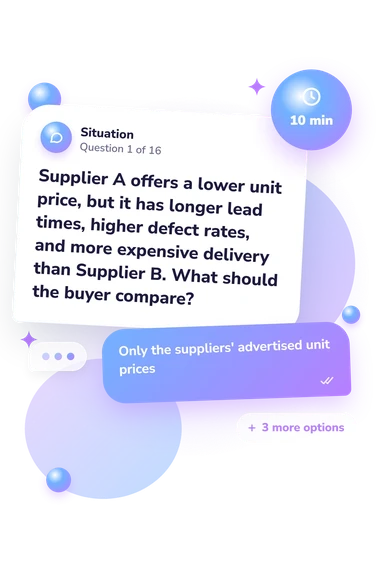
Practical commercial literacy is the central construct. The items test how respondents connect prices, costs, profitability, liquidity, market position, customer economics, and constrained business decisions. Several dimensions appear through commercial questions in the quiz, including supplier choice, inventory, recurring revenue, concentration risk, and sunk expenditure.
The thematic groups are:
- Margin and contribution analysis shows how price and variable cost shape gross margin and break-even reasoning.
- Cash-flow reasoning shows how receivables, inventory, and payment timing affect liquidity.
- Market and customer measures show how segmentation, share, retention, and concentration shape choices.
- Decision economics shows how incremental costs and sunk expenditure influence action.
Together, these areas describe practical knowledge rather than a personality trait or general intelligence. A stronger result suggests broader command of the fundamentals; a weaker result identifies concepts worth reviewing. It does not establish competence in abilities not sampled here.
Methodology and Evidence Base
The questionnaire uses short business scenarios, straightforward calculations, and four answer choices. As a commercial knowledge test, it asks the respondent to select the best answer, while the displayed Commercial Knowledge score reflects the number answered correctly, from 0-16. Results appear as Foundational (0-6), Developing (7-12), or Strong (13-16), describing performance on this educational sample rather than a professional credential.
Conceptually, the design is consistent with Anderson, Volker and Phillips (2005-2006), whose work examines applied business literacy in a manufacturing setting; this questionnaire is not an adaptation of that study. Rohr-Mentele and Forster-Heinzer (2021) provide a closer reference for commercial knowledge assessment, while Huston (2010) helps distinguish financial knowledge from broader financial literacy.
Interpretation should stay close to the item content. A high result suggests recognition of more tested relationships, but not equal skill in pricing, cash management, or sales strategy. The online format has no reported normative sample, reliability estimate, or externally established cutoff. Guessing, accounting familiarity, and current learning context may also affect performance, so the profile is best used to direct further study and self-reflection.
- Anderson, Steven J., John X. Volker, and Michael D. Phillips. “Business Literacy: A Millennium Assessment in the Manufacturing Environment.” Southwest Business and Economics Journal 14 (2005-2006): 13-24.
- Rohr-Mentele, Silja, and Sarah Forster-Heinzer. “Practical validation framework for competence measurement in VET: a validation study of an instrument for measuring basic commercial knowledge and skills in Switzerland.” Empirical Research in Vocational Education and Training 13, article 18 (2021). 10.1186/s40461-021-00122-2
- Huston, Sandra J. “Measuring Financial Literacy.” Journal of Consumer Affairs 44(2) (2010): 296-316. 10.1111/j.1745-6606.2010.01170.x