
Classroom Objects in Spanish Quiz
How the Scales are Structured
Who Usually Takes This Test?
See How You Compare
Below is a preview of how scores are typically distributed across each scale.
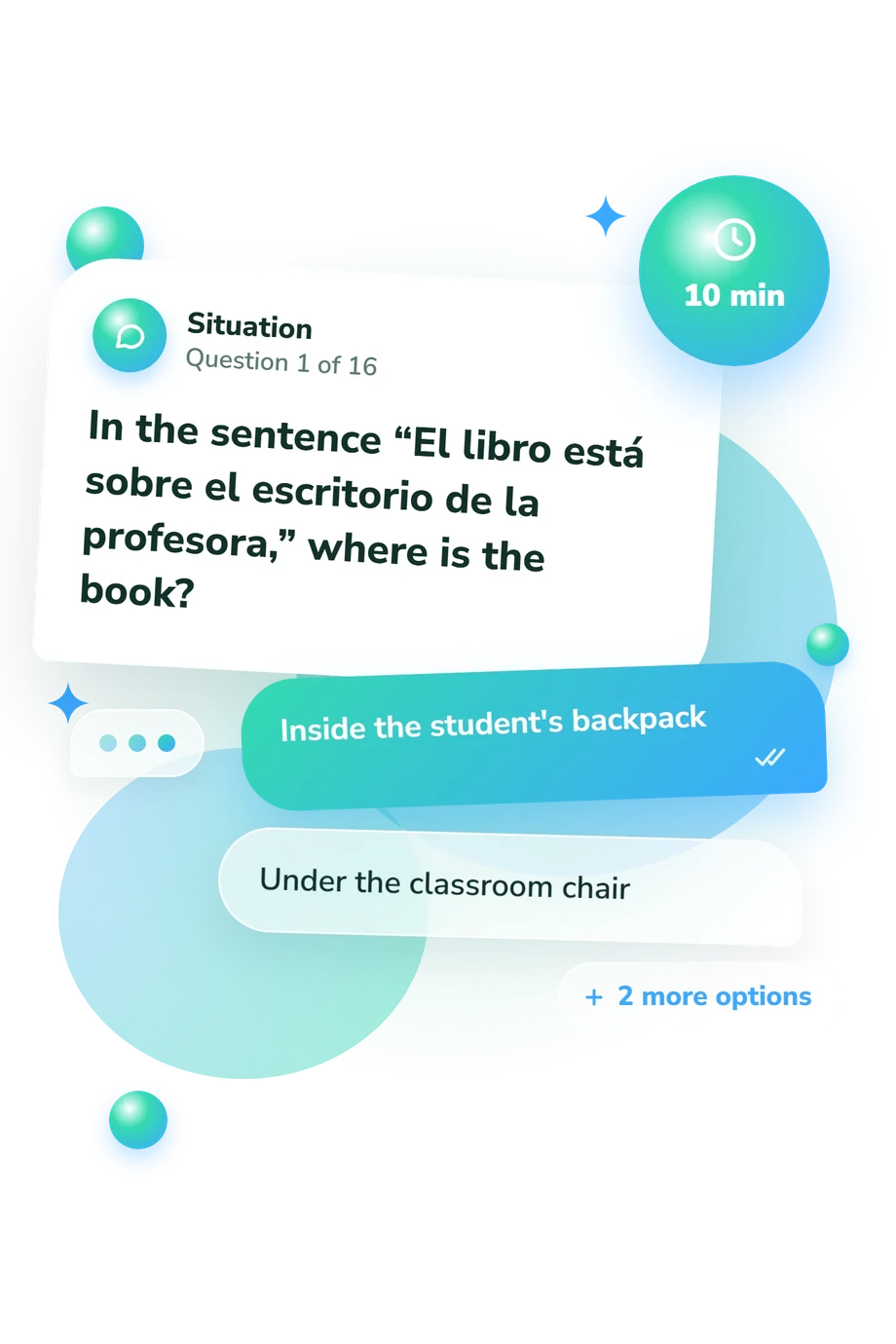
Example Questions From the Test
- Inside the student's backpack
- Under the classroom chair
- Beside the bookshelf
- On the teacher's desk
- La goma de borrar
- La tiza
- La calculadora
- La grapadora
- La cinta adhesiva
- La hoja de papel
- El sacapuntas
- La grapadora
Classroom Objects in Spanish Quiz - Description and methodology of the test
For learners developing Spanish classroom vocabulary, this assessment offers a focused way to practise recognition of common classroom terms and short instructions. The Classroom Objects in Spanish Quiz is useful for students, teachers, or independent learners who want to work with everyday words in context. Its format supports practice with classroom terms and indicates broad areas where further review may be useful.
What This Assessment Explores
The questions connect Spanish names with familiar classroom objects and test whether you understand them in simple directions. The assessment functions as a Spanish classroom objects quiz focused on usable vocabulary in familiar school settings.
Items ask you to identify a labelled object, choose what a task requires, or interpret a short instruction. This checks whether a word is available beyond isolated translation.
The result stays focused on this topic rather than overall Spanish ability.
The questions represent three practical areas:
- Supplies and tools show whether you can identify common materials and equipment.
- Furniture and storage show whether you can distinguish places and containers.
- Classroom instructions show whether you can use object words while following directions.
Methodology and Evidence Base
This is an online, item-based vocabulary check. Each question presents a Spanish term, an English meaning, or a classroom situation with four choices. The displayed Classroom Objects in Spanish Knowledge result spans 0-16: Foundations to Build (0-6), Developing Knowledge (7-12), or Strong Knowledge (13-16); the questionnaire's answer weighting is not documented.
Khong and Kabilan's Spanish-vocabulary instrument provides the closer comparison: it treats vocabulary knowledge as more than memorized definitions, supporting attention to recognition and use. This questionnaire is conceptually consistent with that instrument, while remaining a narrower classroom-themed check rather than an adaptation of it. LexTALE-Esp offers a broader comparison, measuring Spanish vocabulary beyond this topic. Contextualized items also align with the World-Readiness Standards, which connect language learning with communication in familiar situations.
For learners reviewing classroom vocabulary in Spanish, missed answers can identify terms to revisit through flashcards, labelled materials, or instructions. Results may reflect recent study, item wording, attention, and familiarity with context. This is an informal vocabulary result, with bands that serve as descriptive labels for classroom-object vocabulary and can guide review and progress tracking.
- Izura, Cristina, Fernando Cuetos, and Marc Brysbaert. (2014). Lextale-Esp: A test to rapidly and efficiently assess the Spanish vocabulary size. Psicológica, 35(1), 49-66.
- Khong, Hou Keat, and Muhammad Kamarul Kabilan. (2024). Development of an instrument for measuring Spanish vocabulary knowledge. Porta Linguarum, 41, 79-95. 10.30827/portalin.vi41.25406
- National Standards Collaborative Board. (2015). World-Readiness Standards for Learning Languages. 4th ed. Alexandria, VA: Author.
Updated: