
Do I Need the Morning After Pill Quiz
How the Scales are Structured
Who Usually Takes This Test?
See How You Compare
Below is a preview of how scores are typically distributed across each scale.
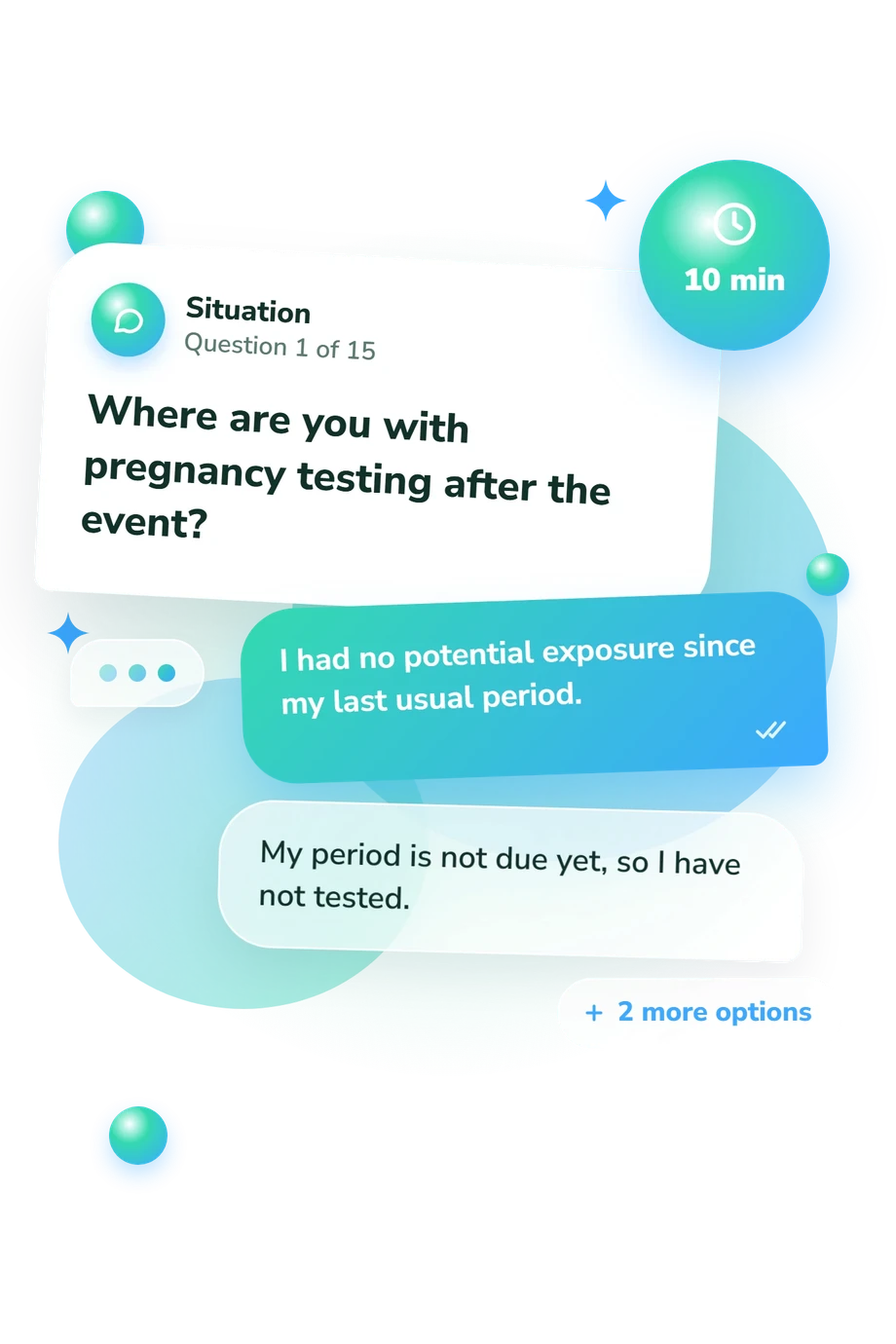
Example Questions From the Test
- There was no possible pregnancy exposure to address.
- I took emergency contraception as directed and had no later unprotected sex.
- I have not taken emergency contraception for this exposure.
- I vomited within the product's stated redosing window, or I had another unprotected event after taking it.
- I had no potential exposure since my last usual period.
- My period is not due yet, so I have not tested.
- My period is late or unusual, or about three weeks have passed since the event, and I have not tested.
- I received a positive or unclear result, or my period remains late despite a negative test.
- I did not have a possible pregnancy exposure.
- Less than 72 hours.
- Between 72 and 120 hours.
- More than 120 hours, or I cannot work out when it happened.
Do I Need the Morning After Pill Quiz - Description and methodology of the test
People who are unsure what to do after a possible pregnancy exposure can use this questionnaire to sort the situation into practical next steps. The Do I Need the Morning After Pill Quiz helps an uncertain visitor identify which details deserve prompt discussion and what kind of support may be appropriate. Someone wondering - should I take a Plan B quiz? - can use the result to focus the next conversation.
What This Assessment Explores
This assessment suits someone reviewing a recent or uncertain event involving possible pregnancy exposure. Its questions cover contraception, emergency contraception, pregnancy testing, cycle timing, symptoms, medicines, body weight, consent, STI concerns, and access to care. Questions about morning-after-pill decisions organize factors that may change the next step.
The displayed result is organized into three summaries:
- Follow-Up and Support Needs (0-15) shows No listed follow-up need (0), Check-in warranted (1-2), or Prompt support or care (3-15) for symptoms, consent, or access concerns.
- Potential Pregnancy Exposure (0-15) shows No listed exposure (0), Prompt check-in (1-2), or Prompt action (3-15) when exposure remains possible.
- Timing and Option Considerations (0-15) shows No timing factor noted (0-0), Time-sensitive review (1-2), or Prompt professional input (3-15) when timing, medication or supplement interactions, body weight, repeat exposure, or access factors may change the appropriate option.
Methodology and Scientific Basis
Each item offers graded response choices, moving from no relevant exposure toward uncertainty, a missed protection step, symptoms, or urgency. Answers feed the three summaries. The questionnaire does not disclose how individual responses contribute points to each summary; its scores are unvalidated reflective summaries, not standardized measures, and their bands prompt timely review rather than indicate pregnancy probability, severity, or diagnostic cutoffs.
The questionnaire functions as an emergency contraception quiz, using self-report to prepare a conversation with a pharmacist or clinician; memory and willingness to disclose can affect the result. Lee et al. (2013) examined pregnancy-testing encounters involving emergency-contraception questions and care needs. Lee et al. (2015) studied a contraceptive-knowledge checklist; this questionnaire is conceptually consistent with both, not adapted from either.
ACOG Practice Bulletin No. 152 and CDC 2024 recommendations provide context for timing, medication interactions, repeat exposure, and follow-up testing. Responses indicating possible exposure, time-sensitive circumstances, or support needs feed relevant summaries; bands prioritize clinician review, testing or support, and urgent action on red flags. Severe or one-sided pain, fainting, heavy bleeding, forced or non-consensual sex, or inability to obtain timely care warrants action independently of the total.
- Lee JK, Parisi SM, Baldauf E, Rapkin RB, Updike GM, Schwarz EB. Asking for what she needs? Pregnancy testing or EC? Contraception. 2013;87(6):859-863. 10.1016/j.contraception.2012.10.019
- Lee J, Papic M, Baldauf E, Updike G, Schwarz EB. A checklist approach to caring for women seeking pregnancy testing: Effects on contraceptive knowledge and use. Contraception. 2015;91(2):143-149. 10.1016/j.contraception.2014.11.003
- Curtis KM, Nguyen AT, Tepper NK, Zapata LB, Snyder EM, Hatfield-Timajchy K, et al. U.S. Selected Practice Recommendations for Contraceptive Use, 2024. MMWR Recommendations and Reports. 2024;73(3):1-77. 10.15585/mmwr.rr7303a1
- American College of Obstetricians and Gynecologists. Practice Bulletin No. 152: Emergency Contraception. Obstetrics & Gynecology. 2015;126(3):e1-e11. 10.1097/AOG.0000000000001047
Updated: