
Double Entry Accounting Quiz
How the Scales are Structured
Who Usually Takes This Test?
See How You Compare
Below is a preview of how scores are typically distributed across each scale.
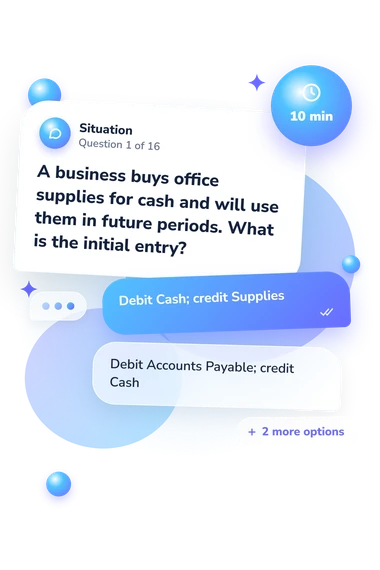
Example Questions From the Test
- Debit Cash; credit Supplies
- Debit Accounts Payable; credit Cash
- Debit Supplies Expense; credit Accounts Payable
- Debit Supplies; credit Cash
- Debit Prepaid Insurance; credit Insurance Expense
- Debit Cash; credit Insurance Expense
- Debit Accounts Payable; credit Prepaid Insurance
- Debit Insurance Expense; credit Prepaid Insurance
- Debit Accounts Receivable; credit Service Revenue
- Debit Cash; credit Service Revenue
- Debit Cash; credit Unearned Revenue
- Debit Unearned Revenue; credit Cash
Double Entry Accounting Quiz - Description and methodology of the test
Designed for learners reviewing financial accounting, this double entry accounting quiz checks whether you can apply core debit-credit rules rather than merely recall terminology. It is suitable for students, trainees, and independent learners who want to test their handling of routine entries and adjustments. The double entry bookkeeping quiz shows which transaction and adjustment topics deserve further study and which principles are already secure.
What This Assessment Explores
The items examine practical understanding of the accounting equation, account classification, normal debit and credit behavior, and the purpose of adjusting entries. Scenarios involve cash purchases, credit transactions, advance payments, accrued expenses, owner withdrawals, loan proceeds, equipment, and trial-balance errors. Together, the questions offer useful double entry accounting practice by showing whether a learner can:
- Classify accounts correctly and apply their normal debit or credit behavior.
- Record routine cash, credit, loan, equipment, revenue, and owner transactions.
- Handle prepayments, accruals, earned amounts, and other timing adjustments.
- Recognize what a balanced trial balance proves and what errors it can conceal.
Results appear on one scale, Double Entry Accounting Knowledge (0-16), with Foundations to build (0-6), Developing knowledge (7-12), and Strong knowledge (13-16). The result is most useful for choosing which accounting rules to review next.
Methodology and Evidence Base
Each item presents an accounting situation or principle with four answer choices, asking which entry, account effect, or conclusion is correct. This selected-response format tests application as well as recall: plausible alternatives require distinguishing cash from receivables, expenses from prepaid assets, and payables from cash.
The questionnaire reports no population norms or validation statistics, so its bands are descriptive feedback on this question set rather than norm-referenced proficiency levels. The result can direct debit and credit accounting practice toward topics that need revision.
Conceptually, the content is consistent with double-entry reasoning discussed by Culhane and O'Mahony (2025). Core rules also align with Franklin, Graybeal, and Cooper's instructional treatment and the historical framework associated with Pacioli. The question content is conceptually consistent with these works, but the questionnaire is not claimed to be a validated adaptation of them.
Results can vary with prior study, terminology familiarity, and test-taking conditions. The three bands can guide review: revisit core rules at the lower level, practise timing adjustments and error detection in the middle, and apply sound entries to unfamiliar transactions at the higher level.
- Culhane, Sarah, and Tom O'Mahony. "An investigation into how students determine the double entry of a financial transaction." Accounting Education, vol. 34, no. 1, 2025, pp. 69-86. 10.1080/09639284.2023.2285855
- Franklin, Mitchell, Patty Graybeal, and Dixon Cooper. Principles of Accounting, Volume 1: Financial Accounting. OpenStax, 2019.
- Pacioli, Luca. Particularis de Computis Et Scripturis: 1494. Translated by Jeremy G. A. Cripps. Pacioli Society, 1994. ISBN 9780964777804
Updated: