
Computer Network Quiz
How the Scales are Structured
Who Usually Takes This Test?
See How You Compare
Below is a preview of how scores are typically distributed across each scale.
Example Questions From the Test
- Converting domain names into IP addresses
- Providing electrical power to every connected device
- Storing web pages for all local clients
- Forwarding packets between different IP networks
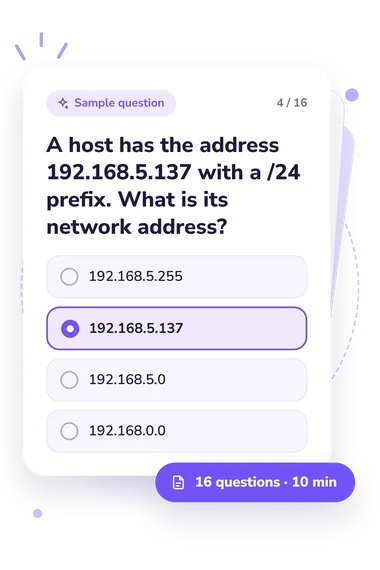
- 168.5.255
- 168.5.137
- 168.5.0
- 168.0.0
- TCP port 443
- TCP port 53
- TCP port 80
- TCP port 22
Computer Network Quiz - Description and methodology of the test
Students, career changers, and technology users can use this computer network quiz to check how confidently they connect networking principles with practical situations. The computer network quiz questions and answers focus on recognizing mechanisms behind addressing, protocols, devices, wireless behavior, and troubleshooting symptoms. Results point to strengths and review priorities, making the assessment useful for study planning and everyday technical learning.
What This Assessment Explores
The questions cover foundational network knowledge rather than a single specialist task. They ask respondents to connect an address, protocol, device, transmission rule, or fault symptom with the mechanism that explains it. Learners reviewing computer networks quiz questions with answers can use the result to identify secure concepts and distinctions needing practice.
The items group into four areas:
- Addressing shows whether you can distinguish network, private, link-local, and translated addresses.
- Protocols show whether you understand DHCP, DNS, HTTPS, TCP, and TTL in context.
- Devices and media show whether router, switch, Ethernet, and Wi-Fi functions are assigned correctly.
- Troubleshooting shows whether symptoms lead you toward an appropriate first check.
Computer Network Knowledge (0-16) is reported as Foundation Building (0-6), Developing Knowledge (7-12), or Strong Knowledge (13-16). These bands summarize performance across the assessed concepts rather than every networking skill.
Methodology and Scientific Basis
Each item is either a direct networking question or a short scenario followed by four answer choices. Across the networking quiz questions, the alternatives include nearby but incorrect concepts, so selecting an answer requires recognizing the relevant mechanism rather than matching isolated vocabulary.
The displayed scoring is a single total across the assessment; no separate subscales or weighting scheme are presented. Interpretation therefore works best at the level of overall knowledge and the topic areas identified above, not as a precise estimate of each individual skill.
Methodologically, the design is conceptually consistent with NetPASS (Williamson et al., 2004), which connects observed performance with claims about proficiency, and with Levy and Mislevy (2004), whose work addresses measurement models for computer-based assessment. The questionnaire is not presented as an adaptation of either source. Its technical content is consistent with networking principles described by Kurose and Ross (2021).
No normative standardization is provided; the result is an educational summary rather than a professional certification, and guessing, prior exposure, and current recall can affect performance, so use it to plan revision and exercises.
- Williamson, David M., Malcolm I. Bauer, Linda S. Steinberg, Robert J. Mislevy, John T. Behrens, and Sarah F. DeMark. “Design Rationale for a Complex Performance Assessment.” International Journal of Testing, 4(4), 303-332, 2004. 10.1207/S15327574IJT0404_2
- Levy, Roy, and Robert J. Mislevy. “Specifying and Refining a Measurement Model for a Computer-Based Interactive Assessment.” International Journal of Testing, 4(4), 333-369, 2004. 10.1207/S15327574IJT0404_3
- Kurose, James F., and Keith W. Ross. Computer Networking: A Top-Down Approach, 8th edition. Pearson, 2021. ISBN: 9780136681557