
Changes of Matter Quiz
How the Scales are Structured
Who Usually Takes This Test?
See How You Compare
Below is a preview of how scores are typically distributed across each scale.
Example Questions From the Test
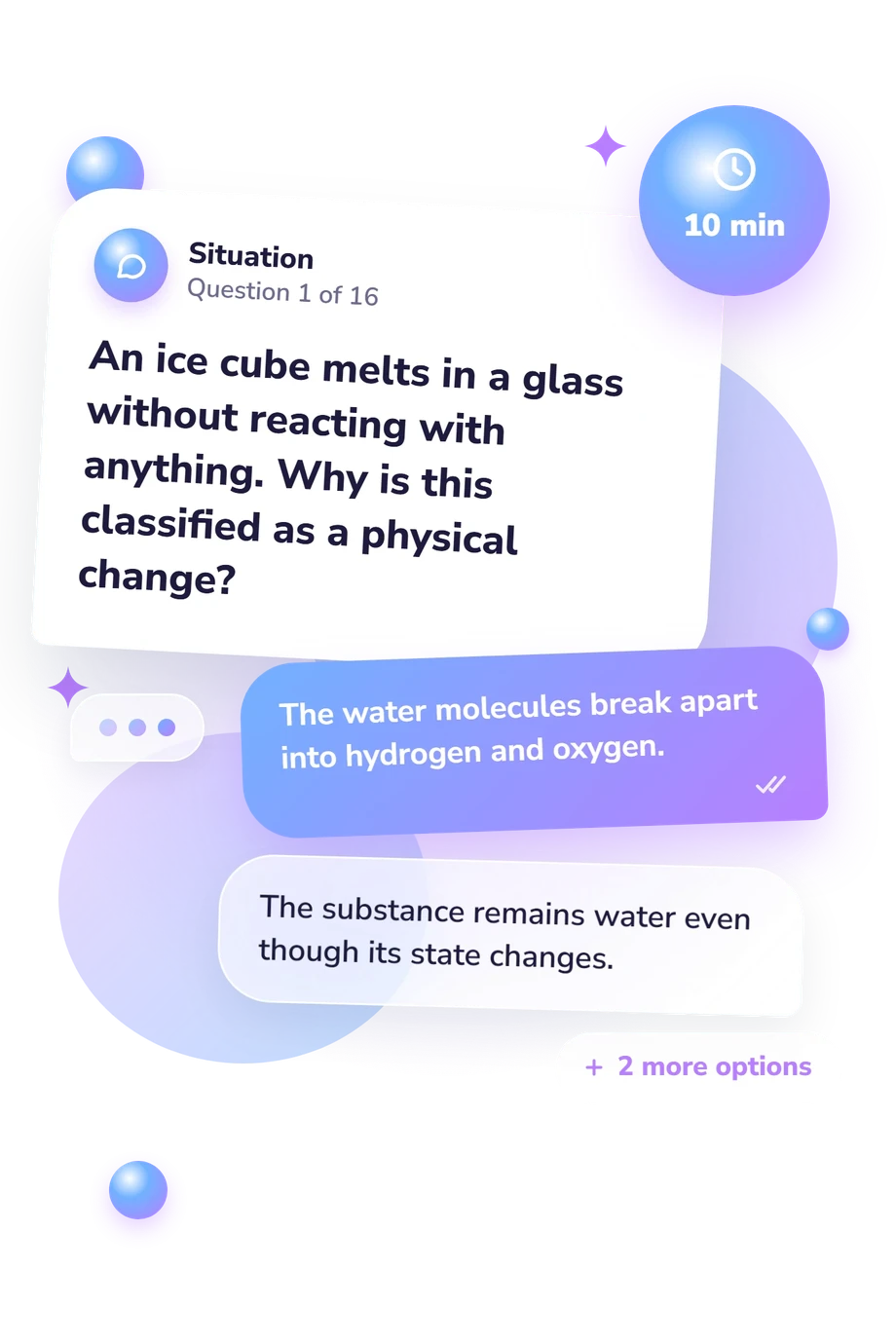
- The water molecules break apart into hydrogen and oxygen.
- The substance remains water even though its state changes.
- Melting permanently changes the substance's chemical properties.
- The liquid formed has more mass than the original ice.
- Freezing
- Deposition
- Sublimation
- Condensation
- Condensation throughout the liquid
- Evaporation from the water's surface
- Sublimation from liquid to gas
- Melting caused by moving air
Changes of Matter Quiz - Description and methodology of the test
Students reviewing introductory chemistry can use this assessment to distinguish visible physical changes from reactions that produce new substances. Its supplied title, Chapter 4 Economics Quiz, does not match the science content, but the questionnaire itself targets changes of matter. It suits learners checking conceptual understanding before revisiting class notes. As a physical and chemical changes quiz, it links definitions with practical scenarios.
What This Assessment Explores
At the conceptual level, the assessment links observations with particle explanations. It asks whether matter keeps its identity, changes state, separates physically, or forms new substances. Learners reviewing introductory chemistry can use the result to check key ideas and applications.
The main areas are:
- Physical versus chemical change shows whether matter remains the same or forms materials with different properties.
- Phase transitions shows whether you can distinguish melting, freezing, evaporation, boiling, condensation, sublimation, and deposition.
- Particle behavior shows whether heating or cooling changes motion, spacing, and attractions.
- Conservation and separation shows whether mass is tracked while chemical identity is preserved.
For this changes of matter quiz, Changes of Matter Knowledge (0-16) is reported as Foundations to Build (0-6), Developing Knowledge (7-12), or Strong Knowledge (13-16). These bands indicate whether core distinctions need review, understanding is developing, or performance is reliable.
Methodology and Evidence Base
Each item presents a situation, comparison, or observation with four answer choices. Respondents identify a process, explain a particle-level event, compare evaporation with boiling, judge evidence of chemical change, or apply conservation of mass. Scoring uses correct responses; no separate weighting or penalty system is stated.
The closest conceptual comparison is Chemical and Physical Change Assessment (CPCA; Christian & Yezierski, 2012). This questionnaire is conceptually consistent with CPCA’s focus on distinguishing physical and chemical change, but it is not presented as an adaptation. Yezierski and Birk (2006) align with the particulate explanations; Johnson (1998) and Hesse and Anderson (1992) support the treatment of evaporation, condensation, and chemical-change reasoning. These studies clarify the concepts, not this version’s norms or validity.
As a physical and chemical change test, it is best read as study guidance rather than a population ranking. No normative sample or independent reliability estimates are stated, so performance can vary with recent instruction, classroom wording, honest self-report, and selected-response limits.
- Brittany N. Christian and Ellen J. Yezierski, "Development and validation of an instrument to measure student knowledge gains for chemical and physical change for grades 6-8," Chemistry Education Research and Practice, 13(3), 384-393 (2012). 10.1039/C2RP20041D
- Ellen J. Yezierski and James P. Birk, "Misconceptions about the Particulate Nature of Matter. Using Animations To Close the Gender Gap," Journal of Chemical Education, 83(6), 954-960 (2006). 10.1021/ed083p954
- Philip Johnson, "Children's understanding of changes of state involving the gas state, Part 2: Evaporation and condensation below boiling point," International Journal of Science Education, 20(6), 695-709 (1998). 10.1080/0950069980200607
- Joseph J. Hesse III and Charles W. Anderson, "Students' conceptions of chemical change," Journal of Research in Science Teaching, 29(3), 277-299 (1992). 10.1002/tea.3660290307
Updated: