
Current Affairs Quiz UK
How the Scales are Structured
Who Usually Takes This Test?
See How You Compare
Below is a preview of how scores are typically distributed across each scale.
Example Questions From the Test
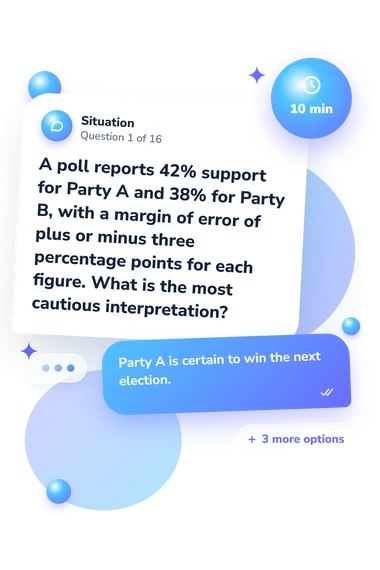
- Party A is certain to win the next election.
- Party B must be ahead once turnout is considered.
- Party A leads in this sample, but the poll alone does not establish a definite lead in the wider population.
- The four-point difference proves the poll is inaccurate.
- The conflict has legally ended and all disputes are settled.
- One side has necessarily surrendered all its territory.
- Fighting is meant to stop under agreed terms, but a final political settlement may not exist.
- International law no longer applies to either side.
- The government's legislative programme and priorities
- The Supreme Court's judgments for the coming year
- The opposition parties' agreed election manifesto
- The monarch's personal voting preferences
Current Affairs Quiz UK - Description and methodology of the test
The result from the Current Affairs Quiz UK can help readers identify which kinds of UK coverage or institutional concepts deserve attention. It can point to gaps in interpreting institutions, policy and international events, giving people who follow public life a practical way to decide what to revisit. The format makes it a UK news quiz, turning reporting into a structured way to identify strengths and gaps in news literacy.
What This Assessment Explores
The questions assess concepts in UK reporting, rather than party loyalty or personal opinion. They ask respondents to interpret polls, real-terms changes, parliamentary roles, devolution, international events and environmental terminology.
This UK current affairs test reflects readers' grasp of the institutions, processes and consequences behind headlines.
The questions group into four practical areas:
- Political processes show understanding of polls, parliamentary stages and select committees.
- Economic concepts indicate how inflation, wages, budgets and interest rates are interpreted.
- Constitutional institutions reveal recognition of courts, devolution, the King’s Speech and public-finance oversight.
- International and environmental affairs cover ceasefires, asylum, NATO, UN decisions and net zero.
UK Current Affairs Knowledge is the displayed scale, running from 0-16. Foundations to build covers 0-6, Developing understanding 7-12, and Strong news literacy 13-16. Higher bands reflect broader performance, not political allegiance, intelligence or opinion quality.
Methodology and Scientific Basis
Each item presents a short scenario or factual prompt followed by several answer choices. The respondent selects the most accurate interpretation, so the format tests recognition and application of public knowledge. Examples involve a ceasefire versus a peace agreement, a cash budget versus its real-terms value, and UK institutional responsibilities.
The result is presented on the displayed 0-16 scale, but its item-level scoring or weighting method is not specified. The bands are descriptive categories rather than population norms or clinical thresholds.
Methodologically, the questionnaire is consistent with Sturgis's political-knowledge measurement study on factual understanding. That work is contextual evidence, not the instrument used here; this questionnaire is not an adaptation of that measure.
Research by Munzert and Selb addresses web-based visual and verbal formats, while Bullock and Rader show that response options can influence observed performance.
This current-affairs knowledge assessment offers a snapshot of current understanding across UK coverage. News exposure, guessing, wording, memory and familiarity with UK institutions can affect results, so the score is best read as a structured self-check rather than a fixed measure of reasoning ability or political judgment.
- Sturgis, Patrick, Nick Allum, and Patten Smith. "An Experiment on the Measurement of Political Knowledge in Surveys." Public Opinion Quarterly 72, no. 1 (2008): 90-102. 10.1093/poq/nfm032
- Munzert, Simon, and Peter Selb. "Measuring Political Knowledge in Web-Based Surveys: An Experimental Validation of Visual Versus Verbal Instruments." Social Science Computer Review 35, no. 2 (2017): 167-183. 10.1177/0894439315616325
- Bullock, John G., and Kelly Rader. "Response Options and the Measurement of Political Knowledge." British Journal of Political Science 52, no. 3 (2022): 1418-1427. 10.1017/S0007123421000120