
Connect Pictures Quiz
How the Scales are Structured
Who Usually Takes This Test?
See How You Compare
Below is a preview of how scores are typically distributed across each scale.
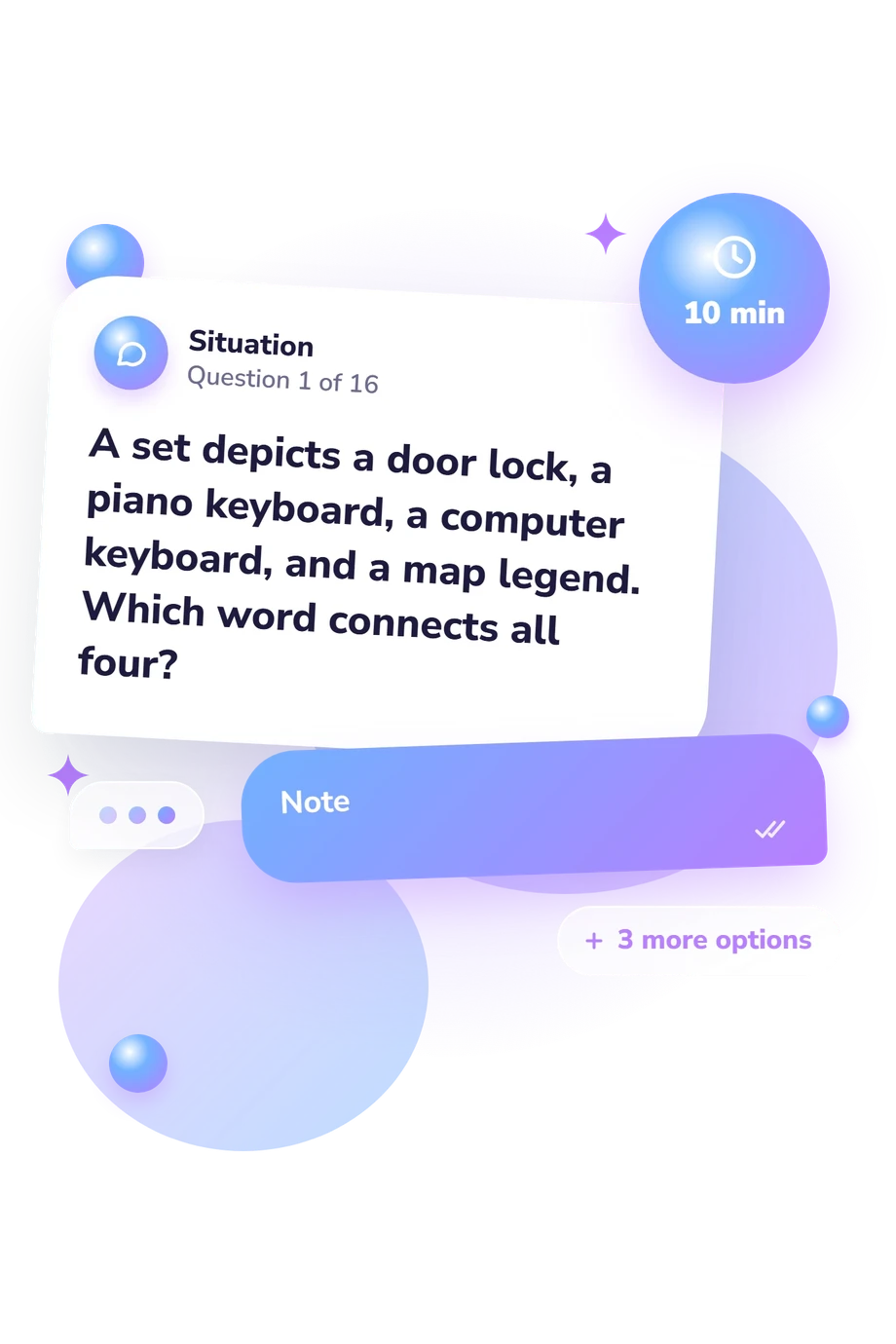
Example Questions From the Test
- Note
- Scale
- Key
- Code
- Agriculture
- Medicine
- Navigation
- Justice
- Metallic ores
- Fossil fuels
- Ceramic materials
- Gemstones
Connect Pictures Quiz - Description and methodology of the test
For anyone curious about how familiar ideas become connected, the Connect Pictures Quiz offers a focused way to examine these links. It is intended for readers who enjoy visual reasoning, language-based links, and everyday knowledge rather than specialist training. The questions in this picture-connection quiz provide a concise snapshot of accuracy on the included connections. Its picture connect quiz questions focus on visual links among familiar clues.
What This Assessment Explores
The result summarizes correct connections across clues that point toward a common answer. The visual connection test samples categories, shared words, visual structure, and meanings carried by signs or cultural knowledge. This is a narrow summary of correct answers on these sets, not evidence of a broader cognitive trait or ability.
These are the connection types represented:
- Shared words show whether you identify a term linking objects, symbols, sounds, or ideas.
- Categories show whether examples fit a common class, such as instruments, animals, materials, or regions.
- Patterns show whether you notice geometry, repeated forms, or structural similarities.
- Meanings show whether signs, actions, places, and objects connect through what they communicate.
The displayed scale, Connect Pictures Knowledge, spans 0-16: Foundation 0-6, Developing Connector 7-12, and Strong Connector 13-16. The bands progress from direct links to consistent integration of clues and alternatives.
Methodology and Evidence Base
Each item presents four pictured or described clues and asks you to select the answer choice that links them most directly. The sets move across objects, symbols, animals, places, sports, materials, and cultural references, so solving depends on noticing the intended relationship rather than recalling a specialized fact.
Scoring is straightforward: each correct connection adds one point to the questionnaire's total. The picture connection test summarizes accuracy on the included associations; it does not estimate a hidden ability from an undisclosed formula.
Its evidence base is conceptual. The format is conceptually comparable to the Semantic Association Task described by Di Giacomo and colleagues, which examines links among concepts. Mednick's associative theory explains linking remote ideas, while Bowden and Jung-Beeman's remote-associate research offers a related model for finding one answer that connects separate prompts.
Interpret the result as a snapshot of performance under these wording, imagery, and knowledge conditions. Attention, vocabulary, cultural familiarity, and plausible alternatives can influence choices, so the bands are useful for self-reflection but should not be treated as population norms or a diagnosis.
- Dina Di Giacomo, Lucia Serenella De Federicis, Manuela Pistelli, Daniela Fiorenzi, and Domenico Passafiume (2012). Semantic associative relations and conceptual processing. Cognitive Processing, 13(1), 55-62. 10.1007/s10339-011-0399-7
- Edward M. Bowden and Mark Jung-Beeman (2003). Normative data for 144 compound remote associate problems. Behavior Research Methods, Instruments, & Computers, 35(4), 634-639. 10.3758/BF03195543
- Sarnoff A. Mednick (1962). The associative basis of the creative process. Psychological Review, 69(3), 220-232. 10.1037/h0048850
Updated: