
Encanto Character Quiz
How the Scales are Structured
Who Usually Takes This Test?
See How You Compare
Below is a preview of how scores are typically distributed across each scale.
Example Questions From the Test
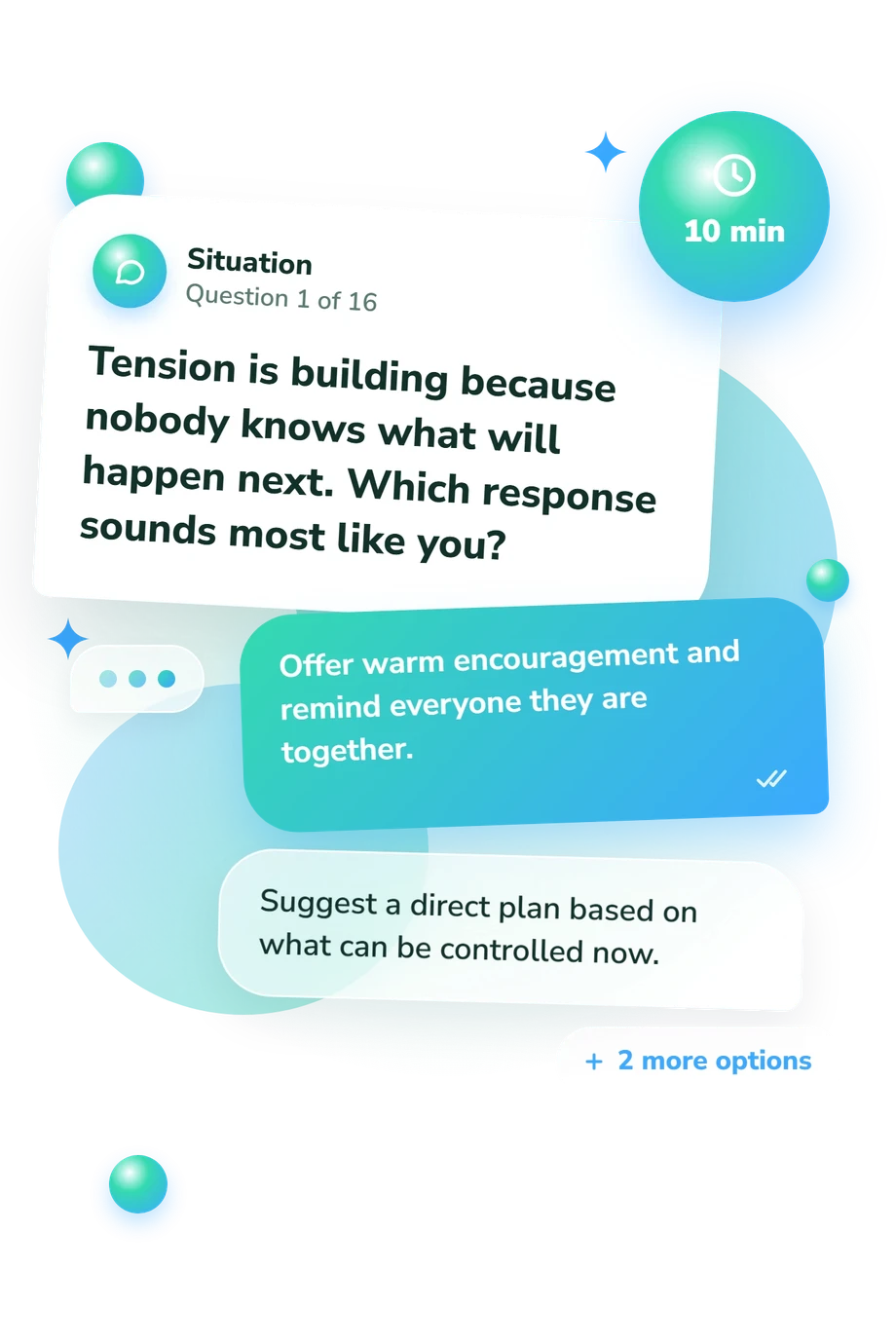
- Offer warm encouragement and remind everyone they are together.
- Suggest a direct plan based on what can be controlled now.
- Reframe the uncertainty as a chance to create something different.
- Use offbeat humor, then share the pattern you have quietly noticed.
- Restoring the original plan as closely as possible.
- Stepping aside briefly to understand the pattern on your own.
- Turning the disruption into a bold new version of the event.
- Checking who feels unheard and improvising a solution together.
- Small inconsistencies that might reveal what actually happened.
- Whether anyone feels embarrassed or excluded by the incident.
- The immediate practical steps needed to restore order.
- A creative way to shift the mood and reset the evening.
Encanto Character Quiz - Description and methodology of the test
Fans who want to connect the film’s characters with their own habits, values, and reactions can use the Encanti Quiz as a light self-reflection exercise. It suits readers curious about whether they lean toward observation, creative reinvention, practical responsibility, or inclusive persistence. This Encanto personality quiz offers a comparative character profile rather than a fixed label.
What This Assessment Explores
The questions present situations involving uncertainty, creativity, family expectations, responsibility, belonging, and overlooked details. Your result shows which response patterns resemble you, so the profile describes affinity rather than a fixed identity. This Encanto character test works best when you choose your instinctive response, not the one that sounds most admirable.
The four displayed scales are:
- Bruno (0-12) reads private observation and unusual pattern-finding: Different Lens (0-4), Quiet Observer (5-8), or Bruno Match (9-12).
- Isabela (0-12) reflects expressive, evolving creativity: Different Expression (0-4), Growing Originality (5-8), or Isabela Match (9-12).
- Luisa (0-12) reflects dependable, action-oriented support: Different Strength (0-4), Reliable Streak (5-8), or Luisa Match (9-12).
- Mirabel (0-12) reflects curiosity, empathy, persistence, and connection: Different Focus (0-4), Shared Spark (5-8), or Mirabel Match (9-12).
Methodology and Scientific Basis
Methodologically, this Encanto character quiz uses forced-choice self-report: each prompt presents a situation with four responses. The choices map onto character-oriented styles, while the result reports four affinity scores rather than one total. Without a stated point-by-point weighting rule, the scores are comparative within this questionnaire.
Evidence is conceptual rather than validation evidence. Moss and colleagues’ Encanto analysis provides the closest Encanto-specific basis for linking the characters with family roles, identity, and communication; this questionnaire is conceptually consistent with that work, not an adaptation of its study. Cohen’s account of character identification frames it as an audience relationship with media figures, and Huang and Fung’s narrative-character identification scale offers a related measurement framework. These sources clarify the construct but do not establish reliability or norms for this tool.
Interpret the result as a self-described affinity profile shaped by film familiarity, current mood, cultural interpretation, and the need to choose one best response. The bands are descriptive labels rather than population norms, and scores within one point form a blended match. The outcome is best used as a focused prompt for reflection on personal patterns and preferences.
- Moss, Chelsea E., Taylor S. Vasquez, Carla L. Fisher, and Larry F. Forthun. “Make Your Family Proud”: Analyzing the Communication of Roles and Identity in Disney’s Encanto. Journal of Family Communication, vol. 24, no. 1-2, 2024, pp. 82-98. 10.1080/15267431.2023.2266479
- Huang, Kate Y., and Helene H. Fung. “Measuring Identification with Narrative Characters: The Development and Validation of a New Scale.” Current Psychology, vol. 43, 2024, pp. 24835-24849. 10.1007/s12144-024-06191-2
- Cohen, Jonathan. “Defining Identification: A Theoretical Look at the Identification of Audiences With Media Characters.” Mass Communication and Society, vol. 4, no. 3, 2001, pp. 245-264. 10.1207/S15327825MCS0403_01
Updated: