
Digital Logic Design Quiz
How the Scales are Structured
Who Usually Takes This Test?
See How You Compare
Below is a preview of how scores are typically distributed across each scale.
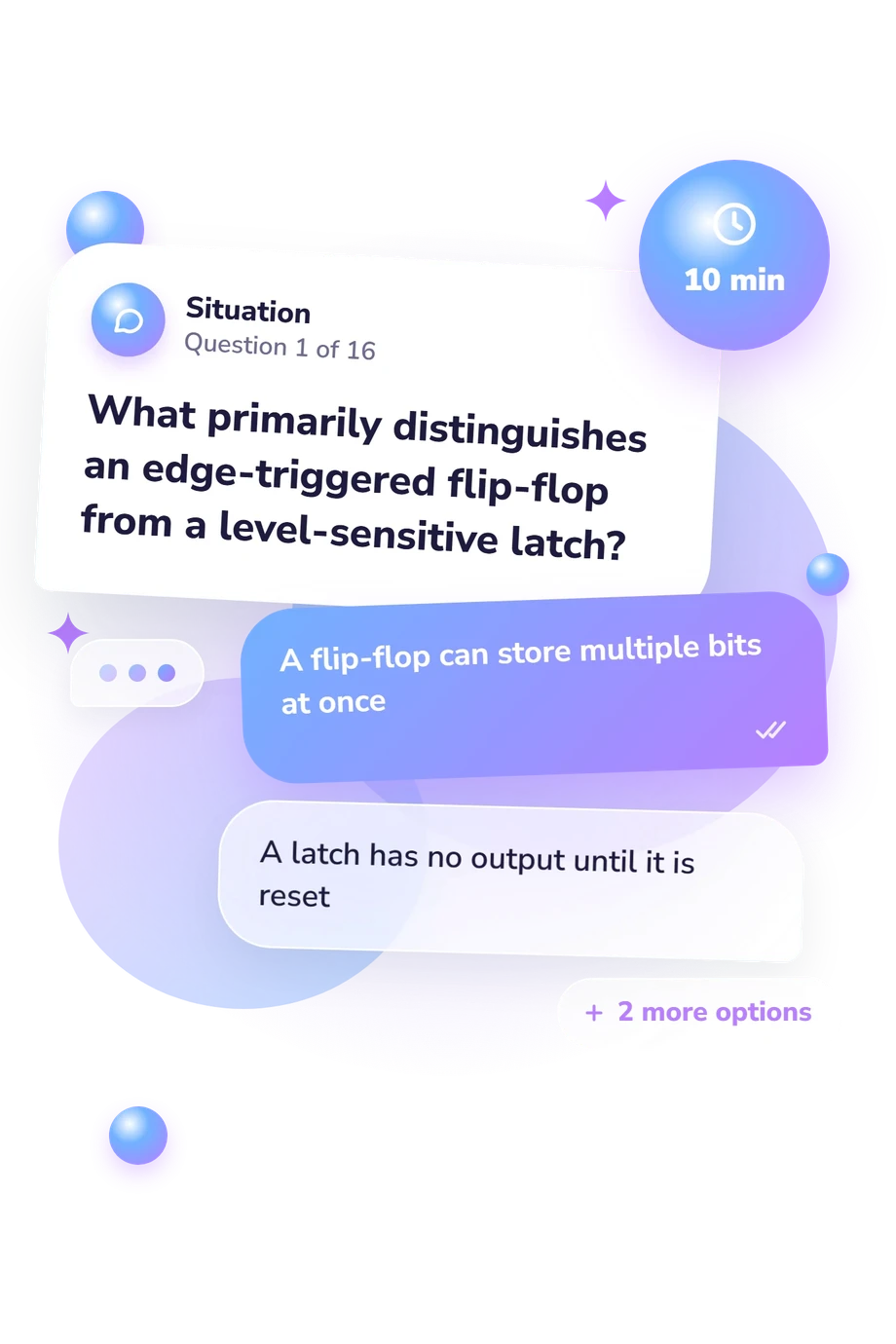
Example Questions From the Test
- A flip-flop can store multiple bits at once
- A latch has no output until it is reset
- A flip-flop samples its input around a clock edge
- A latch always changes state on both clock edges
- NOT A AND NOT B
- NOT A OR B
- A OR B
- NOT A OR NOT B
- A + B
- AB
- A
- B
Digital Logic Design Quiz - Description and methodology of the test
Students, trainees, and self-directed learners can use the digital logic design quiz to check whether their foundational understanding is ready for more advanced design tasks. This digital logic quiz offers learners a compact check of Boolean reasoning, logic components, and state-based behavior before they continue with digital systems study or related coursework.
What This Assessment Measures
The questions test how well you recognize, simplify, and apply digital logic relationships. They cover Boolean algebra, gates, Karnaugh maps, multiplexers, decoders, adders, latches, flip-flops, state machines, counters, resets, timing, and hazards.
Within the broader design coverage, Boolean-algebra questions ask for equivalent expressions alongside predictions about circuit outputs or state changes. The digital logic assessment suits learners reviewing introductory digital systems, electronics, computer engineering, or related coursework.
The catalogue reports one scale, Digital Logic Design Knowledge (0-16), with these bands:
- Foundations to build (0-6) signals that core notation or circuit behavior needs review.
- Developing knowledge (7-12) shows usable fundamentals with some gaps in timing or analysis.
- Strong knowledge (13-16) indicates broad command of foundational design ideas.
The result summarizes overall foundational knowledge rather than complete design or troubleshooting ability.
Methodology and Evidence Base
Each prompt uses four-option multiple choice and asks for the best response to a defined logic or timing problem. The content spans recall and application: a respondent may identify a gate, simplify an expression, choose a Karnaugh grouping, or infer a flip-flop's next state. The questionnaire reports one displayed overall result, and its item-weighting rule is not stated. No norm group, reliability estimate, or validated cutoff is specified.
Mano and Ciletti provide a conceptual engineering frame covering Boolean algebra, combinational circuits, sequential logic, and timing. Harris and Harris, along with Brown and Vranesic, cover the same engineering concepts in their textbooks. The questionnaire is conceptually consistent with those concepts, but the textbooks do not establish its norms, reliability, or validity.
Because this digital circuit quiz samples a limited set of situations, the score can be affected by prior coursework, terminology familiarity, guessing, and momentary concentration. It cannot establish broader professional design, troubleshooting, or engineering competence.
- Mano, M. Morris R., and Michael D. Ciletti. Digital Design: With an Introduction to the Verilog HDL, VHDL, and SystemVerilog. 6th ed. Pearson, 2017. ISBN 9780134549897.
- Harris, David Money, and Sarah L. Harris. Digital Design and Computer Architecture. 2nd ed. Morgan Kaufmann, 2012. ISBN 9780123944245. 10.1016/C2011-0-04377-6.
- Brown, Stephen D., and Zvonko G. Vranesic. Fundamentals of Digital Logic with Verilog Design. 3rd ed. McGraw-Hill, 2014. ISBN 9780073380544.
Updated: