
Chem Lab Quiz
How the Scales are Structured
Who Usually Takes This Test?
See How You Compare
Below is a preview of how scores are typically distributed across each scale.
Example Questions From the Test
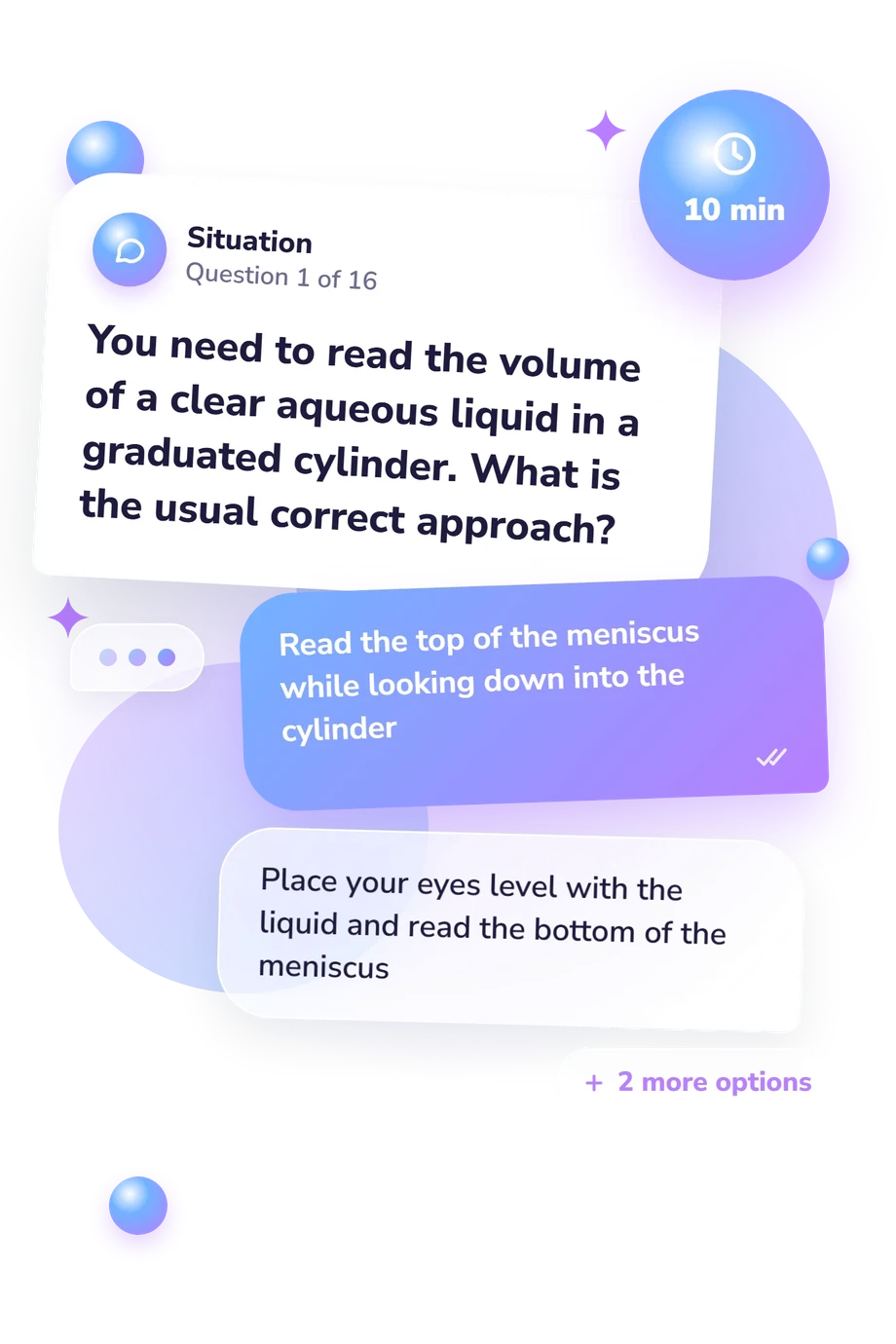
- Read the top of the meniscus while looking down into the cylinder
- Place your eyes level with the liquid and read the bottom of the meniscus
- Tilt the cylinder until the liquid surface appears flat
- Read where the liquid touches the cylinder wall at its highest point
- A 50 mL beaker
- A 50 mL graduated cylinder
- A 25 mL volumetric pipette used with a pipette aid
- A disposable dropper marked at 1 mL intervals
- Simple distillation
- Titration
- Filtration
- Volumetric dilution
Chem Lab Quiz - Description and methodology of the test
People preparing for routine chemistry practicals, refresher study, or safer bench work can use the chem lab quiz as a knowledge check covering recognition of common laboratory procedures, safety practices, equipment use, waste handling, and emergency response. It is especially useful when you want a focused laboratory safety quiz for reviewing everyday decisions about measurement, heating, labeling, disposal, and responses to hazards. The overall result indicates breadth of common laboratory knowledge.
What This Assessment Measures
The questionnaire examines practical knowledge in routine chemistry work. It suits learners and workers refreshing core habits, with scenarios about safe and correct laboratory procedures.
The main thematic groups are:
- Measurement and equipment use covers reading a meniscus, choosing volumetric glassware, balancing a centrifuge, and cooling vessels before weighing.
- Safe handling and emergency response measures recognition of appropriate responses involving heat, volatile solvents, exposures, fire, damaged equipment, and broken glass.
- Waste and preparation practices indicate understanding of labeling, excess reagents, acid dilution, and disposal decisions that depend on procedure or local guidance.
This chemistry lab quiz reports one overall score: Chem Lab Knowledge (0-16), with one point awarded for each correct answer. It appears as Foundation (0-6), Developing (7-12), or Strong (13-16), indicating the breadth of common lab practices recognized by the respondent.
Methodology and Evidence Base
Each item presents a brief laboratory scenario with four answer choices. The respondent selects the best procedural response, and the score counts correct choices. It is a fixed-answer knowledge check, not a personality inventory.
The subject matter is consistent with the 2021 chemistry lab safety study by Camel and colleagues. The laboratory-safety textbook by Hill and Finster, together with American Chemical Society guidelines, provides reference points for laboratory hazards, emergency response, waste, labeling, and equipment use. These works offer conceptual context rather than evidence of norms or validation for this questionnaire.
The fixed key and bands provide direct feedback. A lower result points to foundational review, while a higher result indicates broader recognition of common practices. As a chem lab knowledge test, the result can guide review of core safety rules, equipment selection, and routine procedures, alongside local procedures, chemical-specific hazards, and equipment instructions.
Guessing, memory, and unfamiliarity with a particular laboratory can affect performance. The score is not a safety certification or proof of readiness for unsupervised work, because current instructions and supervision govern real laboratory decisions.
- Camel, Valerie, Marie-Noëlle Maillard, Nicolas Descharles, Even Le Roux, Mathieu Cladière, and Isabelle Billault. "Open Digital Educational Resources for Self-Training Chemistry Lab Safety Rules." Journal of Chemical Education 98, no. 1 (2021): 208-217. 10.1021/acs.jchemed.0c00094
- Hill, Robert H., Jr., and David C. Finster. Laboratory Safety for Chemistry Students. John Wiley & Sons, 2010.
- American Chemical Society, Committee on Chemical Safety. Guidelines for Chemical Laboratory Safety in Academic Institutions. American Chemical Society, 2016.
Updated: