
Child Safety Quiz
How the Scales are Structured
Who Usually Takes This Test?
See How You Compare
Below is a preview of how scores are typically distributed across each scale.
Example Questions From the Test
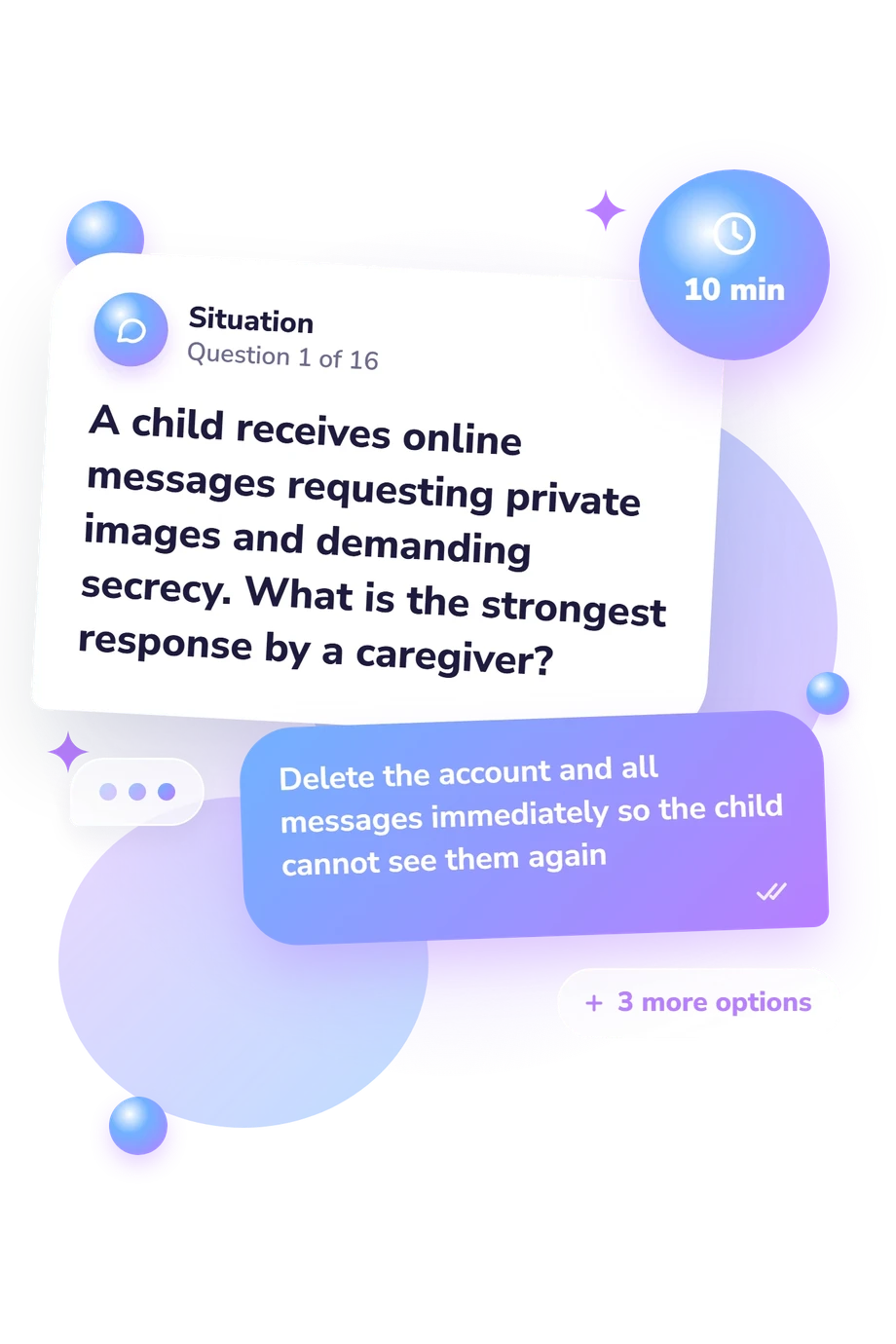
- Delete the account and all messages immediately so the child cannot see them again
- Continue the conversation while pretending to be the child to identify the sender
- Support the child, preserve relevant evidence without redistributing it, stop or block contact, and report through appropriate channels
- Punish the child by permanently removing all device access
- The lap belt lies low across the hips or upper thighs, with the shoulder belt across the chest and shoulder
- The lap belt rests across the abdomen and the shoulder belt touches the neck
- The lap belt lies low while the shoulder belt is placed behind the child’s back
- Both sections of the belt pass under the child’s arm to avoid the face
- Leave the air conditioning running and lock the doors
- Take the child along rather than leaving the child unattended in the vehicle
- Crack the windows and return within a few minutes
- Use a phone monitor while completing the stop nearby
Child Safety Quiz - Description and methodology of the test
Parents, caregivers, educators, and other adults who support children can use this assessment to examine practical decisions around everyday protection and responding to concerns. The child safety quiz focuses on recognizing safer actions, not judging a child or caregiver. For adults supporting children, this quiz about children’s safety offers a structured way to notice strengths and identify topics worth reviewing before a difficult situation arises.
What This Assessment Explores
The questions address four connected areas of protection:
- The vehicle-safety area reflects recognition of safer car-seat use, belt fit, crash checks, and routines preventing unattended-vehicle incidents.
- The digital-safety area reflects responses to coercive messages, secrecy, evidence preservation, blocking, and reporting.
- The body-boundaries area reflects knowledge of consent, body-part language, trusted adults, and refusal of unwanted touch.
- The safeguarding-response area reflects calm listening, immediate protection, non-leading communication, and appropriate escalation.
These child safety topics are relevant to parents, caregivers, educators, and other adults who support children. The displayed Child Safety Knowledge scale runs from 0-16: Foundations to strengthen (0-6), Developing knowledge (7-12), and Strong knowledge (13-16). The single displayed result is an overall indication of knowledge of protective principles rather than a person’s character.
Methodology and Evidence Base
Each item presents a brief vehicle-safety or safeguarding situation with four response options. Choices separate protective actions from unsafe assumptions, dismissive reactions, or responses that place responsibility on the child. It is an educational child safety assessment, not a personality measure.
The questionnaire presents one educational knowledge result. The displayed result indicates which protective principles may need review. This educational result can support preparation before a difficult situation, but it is not a validated safety, legal, or clinical assessment and cannot establish whether harm occurred.
The content is conceptually consistent with Temsah et al. (2022) on parent knowledge of childhood and adolescent safety, Liu et al. (2016) on child passenger-safety knowledge, and the prevention-education approach described by Guastaferro et al. (2019). These studies provide context rather than validation of this online questionnaire. Results can vary with attention, scenario interpretation, prior knowledge, and the situation each respondent imagines; local requirements, manufacturer instructions, and safeguarding guidance are more specific when a concern requires action.
- Temsah MH, Aljamaan F, Alhaboob A, et al. Enhancing parental knowledge of childhood and adolescence safety: An interventional educational campaign. Medicine (Baltimore). 2022;101(3):e28649. 10.1097/MD.0000000000028649
- Guastaferro K, Zadzora KM, Reader JM, Shanley J, Noll JG. A Parent-focused Child Sexual Abuse Prevention Program: Development, Acceptability, and Feasibility. Journal of Child and Family Studies. 2019;28(7):1862-1877. 10.1007/s10826-019-01410-y
- Liu X, Yang J, Chen X, Li L. Knowledge, Attitudes and Behaviors on Child Passenger Safety among Expectant Mothers and Parents of Newborns: A Qualitative and Quantitative Approach. PLOS ONE. 2016;11(1):e0146121. 10.1371/journal.pone.0146121
Updated: