
Confidentiality Quiz
How the Scales are Structured
Who Usually Takes This Test?
See How You Compare
Below is a preview of how scores are typically distributed across each scale.
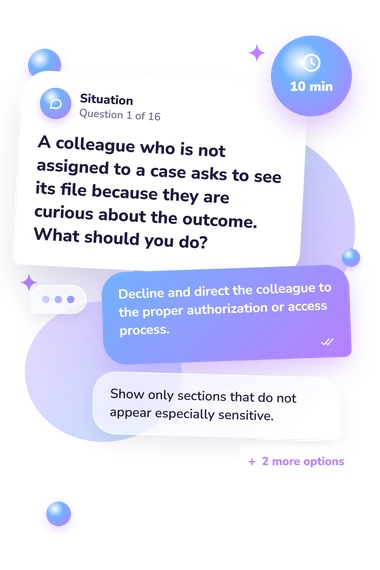
Example Questions From the Test
- Decline and direct the colleague to the proper authorization or access process.
- Show only sections that do not appear especially sensitive.
- Allow access if the colleague works in the same department.
- Share a verbal summary but not the written file.
- Information is confidential only when it is protected by encryption or a password.
- All information about a person must remain secret in every circumstance.
- People may decide for themselves which personal details deserve protection.
- Information entrusted to someone is used or disclosed only for authorized purposes and to authorized people.
- Keeping every record for the shortest technically possible period.
- Accessing or sharing only the information needed for an authorized task.
- Giving all team members equal access so work is not delayed.
- Removing names from information before every internal use.
Confidentiality Quiz - Description and methodology of the test
People who handle personal, client, patient, or organizational information can use the confidentiality quiz to check how they reason about access, disclosure, and secure handling. It is intended for practical self-review rather than for assigning a legal status or professional credential. As a confidentiality assessment, it turns everyday decisions into a focused profile of working knowledge.
What This Assessment Explores
The content asks whether a respondent can recognize authorized use, limited access, careful handling, and proportionate disclosure. The confidentiality questions in the quiz cover access requests, remote work, disposal, consent, legal demands, accidental email, pseudonymization, team discussion, and urgent safety concerns.
These are the practical dimensions represented in the questions:
- Authorization and access show whether information reaches approved people for legitimate tasks.
- Disclosure and consent show whether sharing is permitted, necessary, and understood.
- Secure handling shows how information is protected during work and disposal.
- Incident and safety response show whether escalation is timely and proportionate.
Results are reported as Confidentiality Knowledge, a 0-16 educational scale. Foundations to build (0-6) signals review needs; Developing judgment (7-12) suggests uncertainty around exceptions; Strong working knowledge (13-16) indicates consistent recognition of sound practices. The bands describe questionnaire performance, not legal compliance.
Methodology and Scientific Basis
Each item presents a workplace situation or asks for the best definition of a core principle. Four answer choices are provided, and the respondent selects the response that best fits authorized, necessary, and protective practice. The format tests recognition as well as judgment when a request is ambiguous or urgent.
Scoring uses the displayed scale and bands; however, the questionnaire does not state a per-answer weighting rule. As a confidentiality knowledge test, it is most useful for identifying topics for refresher training or discussion.
Methodologically, the content is conceptually consistent with Hosseini-Qavam-Abad et al. (2016), a published tool addressing knowledge and attitudes around confidentiality and disclosure, but it is not presented as an adaptation of that tool. The HIPAA Privacy Rule, NIST SP 800-122, and General Medical Council guidance add context for authorization, minimum necessary access, pseudonymization, secure handling, and controlled disclosure.
It is presented as an educational self-reflection questionnaire rather than a norm-referenced or professionally certified measure. Self-report, current context, and local policy can affect responses, so the result should guide learning rather than settle a real privacy or safety decision.
- Leila Hosseini-Qavam-Abad, Fariba Asghari, Ali Bandehagh, Shoaleh Bigdeli, and Sedigheh Najafipour. Designing a Tool to Assess Medical Students’ Knowledge and Attitudes of Confidentiality and Disclosure of Patient Information. Journal of Medical Education for Future Demands. 2016;15(2):e105488.
- Office for Civil Rights, U.S. Department of Health and Human Services. Standards for Privacy of Individually Identifiable Health Information; Final Rule. Federal Register. 2002;67(157):53182-53273.
- Erika McCallister, Tim Grance, and Karen Scarfone. Guide to Protecting the Confidentiality of Personally Identifiable Information (PII). NIST Special Publication 800-122. National Institute of Standards and Technology; 2010. 10.6028/NIST.SP.800-122
- General Medical Council. Confidentiality: good practice in handling patient information. Professional standards guidance. General Medical Council; 2017, updated December 13, 2024.