
Computer Game Quiz
How the Scales are Structured
Who Usually Takes This Test?
See How You Compare
Below is a preview of how scores are typically distributed across each scale.
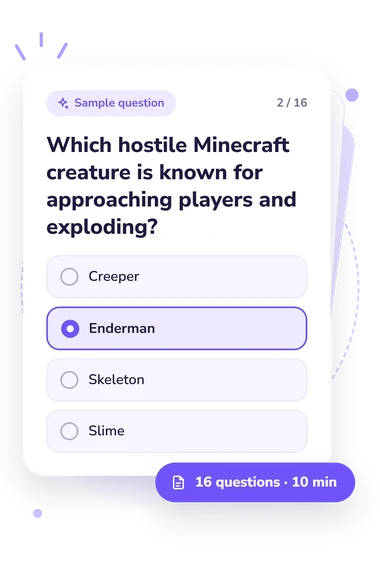
Example Questions From the Test
- Creeper
- Enderman
- Skeleton
- Slime
- Ganon
- Tingle
- Zelda
- Link
- All bosses in the area are permanently weakened
- Unused weapons are converted into health
- The player becomes invisible until attacking
- Resources are restored, but many ordinary enemies return
Computer Game Quiz - Description and methodology of the test
Players, casual fans, and people curious about gaming can use this assessment to check the breadth of their knowledge across familiar games, without needing expertise in one franchise. The computer game quiz questions in this assessment provide a broad knowledge check that can show which areas feel familiar and where further exploration may be useful. It suits readers who enjoy gamer quiz questions that move across several eras and genres.
What This Assessment Measures
Across the assessment, computer game trivia questions test recognition of characters, mechanics, genres, and likely game outcomes. Some items rely on recall, while others require simple reasoning, such as predicting checkpoint behavior, adjusting graphics for performance, or calculating whether a crop will mature in time. The test suits players and gaming-culture followers across platforms and genres.
Your result is reported on the Computer Game Knowledge scale, from 0 to 16, with one point for each correct answer. The bands are:
- Starting Player (0-6) shows recognition of some gaming basics, with genres and mechanics still to explore.
- Experienced Player (7-12) shows solid knowledge of well-known games with a few gaps.
- Trivia Champion (13-16) shows broad, dependable knowledge of characters, objectives, genres, and gameplay systems.
These labels describe performance on this selected knowledge sample, not overall playing skill or game analysis.
Methodology and Evidence Base
Each item presents a gaming situation or fact with four answer choices, and the respondent selects the option that best fits. A correct response contributes one point to the total, which is interpreted through the displayed bands. The set combines recall with basic application, so performance depends on recognizing references and understanding what a mechanic or objective does.
As a computer game knowledge quiz, this assessment is conceptually consistent with Manzano-León et al. (2025), whose work treats video game literacy as assessable knowledge spanning game content and systems. Gee (2007) provides a broader literacy perspective, while Rosenberg (2011) is relevant to constructing and validating a gaming-literacy measure. These sources support the conceptual framing; they do not show that this online questionnaire is an adaptation, standardized edition, or validated reproduction of any one instrument.
No norms or reliability estimates are reported for this questionnaire; its score describes performance on selected tasks, not population norms. Franchise familiarity, platform exposure, cultural context, memory, and guessing can affect performance. The result reflects the selected knowledge tasks, not general intelligence, overall gaming ability, or psychological functioning.
- Manzano-León, Ana, Júlia Vilasís-Pamos, and Jorge Oceja. (2025). Design and Validation of Four Instruments to Assess Video Game Literacy in Secondary Education. International Journal of Game-Based Learning, 15(1), 1-20. 10.4018/IJGBL.395345
- Gee, James Paul. (2007). What Video Games Have to Teach Us About Learning and Literacy (2nd ed.). New York: Palgrave Macmillan.
- Rosenberg, Kenneth Allen. (2011). Gaming Literacy: Construct Validation and Scale Construction. Master's thesis, University of South Florida.