
Classification of Plants Quiz
How the Scales are Structured
Who Usually Takes This Test?
See How You Compare
Below is a preview of how scores are typically distributed across each scale.
Example Questions From the Test
- Kingdom → class → division → order
- Kingdom → division → class → order
- Division → kingdom → order → class
- Class → division → kingdom → order
- Produce flowers but no fruit
- Reproduce by spores and lack seeds
- Lack vascular tissue in their stems
- Produce seeds that are not enclosed in fruits
- It lacks vascular tissue.
- It reproduces only through spores.
- Its seeds are not enclosed within a fruit.
- Its flowers have three petals.
Classification of Plants Quiz - Description and methodology of the test
Students, teachers, and curious learners can use the classification of plants quiz to check whether their understanding of plant diversity holds together across familiar and less familiar examples. The result shows how confidently you distinguish major lineages, reproductive structures, taxonomic ranks, and scientific naming. As a plant classification quiz, it provides a focused snapshot of topics that may deserve further study.
What This Assessment Measures
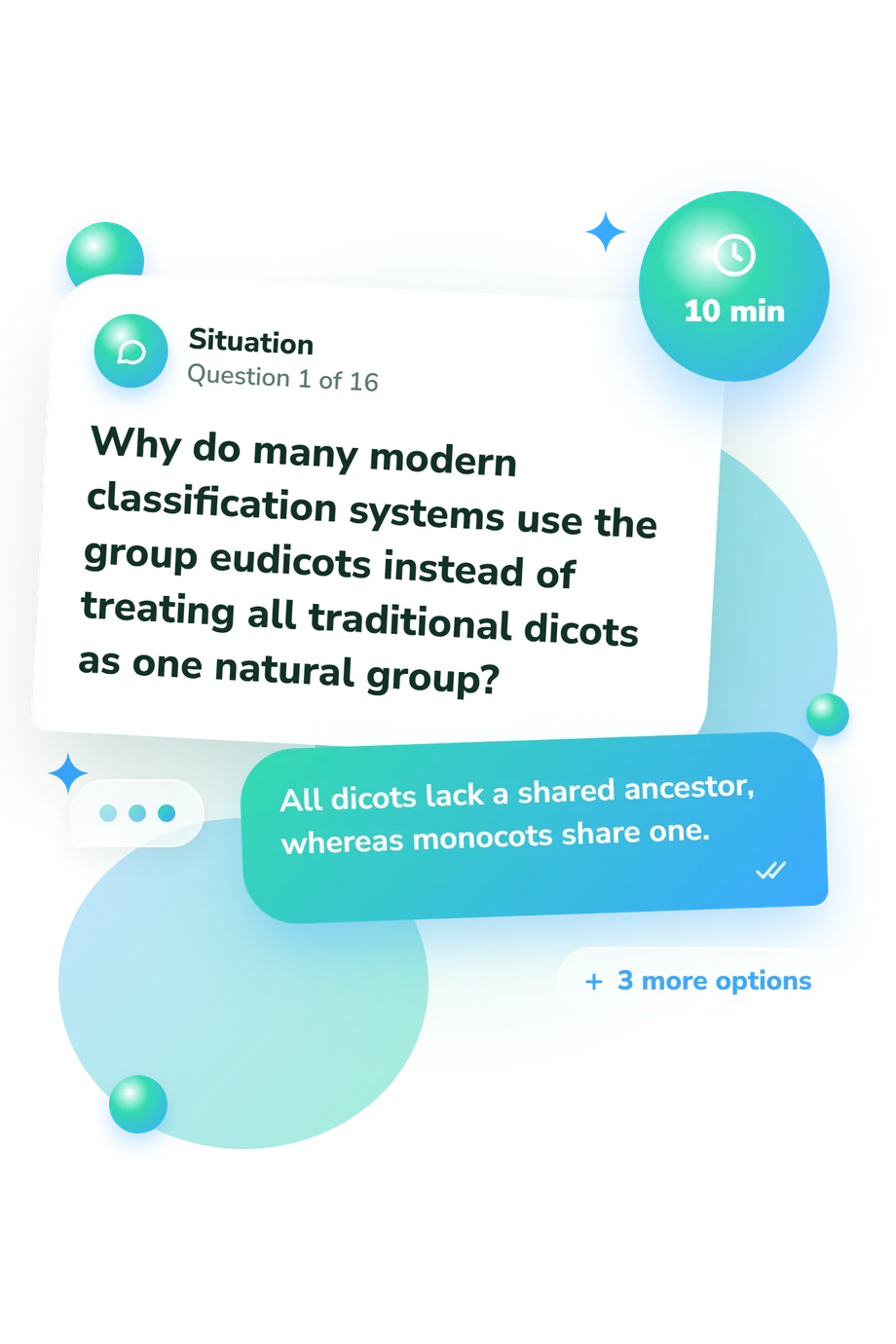
The questions connect visible and reproductive features with evolutionary groups. They cover bryophytes, seedless vascular plants, gymnosperms, angiosperms, monocots, eudicots, taxonomic ranks, and binomial names. Together, these topics make a useful plant taxonomy quiz for reviewing how classification evidence fits together. The result indicates which principles you apply reliably and which distinctions remain uncertain.
Plant Classification Knowledge runs from 0-16, with one point for each correct answer. Foundation (0-6) signals a need to review core traits and ranks; Developing (7-12) reflects useful knowledge with some distinctions to reinforce; Strong (13-16) reflects consistently accurate classification.
The question themes show what the result draws on:
- Evolutionary grouping shows whether you recognize supported lineages.
- Major plant groups show whether you use vascular tissue, seeds, and flowers.
- Reproductive evidence shows how you use spores, pollen, cones, fruits, and ovules.
- Scientific naming shows whether you interpret genera and species.
Methodology and Evidence Base
Each item presents a biological description, classification question, or scientific-name problem with four answer choices. The format makes this a plant groups quiz that emphasizes application: you select the option that best fits the defining evidence rather than recall an isolated label. Scoring counts correct responses, so the displayed result reflects performance on the tested concepts.
Judd et al. (2016) provides the broad phylogenetic framework for linking plant traits with evolutionary relationships. The angiosperm questions are consistent with APG IV, while fern and lycophyte distinctions align with the Pteridophyte Phylogeny Group classification. These sources support the concepts assessed, but the online questionnaire is not presented as an adaptation or validation study of those publications.
This online questionnaire functions as an educational self-check rather than a normed instrument, so the bands describe performance on these items, not a population norm. Familiarity with terminology, prior coursework, and clues in multiple-choice wording can affect the result. Because no explanations are required, a strong score shows accurate responses here but not complete taxonomic reasoning.
- Judd, Walter S., Christopher S. Campbell, Elizabeth A. Kellogg, Peter F. Stevens, and Michael J. Donoghue. Plant Systematics: A Phylogenetic Approach. 4th ed. Sinauer Associates, Sunderland, Massachusetts, 2016.
- The Angiosperm Phylogeny Group. An update of the Angiosperm Phylogeny Group classification for the orders and families of flowering plants: APG IV. Botanical Journal of the Linnean Society 181(1), 2016, 1-20. 10.1111/boj.12385
- Pteridophyte Phylogeny Group. A community-derived classification for extant lycophytes and ferns. Journal of Systematics and Evolution 54(6), 2016, 563-603. 10.1111/jse.12229
Updated: