
Cell Tissue Quiz
How the Scales are Structured
Who Usually Takes This Test?
See How You Compare
Below is a preview of how scores are typically distributed across each scale.
Example Questions From the Test
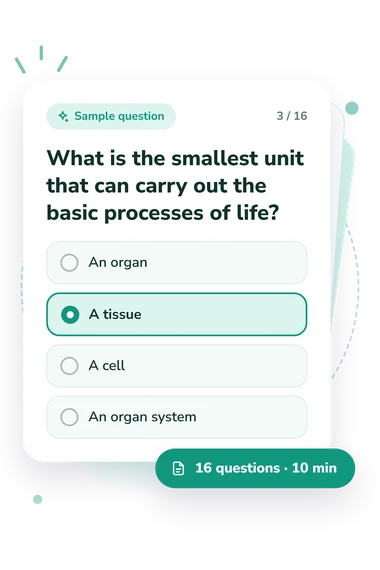
- An organ
- A tissue
- A cell
- An organ system
- Epithelial tissue
- Muscle tissue
- Connective tissue
- Nervous tissue
- Sublimation
- Condensation
- Melting
- Freezing
Cell Tissue Quiz - Description and methodology of the test
Designed for students, teachers, and independent learners, the Cell Tissue Quiz checks core life-science ideas through both recall and short applications. For learners taking this changes of matter quiz, the result can clarify which concepts are secure and where review may be useful. It connects cells, tissues, biological organization, and changes in matter in one focused learning activity.
What This Assessment Explores
Foundational biology meets introductory chemistry here. Questions ask readers to recognize the cell as life’s basic unit, distinguish tissue types, explain how tissues combine into organs and organ systems, and identify physical versus chemical transformations in matter. As a quiz about changes of state, it gives practical questions about melting, freezing, evaporation, condensation, sublimation, and solidification an everyday focus.
The displayed scale is Cells, Tissues, and Changes of Matter Knowledge (0-16); it summarizes performance across definitions and short scenarios, with these result bands:
- Foundation to build (0-6) indicates that basic cell structures, organization, and matter changes need review.
- Developing knowledge (7-12) shows understanding of many core ideas, while some functions, tissue relationships, or change types remain uncertain.
- Strong knowledge (13-16) indicates consistent application across cell, tissue, and matter concepts.
Methodology and Scientific Basis
Each item uses four-option multiple choice and asks for the best explanation, classification, or example. Items group around cell structures and processes, tissue and organ organization, and changes between physical states or through chemical reactions. Short classroom scenarios make questions about physical and chemical changes more applied, testing application as well as recall.
Scoring combines responses into one knowledge result rather than separate dimensions. A higher total reflects stronger performance across the concepts tested, but the result is limited to performance on these questions. Prior instruction, attention, and guessing can affect the total, so use it to guide review.
Standard educational treatments of cell structure, biological organization, tissues, organ systems, and physical or chemical change, together with the cell-theory tradition, provide subject-matter context for these questions. The questionnaire applies these topics in its own four-option format.
The format therefore suits a focused classroom-style check: it moves from definitions such as cell parts and tissue categories to short situations involving oxygen delivery, condensation, rust, or plant-cell features.
- Clark, Mary Ann, Matthew Douglas, and Jung Choi. Biology 2e. Houston, TX: OpenStax, 2018.
- Flowers, Paul, Klaus Theopold, Richard Langley, and William R. Robinson. Chemistry 2e. Houston, TX: OpenStax, 2019.
- Betts, J. Gordon, Kelly A. Young, James A. Wise, Eddie Johnson, Brandon Poe, Dean H. Kruse, Oksana Korol, Jody E. Johnson, Mark Womble, and Peter DeSaix. Anatomy and Physiology 2e. Houston, TX: OpenStax, 2022.
- Schwann, Theodor. Microscopical Researches into the Accordance in the Structure and Growth of Animals and Plants. Translated by Henry Smith. London: Sydenham Society, 1847. 10.5962/bhl.title.17276