
Do I Have Pretty Privilege Quiz
How the Scales are Structured
Who Usually Takes This Test?
See How You Compare
Below is a preview of how scores are typically distributed across each scale.
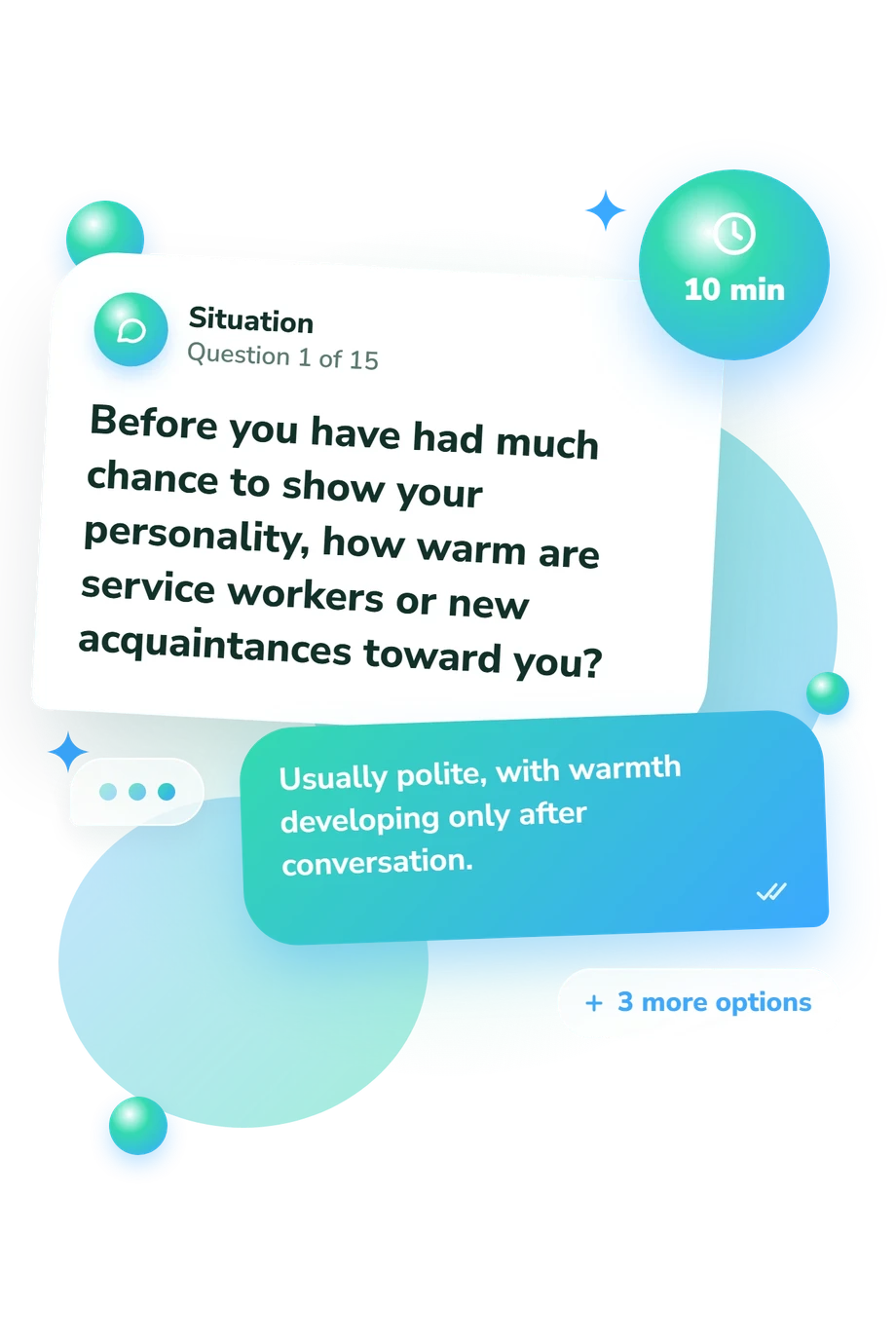
Example Questions From the Test
- Usually polite, with warmth developing only after conversation.
- Noticeably warm and eager to help in many settings.
- Often friendly from the start, although the response varies.
- Mostly neutral or businesslike at first.
- Often as confident, selective, or self-assured.
- Usually in neutral terms, without attaching much meaning to it.
- More often as difficult, cold, or overly demanding.
- Generally positively, though a few people react defensively.
- Occasionally, usually in particular places or outfits.
- Very often, across many kinds of places.
- Fairly often, although not in every setting.
- Almost never or never.
Do I Have Pretty Privilege Quiz - Description and methodology of the test
People who wonder whether appearance affects social treatment can use the Do I Have Pretty Privilege Quiz to organize experiences. It is intended for self-reflection by readers noticing differences in warmth, attention, opportunities, credibility, or leniency across everyday settings. The result describes reported patterns rather than rating attractiveness. This pretty privilege quiz can help you identify where your impressions recur and where context may offer another explanation.
What This Assessment Explores
The questionnaire measures perceived appearance-linked attention and visibility, access and accommodation, and favorable social assumptions across settings. These dimensions remain distinct: attention may be unsolicited or uncomfortable, while access and favorable assumptions describe different reported experiences. The result describes appearance-related social patterns without proving that every appearance-linked response is an advantage. The three dimensions are:
- Access and Accommodation (0-15) measures reported appearance-linked invitations, exceptions, opportunities, or extra effort; Limited pattern (0-5), Mixed pattern (6-10), and Recurring access (11-15).
- Attention and Visibility (0-15) measures unsolicited notice, interest, or appearance-focused attention; Limited pattern (0-5), Mixed pattern (6-10), and Recurring visibility (11-15).
- Favorable Social Assumptions (0-15) measures others' warmth, patience, credibility, or leniency; Limited pattern (0-5), Mixed pattern (6-10), and Recurring favorable assumptions (11-15).
These are perceived patterns, not verified discrimination findings or proof of causation; identity, status, and networks may shape responses.
Methodology and Scientific Basis
Each self-report item presents a social situation with four response descriptions. Choices vary by frequency, intensity, or others' interpretations, so you select the description closest to lived experience. The questionnaire produces separate scores for the three displayed dimensions but does not state each response's point allocation; these scores describe reported appearance-based social treatment, not overall attractiveness.
Conceptually, it is consistent with Anderson and colleagues' Aesthetic capital review of appearance-related advantages and penalties. It also aligns with Dion and colleagues' attractiveness-stereotype study and Eagly and colleagues' related work, while Batres and Shiramizu's research cautions against assuming the same halo effect across cultures. The questionnaire is conceptually consistent with these studies, but they do not validate this online questionnaire or establish it as an adaptation of their instruments.
The displayed bands are descriptive ranges, not established population norms. Memory, context, self-awareness, response style, identity, networks, and unequal opportunities can influence answers; a score cannot isolate appearance as the cause of an interaction. Read the result as a prompt to examine recurring situations, not a fixed conclusion about attractiveness or others' motives.
- Anderson, T. L., Grunert, C., Katz, A., & Lovascio, S. (2010). Aesthetic capital: A research review on beauty perks and penalties. Sociology Compass, 4(8), 564-575. DOI 10.1111/j.1751-9020.2010.00312.x
- Dion, K., Berscheid, E., & Walster, E. (1972). What is beautiful is good. Journal of Personality and Social Psychology, 24(3), 285-290. DOI 10.1037/h0033731
- Eagly, A. H., Ashmore, R. D., Makhijani, M. G., & Longo, L. C. (1991). What is beautiful is good, but...: A meta-analytic review of research on the physical attractiveness stereotype. Psychological Bulletin, 110(1), 109-128. DOI 10.1037/0033-2909.110.1.109
- Batres, C., & Shiramizu, V. (2023). Examining the attractiveness halo effect across cultures. Current Psychology, 42, 25515-25519. DOI 10.1007/s12144-022-03575-0
Updated: