
Cash Flow Statement Quiz
How the Scales are Structured
Who Usually Takes This Test?
See How You Compare
Below is a preview of how scores are typically distributed across each scale.
Example Questions From the Test
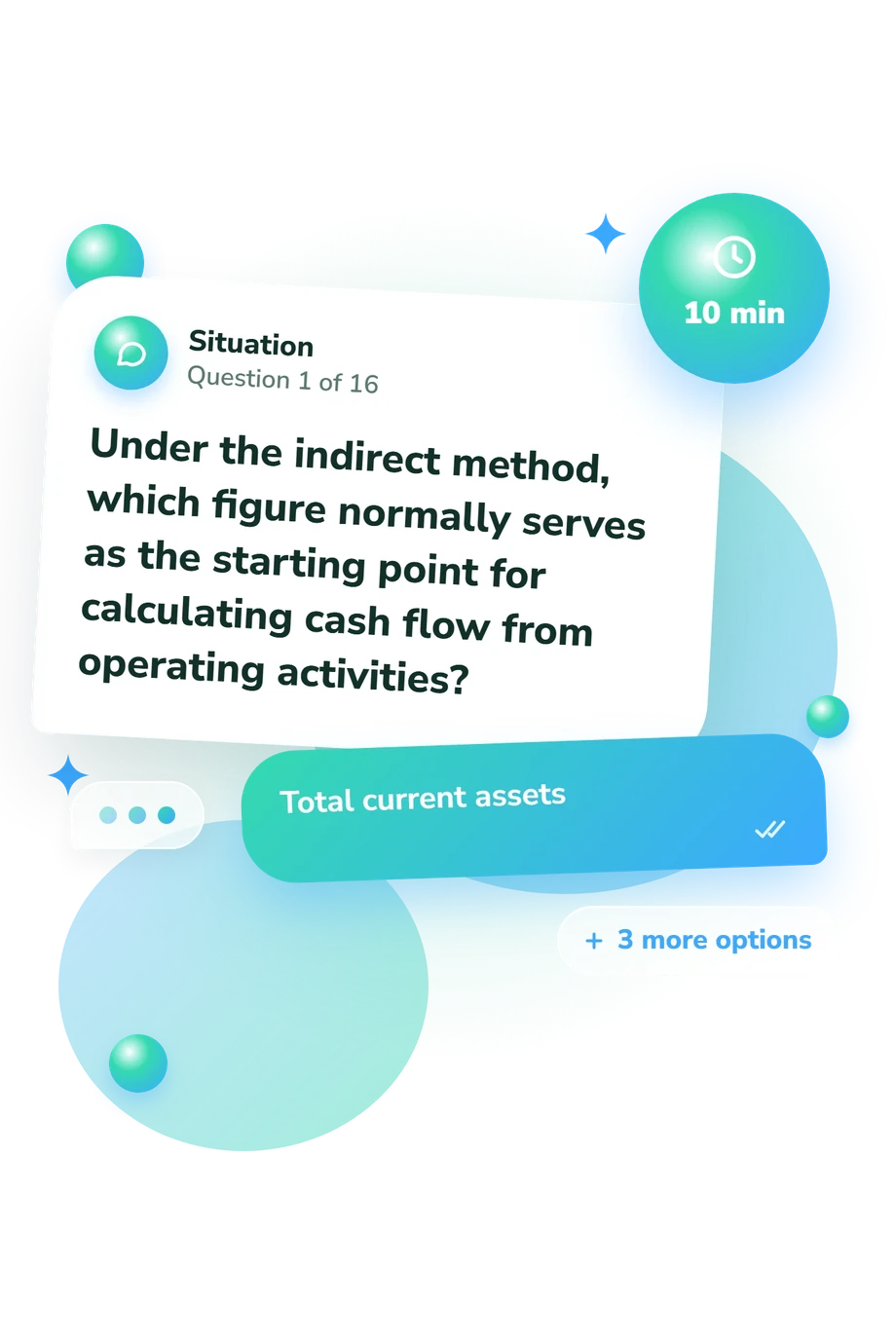
- Total current assets
- Ending cash balance
- Gross profit
- Net income
- Only as a noncash disclosure
- As an operating cash inflow
- As a financing cash inflow
- As an investing cash inflow
- As an operating cash outflow
- As a financing cash outflow
- As an investing cash outflow
- As a noncash disclosure only
Cash Flow Statement Quiz - Description and methodology of the test
Readers reviewing accounting fundamentals can use this cash flow statement quiz to check whether they can follow cash through operating, investing, and financing activities. Despite the catalogue label Celebrities as Santa Picture Quiz, the content addresses financial reporting rather than visual recognition. It suits learners, students, and anyone revising how accrual accounting connects with cash movements.
What This Assessment Explores
This assessment measures applied knowledge of cash-flow reporting: the statement’s purpose, section classifications, reconciliation adjustments, and interpretation of cash changes. It suits people learning or reviewing financial accounting and helps identify relationships that need more practice. A statement of cash flows quiz is useful for checking applied understanding rather than personality or general intelligence.
The result reports Cash Flow Statement Knowledge (0-16): Foundations to Build (0-6) marks basics needing review; Developing Knowledge (7-12) reflects workable understanding with less obvious adjustments to strengthen; Strong Knowledge (13-16) indicates consistent application across definitions, calculations, and business scenarios.
The content covers these practical areas:
- Operating activities show how routine receipts and payments affect cash.
- Investing activities identify movements involving equipment and long-term assets.
- Financing activities cover borrowing, principal repayment, and contributed equity.
- Reconciliation concepts explain noncash items, working-capital adjustments, and reporting methods.
Methodology and Evidence Base
Each item presents one accounting problem with four answer choices. Scenarios require transaction classification, an ending-cash calculation, direct-versus-indirect method recognition, and links between accrual amounts and cash effects. Topics include receivables, payables, depreciation, equipment, share issues, loan principal, customer receipts, gains, and noncash activities.
Scoring is content-based: the output summarizes performance across the questionnaire and places it in a displayed descriptive band. The result is a snapshot of knowledge under test conditions, not a population norm. Prior instruction, terminology familiarity, attention, and answer strategy can influence performance.
FAS 95 (1987) provides the conceptual framework for operating, investing, and financing activities. Vent and Cocco (1996) support the treatment of indirect-method reasoning, while Kieso, Weygandt, and Warfield (2022) cover classification, reconciliation, and disclosure. The celebrity santa picture quiz free label is unrelated to the accounting content; this questionnaire is a content-based self-check, not a validated adaptation of those sources. Its result can guide review of working-capital adjustments and statement sections.
- Financial Accounting Standards Board. Statement of Cash Flows (Statement of Financial Accounting Standards No. 95). Norwalk, CT: Financial Accounting Foundation, 1987.
- Vent, Glenn A., and Anthony F. Cocco. “Teaching the Cash Flows from Operations Section of the Statement of Cash Flows under the Indirect Method: A Conceptual Framework.” Journal of Education for Business 71, no. 6 (1996): 344-347. 10.1080/08832323.1996.10116810.
- Kieso, Donald E., Jerry J. Weygandt, and Terry D. Warfield. Intermediate Accounting. 18th ed. Hoboken, NJ: John Wiley & Sons, 2022.
Updated: