
Functions Quiz
How the Scales are Structured
Who Usually Takes This Test?
See How You Compare
Below is a preview of how scores are typically distributed across each scale.
Example Questions From the Test
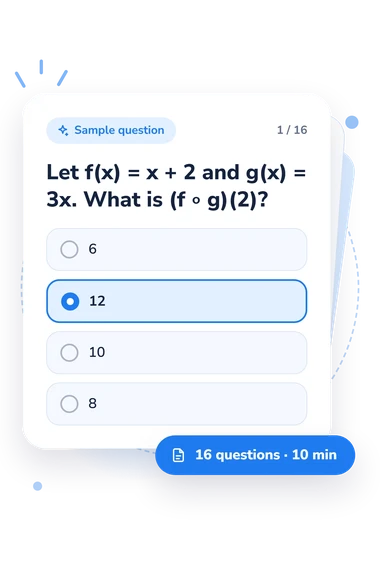
- 6
- 12
- 10
- 8
- Squaring is not defined for negative inputs
- The graph of f fails the vertical line test
- The range of f includes every real number
- Distinct inputs such as -2 and 2 produce the same output
- Every vertical line crosses the graph at most once
- The graph crosses the x-axis no more than once
- The graph crosses the y-axis exactly once
- Every horizontal line crosses the graph exactly once
Functions Quiz - Description and methodology of the test
Students, teachers, and adult learners who want to check their understanding of core algebra can use this functions quiz to identify secure skills and useful next steps. This assessment works as a function practice quiz before revision, after instruction, or when linking symbolic rules with graphs and applications. The result gives a focused snapshot of current performance rather than a judgment of overall mathematical ability.
What This Assessment Explores
These items examine whether a respondent can recognize, interpret, and use functions in algebraic situations. Questions sample formulas, tables, graphs, and applications; the result describes demonstrated command of function concepts and their application. The assessment also works as a quiz on algebra functions, connecting symbolic, visual, numerical, and practical representations. Questions cover four connected areas:
- Definitions and notation show whether a respondent can identify functions and read symbolic forms.
- Evaluation and rate of change show how reliably values are substituted and interpreted.
- Domains, zeros, restrictions, and graph tests show whether conditions are read from formulas or graphs.
- Transformations, composition, inverses, and applications show whether ideas combine in multi-step problems.
Together, these areas sample function concepts across representations. Functions Knowledge is 0-16, with one point per correct answer. Bands are Foundations to review (0-6), Developing knowledge (7-12), and Strong knowledge (13-16).
Methodology and Evidence Base
Each item presents four answer choices and asks the respondent to select the option that fits a definition, calculation, graph interpretation, algebraic rule, or practical situation. Scoring is direct: each correct response earns one point, with the total summarizing performance across the tested function concepts.
The questionnaire samples function knowledge beyond formula manipulation, a conceptual overlap with the Function Concept Inventory (O'Shea et al., 2016). Its attention to the function concept and to relationships among functions, graphs, tasks, learning, and teaching also reflects topics discussed by Dubinsky and Wilson (2013) and Leinhardt, Zaslavsky, and Stein (1990). These sources support the content rationale, but they do not validate or standardize this online test.
As a math functions test, it can show whether familiar ideas are available in the moment, while performance may vary with prior instruction, notation familiarity, attention, and the examples encountered. Guessing and current context can also affect the score, so use the result to target practice rather than treat it as a complete measure of mathematical proficiency.
- Ann O'Shea, Sinéad Breen, and Barbara Jaworski (2016). The Development of a Function Concept Inventory. International Journal of Research in Undergraduate Mathematics Education, 2(3), 279-296. 10.1007/s40753-016-0030-5
- Ed Dubinsky and Robin T. Wilson (2013). High school students' understanding of the function concept. Journal of Mathematical Behavior, 32(1), 83-101. 10.1016/j.jmathb.2012.12.001
- Gaea Leinhardt, Orit Zaslavsky, and Mary Kay Stein (1990). Functions, Graphs, and Graphing: Tasks, Learning, and Teaching. Review of Educational Research, 60(1), 1-64. 10.3102/00346543060001001