
Emotional Eating Quiz
How the Scales are Structured
Who Usually Takes This Test?
See How You Compare
Below is a preview of how scores are typically distributed across each scale.
Example Questions From the Test
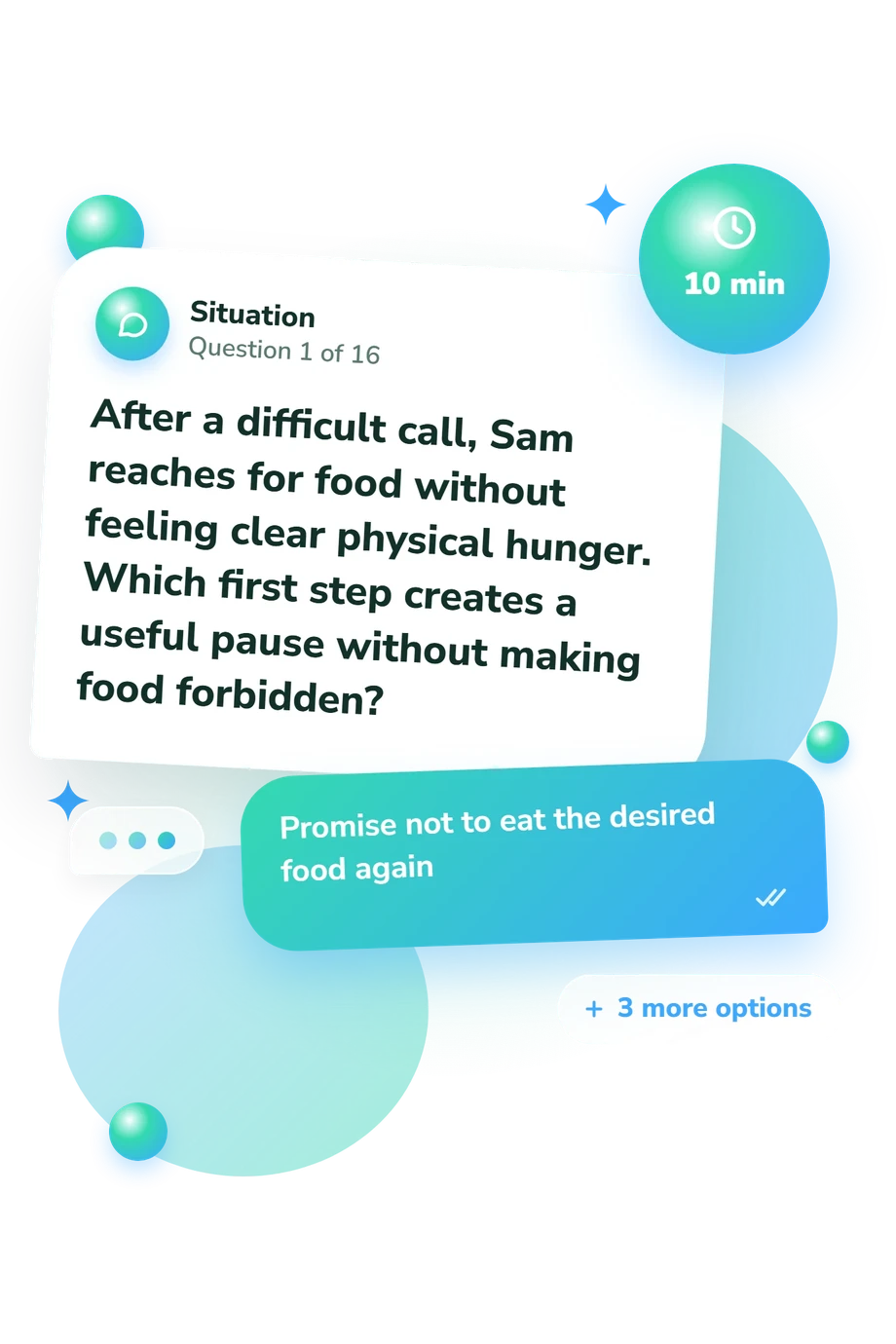
- Promise not to eat the desired food again
- Wait until the urge disappears completely before making any decision
- Check current hunger and emotion, consider available responses, then choose
- Replace the desired food with the lowest-calorie option available
- Noticing sensations, thoughts, and cues during eating with less judgment
- Analyzing the nutritional value of every bite while eating
- Following fixed meal times regardless of bodily signals
- Choosing foods only when no strong emotion is present
- The exact number of calories in each evening snack
- Whether other people would consider the food healthy
- Whether she eats dinner at precisely the same time each day
- Which situations and feelings tend to occur just before the urge
Emotional Eating Quiz - Description and methodology of the test
People who want to understand how emotions can shape eating may use this emotional eating quiz to review core concepts rather than label themselves. It suits readers exploring hunger cues, comfort eating, or coping responses and provides an educational knowledge profile. It covers stress eating and other emotionally prompted cues through everyday situations, practical ideas for noticing urges, and flexible responses.
What This Test Measures
The questionnaire checks whether a person can distinguish physical hunger from emotionally prompted eating and recognize how sleep, stress, activity, and meals affect hunger. It covers automatic snacking, cravings, difficult feelings, environmental cues, and responses after comfort eating. This knowledge test about emotional eating examines patterns rather than classifying the respondent as an emotional eater.
The questions cover these areas, which contribute to one overall knowledge score:
- Hunger and emotion cues test whether the respondent can distinguish bodily signals from feelings.
- Triggers and context test recognition of situations, emotions, routines, and surroundings preceding eating.
- Mindful and flexible responses test understanding of less judgmental attention, self-compassion, urge surfing, and alternatives to rigid rules.
Emotional Eating Knowledge (0-16) reflects correct answers, not the presence or severity of emotional eating. Bands are Foundations to build (0-6), Developing knowledge (7-12), and Strong knowledge (13-16).
Methodology and Evidence Base
Each item presents a situation or concept with four answer choices. Selecting the best answer tests recognition of hunger cues, emotional triggers, mindful observation, flexible coping, and when support may be appropriate; it does not estimate symptom severity. The four-option knowledge-check format includes stress-related eating as one topic.
The displayed total represents correct answers across the questionnaire. It can show which principles need further learning; the score does not show whether the respondent personally experiences emotional eating or indicate its severity, and the supplied bands are educational categories rather than clinical classifications.
Its content is conceptually consistent with the Emotional Eating Scale (Arnow et al., 1995), which examines eating in response to negative affect, and Macht’s five-way model of emotion-related eating. Mindful attention and nonjudgmental observation also fit the approach evaluated by Morillo-Sarto et al. (2023). These sources support the concepts, but do not establish this questionnaire as an adaptation or standardized version of those instruments.
Performance may vary with prior familiarity, interpretation of hypothetical scenarios, and guessing. The result describes tested knowledge, not the respondent’s personal eating pattern.
- Arnow, B., Kenardy, J., & Agras, W. S. (1995). The emotional eating scale: The development of a measure to assess coping with negative affect by eating. International Journal of Eating Disorders, 18(1), 79-90. 10.1002/1098-108X(199507)18:1%3C79::AID-EAT2260180109%3E3.0.CO%3B2-V
- Macht, M. (2008). How emotions affect eating: A five-way model. Appetite, 50(1), 1-11. 10.1016/j.appet.2007.07.002
- Morillo-Sarto, H., López-del-Hoyo, Y., Pérez-Aranda, A., Modrego-Alarcón, M., Barceló-Soler, A., Borao, L., Puebla-Guedea, M., Demarzo, M., García-Campayo, J., & Montero-Marin, J. (2023). ‘Mindful eating’ for reducing emotional eating in patients with overweight or obesity in primary care settings: A randomized controlled trial. European Eating Disorders Review, 31(2), 303-319. 10.1002/erv.2958
Updated: