
Preferred Learning Style Test
How the Scales are Structured
Who Usually Takes This Test?
See How You Compare
Below is a preview of how scores are typically distributed across each scale.
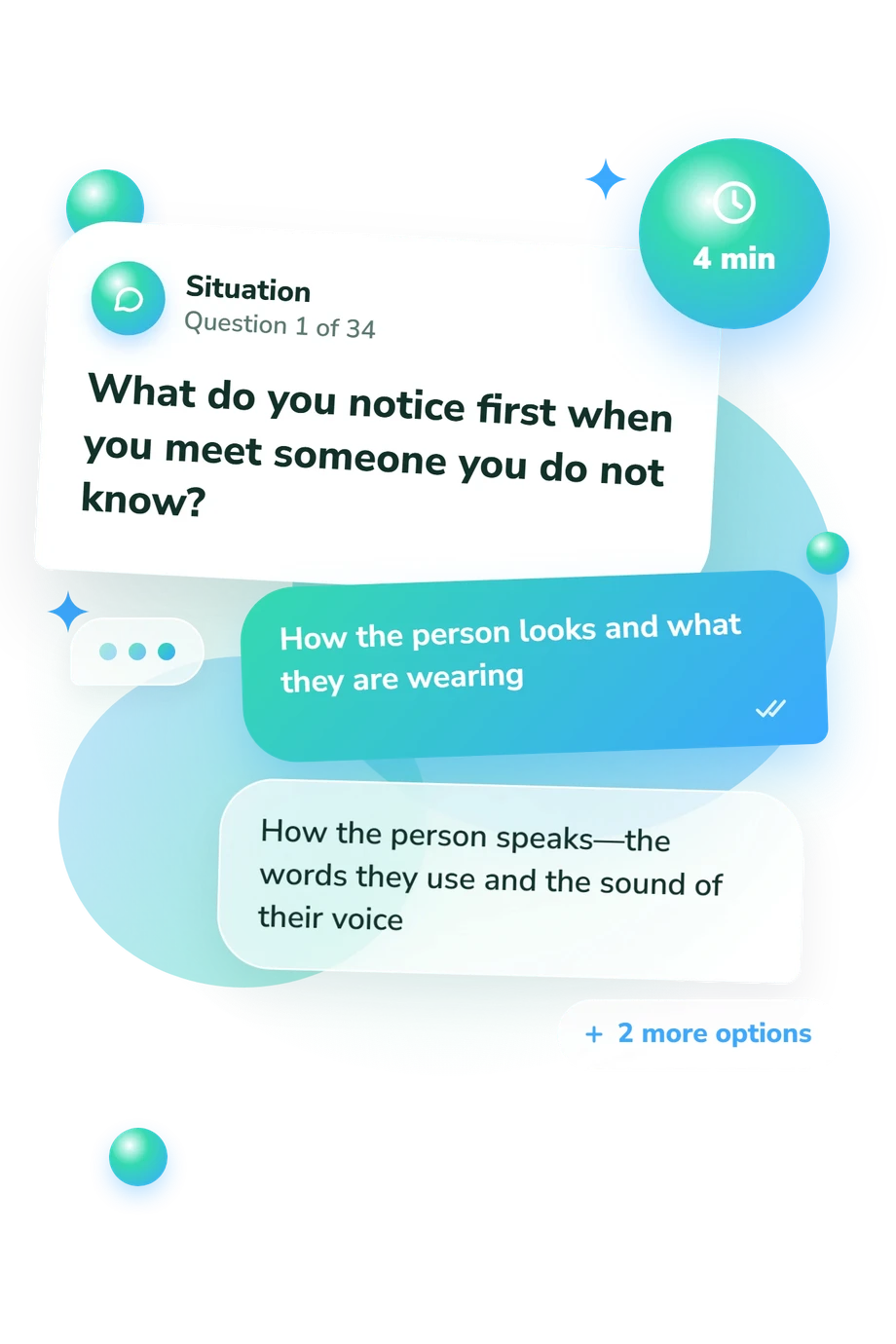
Example Questions From the Test
- The person’s face
- Their first or last name
- How I felt when I was with this person
- What this person and I did together
- How the room looks
- The sounds or conversations in the room
- How comfortable I feel in the room (emotionally or physically)
- What is happening in the room and what I can do there
- Looking at it
- Hearing it
- Writing it down
- Mentally or physically "playing" with it
Preferred Learning Style Test - Description and methodology of the test
Students, educators, and curious learners can use this assessment to examine which kinds of input feel easiest to notice, organize, and remember. The Preferred Learning Style Test compares preferences connected with visual, auditory, tactile, and kinesthetic activity, so the result can suggest study conditions worth trying rather than prescribe a fixed identity. As a learning preferences questionnaire, it is most useful for guided self-reflection.
What the Questionnaire Measures
Items cover conversation, study, surroundings, leisure, memory, and practical activity. The result describes preference, not ability or a permanent identity.
The result reports four dimensions:
- Visual (0–17) measures preference for images, diagrams, written material, and visual associations. Bands: Low visual preference (0–5), Moderate visual preference (6–11), High visual preference (12–17).
- Auditory (0–17) measures preference for listening, discussion, lectures, and spoken repetition. Bands: Low auditory preference (0–5), Moderate auditory preference (6–11), High auditory preference (12–17).
- Tactile (0–17) measures preference for touch, writing, drawing, and handling materials. Bands: Low tactile preference (0–5), Moderate tactile preference (6–11), High tactile preference (12–17).
- Kinesthetic (0–17) measures preference for movement, physical activity, experiments, and practical tasks. Bands: Low (0–5), Moderate (6–11), High (12–17).
A learning preference profile can be mixed, suggesting study conditions to try rather than assigning one label.
Methodology and Evidence Base
Each item offers four alternatives, and the respondent chooses the one that best matches usual experience. Options represent seeing, listening, tactile activity, or movement in situations involving teaching, study, memory, and leisure. Results are reported separately for the four preferences; the questionnaire does not specify an additional response-weighting rule beyond the displayed ranges.
This is a separate online questionnaire conceptually consistent with the Linksman Learning Style Preference Questionnaire, which groups learning preferences by how information is taken in and acted upon; it is not a direct adaptation. A 2025 cluster-analysis study by Pricopie-Filip and Andrei offers contextual evidence that preference profiles can combine, but it does not validate this questionnaire; Pashler, McDaniel, Rohrer, and Bjork (2008) found limited evidence that matching instruction to a declared learning style improves outcomes.
This tool is a descriptive self-report profile. It has no stated population norms, diagnostic thresholds, reliability estimates, or clinical interpretation, and responses may vary with current demands, mood, self-awareness, and learning context. Try study methods for different learning styles—such as diagrams, discussion, note-making, movement, or hands-on practice—and keep those that improve recall and performance.
- Linksman, Ricki. How to Learn Anything Quickly: An Accelerated Program for Rapid Learning. Secaucus, NJ: Carol Publishing Group, 1996. ISBN 0-8065-1792-1.
- Pricopie-Filip, Alina, and Mihaela Andrei. A Cognitive Preference Profiles in Engineering Students: A Cluster Analysis of Learning Tendencies and Cerebral Hemispheric Orientation. RA Journal of Applied Research 11, no. 12 (2025): 1163–1178. 10.47191/rajar/v11i12.12
- Pashler, Harold, Mark McDaniel, Doug Rohrer, and Robert Bjork. Learning Styles: Concepts and Evidence. Psychological Science in the Public Interest 9, no. 3 (2008): 105–119. 10.1111/j.1539-6053.2009.01038.x
Updated: