
Will My Relationship Last Quiz
How the Scales are Structured
Who Usually Takes This Test?
See How You Compare
Below is a preview of how scores are typically distributed across each scale.
Example Questions From the Test
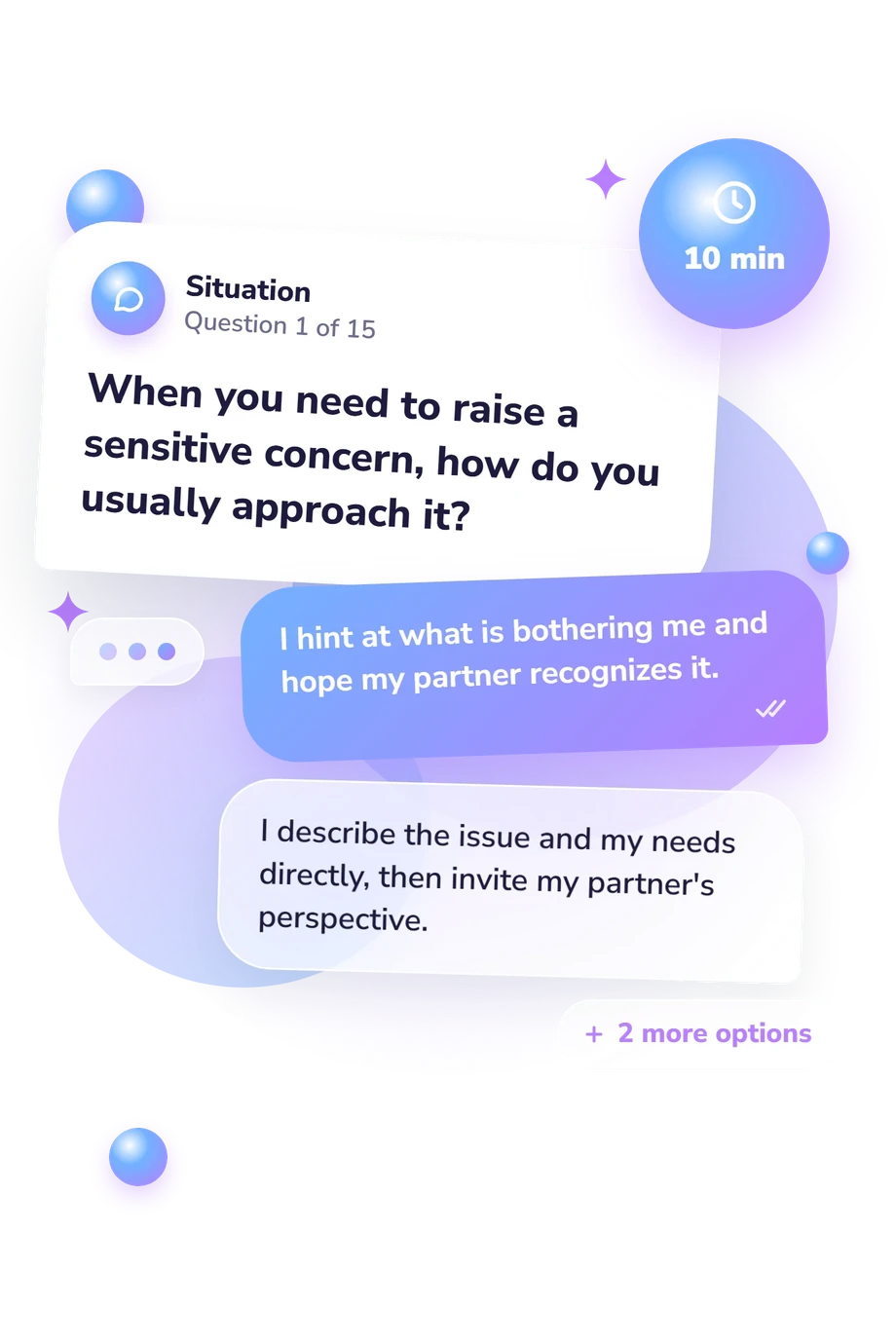
- I hint at what is bothering me and hope my partner recognizes it.
- I describe the issue and my needs directly, then invite my partner's perspective.
- I hold it back until I feel completely sure the conversation will go well.
- I focus on the facts and suggest a solution, even if feelings receive less attention.
- They listen with care, ask what I need, and treat what I shared respectfully afterward.
- They offer advice or reassurance, although I do not always feel fully understood.
- They seem uncomfortable, so I keep parts of the experience to myself.
- The conversation often shifts away from my feelings before I can explain them.
- We look for the underlying need or pattern and try a specific change together.
- We take longer breaks from the topic because previous conversations have felt unproductive.
- We adjust parts of the situation, although the central disagreement may remain.
- We each defend our usual position and wait to see whether circumstances change.
Will My Relationship Last Quiz - Description and methodology of the test
For couples deciding which conversation deserves attention first, this questionnaire offers a structured way to examine habits that may support or strain connection. The Will My Relationship Last Quiz helps partners organize a practical conversation about present concerns and choices. It can function as a how-to-know-if-your-relationship-will-last quiz, showing where communication, security, or shared plans need closer attention.
What This Assessment Explores
Sensitive conversations, vulnerability, disagreements, promises, values, boundaries, goals, and time apart show what this questionnaire examines. Results from this will-your-relationship-last quiz show where a couple needs clarity about the relationship's direction.
The profile groups these situations into three dimensions:
- Communication & Repair (0-15) shows how concerns are raised, understood, revisited, and repaired; bands are Repair feels difficult (0-5), Developing repair habits (6-10), and Constructive repair pattern (11-15).
- Shared Commitment & Future Fit (0-15) shows alignment on priorities, responsibilities, and plans; bands are Direction unclear (0-5), Some shared direction (6-10), and Strong shared direction (11-15).
- Trust & Emotional Security (0-15) shows openness, reliability, limits, and individuality; bands are Uncertain security (0-5), Partial security (6-10), and Strong security (11-15).
Start with the lowest area: revisit an unresolved exchange, clarify a future expectation, and name a behavior or boundary to make trust more dependable.
Methodology and Evidence Base
Each item presents a relationship situation with four response options. Choices contrast direct discussion, listening, follow-through, and repair with hinting, avoidance, defensiveness, or postponement. Together, they invite self-report about whether we will last through recurring challenges, which is the practical question behind a will-we-last quiz.
Responses feed three displayed totals, but the online questionnaire does not state how many points each answer contributes. Displayed bands categorize results without revealing how individual responses are weighted.
Component-level references include Carr and colleagues' C-SCORE work on communication and repair, Wieselquist and colleagues' work on commitment and trust, and Zacchilli and colleagues' work on conflict responses. They address parts of the questionnaire, which is conceptually consistent with these publications but is not an adaptation or validation of their instruments.
To consider whether this relationship will last, read each answer in context; this will-this-relationship-last quiz focuses on current patterns. The questionnaire has no published norms, and its answer weighting is not documented. Scores describe current relationship patterns; they do not predict longevity. Stress, memory, self-awareness, and response bias can affect self-report. This measure is not a safety assessment; fear or controlling behavior warrants support regardless of the score.
- Carr, A., Kieran, A., Sherbersky, H., Shepherd, M., Galbraith, M., Whittinger, N., Pomini, V., Yang Yang, K. K., Nearchou, F., & Stratton, P. (2025). Development and preliminary validation of the C-SCORE: A brief scale for use in systemic couple therapy. Journal of Family Therapy, 47, e12485. 10.1111/1467-6427.12485
- Wieselquist, J., Rusbult, C. E., Foster, C. A., & Agnew, C. R. (1999). Commitment, pro-relationship behavior, and trust in close relationships. Journal of Personality and Social Psychology, 77(5), 942-966. 10.1037/0022-3514.77.5.942
- Zacchilli, T. L., Hendrick, C., & Hendrick, S. S. (2009). The romantic partner conflict scale: A new scale to measure relationship conflict. Journal of Social and Personal Relationships, 26(8), 1073-1096. 10.1177/0265407509347936
Updated: