
Which Titan Are You Quiz
How the Scales are Structured
Who Usually Takes This Test?
See How You Compare
Below is a preview of how scores are typically distributed across each scale.
Example Questions From the Test
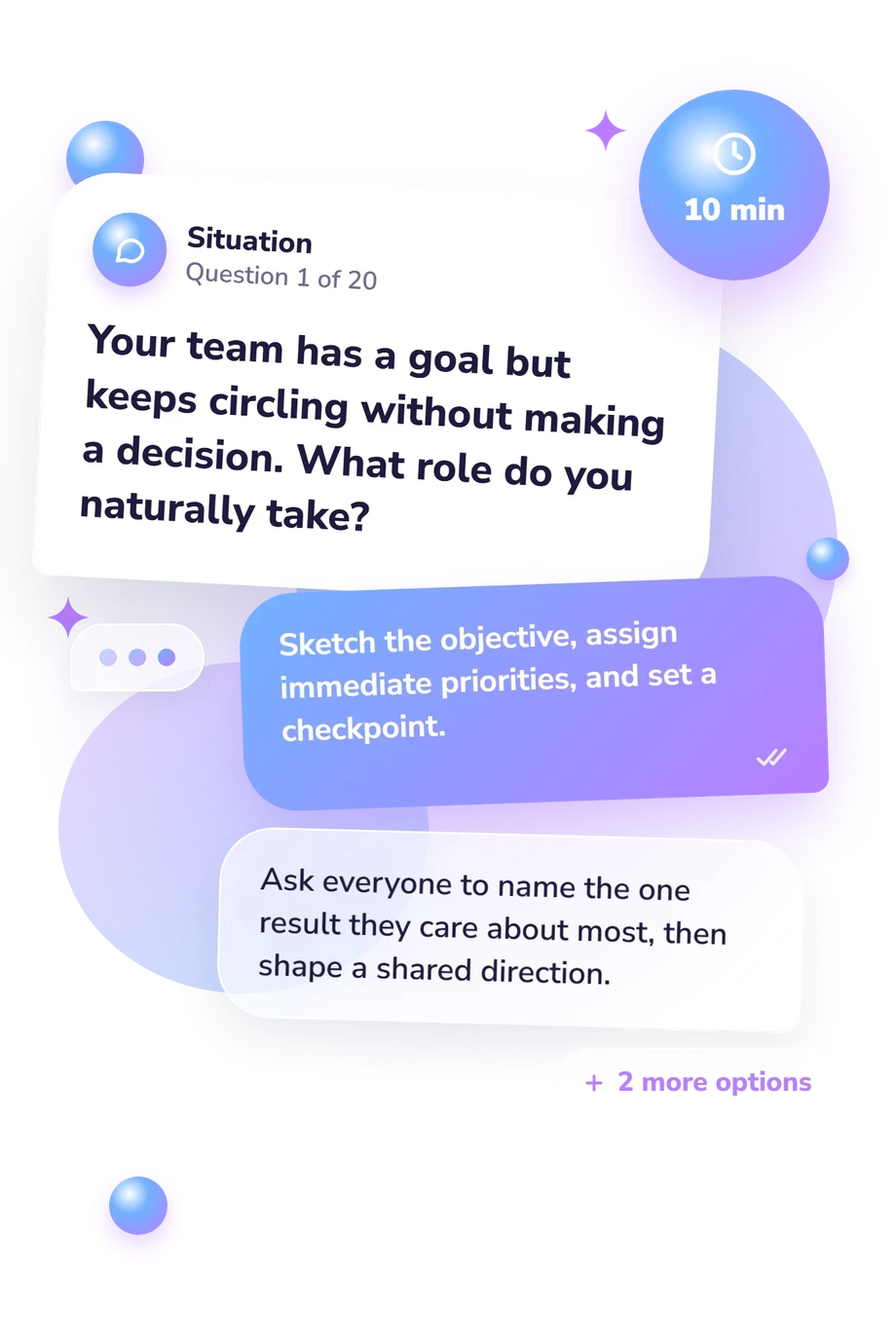
- Sketch the objective, assign immediate priorities, and set a checkpoint.
- Ask everyone to name the one result they care about most, then shape a shared direction.
- Choose a useful task and start making progress without directing the group.
- Lighten the atmosphere so people can reconnect before deciding.
- Send a sincere message recognizing the effort behind it.
- Celebrate enthusiastically and make sure they know how proud I am.
- Suggest a fun group activity that lets everyone share the moment.
- Offer practical help with whatever comes next.
- Finding a quiet place to name what I feel and let it settle.
- Talking it through with one trusted person after some time alone.
- Doing something active or absorbing until my mood shifts.
- Spending time with familiar people without discussing it deeply.
Which Titan Are You Quiz - Description and methodology of the test
People who enjoy the Teen Titans universe and want a playful lens on their own habits can use the Which Titan Are You Quiz to compare five recognizable character styles. Within a what titan am i quiz format, the profile helps readers consider how they handle teamwork, change, closeness, responsibility, and emotional pressure. It is designed for curious fans seeking a strengths-based snapshot rather than a fixed identity.
What This Assessment Explores
It translates familiar character qualities into five lenses on everyday behavior: how someone adapts, builds, reflects, leads, or connects. In this what titan are you quiz, the leading score indicates the strongest affinity, while close scores can produce a blended profile.
The five result dimensions are:
- Beast Boy (0-12) measures playful resilience and flexibility: Steady Specialist (0-4), Flexible Spark (5-8), or Playful Shapeshifter (9-12).
- Cyborg (0-12) measures practical teamwork and systems thinking: People-and-Possibilities Focus (0-4), Practical Collaborator (5-8), or Powered-Up Builder (9-12).
- Raven (0-12) measures reflection and emotional containment: Outward Processor (0-4), Reflective Balance (5-8), or Quiet Mystic (9-12).
- Robin (0-12) measures strategic leadership and disciplined follow-through: Independent Operator (0-4), Emerging Strategist (5-8), or Mission Leader (9-12).
- Starfire (0-12) measures openhearted connection and expressive warmth: Quiet Warmth (0-4), Open Connector (5-8), or Radiant Heart (9-12).
Methodology and Scientific Basis
Each item presents an everyday scenario with four response options. The situations cover leadership, collaboration, troubleshooting, emotional regulation, personal space, affection, curiosity, and adaptation. The respondent chooses the most natural response; the questionnaire tallies those choices into the five dimensions before comparing the resulting totals.
This format is conceptually consistent with research on identification with narrative characters. Hoffner and Buchanan (2005) connected wishful identification with perceived similarity and character attributes, while Huang and Fung (2024) offered a validated way to measure narrative-character identification. The present questionnaire uses the idea of affinity, not either published scale.
Trait language also sits alongside the hierarchical personality perspective of Soto and John’s BFI-2, which distinguishes broad domains from narrower facets. As a Teen Titans personality quiz, it makes those reflections accessible through recognizable fictional roles; its profiles are not Big Five scores or a standardized adaptation.
Read the result as a snapshot of self-reported tendencies. The highest total is the strongest affinity, and any outcome within one point of the highest is included in a blended result. Current mood, self-awareness, and context can shape answers, and the published sources do not establish norms, reliability estimates, or diagnostic cutoffs for this exact online questionnaire.
- Hoffner, Cynthia A., and Martha Buchanan. "Young Adults' Wishful Identification With Television Characters: The Role of Perceived Similarity and Character Attributes." Media Psychology, 7(4), 325-351, 2005. 10.1207/S1532785XMEP0704_2
- Huang, Kate Y., and Helene H. Fung. "Measuring identification with narrative characters: the development and validation of a new scale." Current Psychology, 43, 24835-24849, 2024. 10.1007/s12144-024-06191-2
- Soto, Christopher J., and Oliver P. John. "The next Big Five Inventory (BFI-2): Developing and assessing a hierarchical model with 15 facets to enhance bandwidth, fidelity, and predictive power." Journal of Personality and Social Psychology, 113(1), 117-143, 2017. 10.1037/pspp0000096
Updated: