
Which Dwarf Are You Quiz
How the Scales are Structured
Who Usually Takes This Test?
See How You Compare
Below is a preview of how scores are typically distributed across each scale.
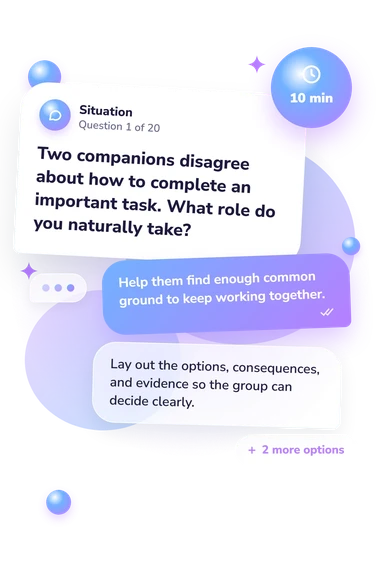
Example Questions From the Test
- Help them find enough common ground to keep working together.
- Lay out the options, consequences, and evidence so the group can decide clearly.
- Let the person with the strongest conviction take the lead.
- Suggest a small trial that will reveal which approach works better.
- Bring some playful energy—a story, song, or joke that can shift the mood.
- Invite someone into a warm conversation about what is weighing on them.
- Handle a practical chore so everyone has less to worry about.
- Offer calm, quiet company without trying to change the atmosphere.
- Take ownership of a necessary task and show through action that you are still committed.
- Check who needs practical help and work alongside them.
- Suggest a pause so the group can decide whether the goal still makes sense.
- Recover your own energy first, then return when you can contribute fully.
Which Dwarf Are You Quiz - Description and methodology of the test
People who enjoy imaginative self-reflection may find the Which Dwarf Are You Quiz useful for noticing how they handle everyday choices and group situations. The test uses the seven dwarfs quiz theme as a playful story frame, while its profile contains five result affinities rather than seven outcomes. Read the result as a prompt for concrete observations about your usual style.
What This Assessment Explores
The playful 7 dwarfs quiz theme frames a tale, not seven outcomes. Five affinities emerge from uncertainty, companionship, making, commitments, and preparation:
- Emberstride (0-12) covers discovery, movement, uncertain challenges: Familiar Ground (0-4) prefers predictability; Emberstride Leaning (5-8) explores; Strong Affinity (9-12) seeks novelty.
- Goldspark (0-12) covers warmth, humor, shared celebration: Quiet Presence (0-4) connects selectively; Goldspark Leaning (5-8) creates warmth; Strong Goldspark Affinity (9-12) energizes groups.
- Hearthforge (0-12) covers skilled hands, durable work, home comfort: Conceptual Focus (0-4) favors ideas; Hearthforge Leaning (5-8) values making; Strong Hearthforge Affinity (9-12) values craft.
- Ironshield (0-12) covers loyalty, follow-through, standing beside others: Independent Stance (0-4) preserves autonomy; Ironshield Leaning (5-8) stays dependable; Strong Ironshield Affinity (9-12) protects commitments.
- Runehelm (0-12) covers organized, informed guidance: Instinctive Approach (0-4) favors flexibility; Runehelm Leaning (5-8) adapts plans; Strong Runehelm Affinity (9-12) relies on planning.
Methodology and Evidence Base
Each item presents an everyday situation with four possible reactions, asking which response feels most natural. Scenarios address changing plans, social support, craft, responsibility, and unfamiliar challenges. Its dwarf personality quiz format keeps the tone imaginative while each answer contributes to a profile. The response options are behavioral choices, not right-or-wrong answers, so the method is situational self-report rather than performance testing.
Responses produce five scale totals. The highest identifies the clearest affinity, while totals within one point create a blended result. Read the pattern as a set of descriptive bands, not as a pass-or-fail judgment.
The dwarf characters and situations provide the interpretive frame; the item themes organize an online descriptive profile of response tendencies rather than a general personality type.
Because this is an online self-report, current mood, self-awareness, and socially desirable responding may influence answers, so the profile is best read as a structured snapshot rather than a complete account of stable personality or functioning.
- Peterson, Christopher, and Martin E. P. Seligman. 2004. Character Strengths and Virtues: A Handbook and Classification. Washington, DC: American Psychological Association; New York: Oxford University Press. ISBN 978-0-19-516701-6.
- Park, Nansook, Christopher Peterson, and Martin E. P. Seligman. 2004. "Strengths of Character and Well-Being." Journal of Social and Clinical Psychology 23(5): 603-619. DOI 10.1521/jscp.23.5.603.50748
Updated: