
Which Akatsuki Member Are You Quiz
How the Scales are Structured
Who Usually Takes This Test?
See How You Compare
Below is a preview of how scores are typically distributed across each scale.
Example Questions From the Test
- Create precise components and make sure each one fits the whole.
- Build a contingency plan around the most likely disruptions.
- Focus on communication so people can coordinate in real time.
- Set a broad direction and adapt freely as the day unfolds.
- Make the next version bolder and harder to ignore.
- Change the format while preserving the original spark.
- Clarify the message so its value is easier to understand.
- Accept that meaningful work can have a small audience.
- Stay quietly present and take care of a practical need.
- Listen briefly and let them decide whether to say more.
- Suggest a gentle activity that might shift the atmosphere.
- Respect their distance and wait for them to reconnect.
Which Akatsuki Member Are You Quiz - Description and methodology of the test
For fans connecting choices with Akatsuki personalities, the akatsuki member quiz offers a character-affinity profile built around fictional traits. Readers taking the what akatsuki member are you quiz can use the result to see whether their answers lean toward creative intensity, strategic restraint, endurance, careful preparation, or transformative leadership. It points to the fictional qualities most strongly echoed in their responses.
What This Assessment Explores
Questions about conflict, art, crisis, loyalty, planning, leadership, setbacks, and relationships reveal five fictional dimensions. In the which akatsuki member are you quiz, they describe affinities rather than fixed identities; the highest profile leads, and scores within one point indicate a blend. The result includes:
- Deidara Affinity (0-12) reflects expressive originality: Enduring Builder (0-4), Expressive Experimenter (5-8), or Impact Artist (9-12).
- Itachi Uchiha Affinity (0-12) reflects restraint and long-range analysis: Open Operator (0-4), Quiet Strategist (5-8), or Veiled Protector (9-12).
- Kisame Hoshigaki Affinity (0-12) reflects endurance and blunt loyalty: Measured Navigator (0-4), Steady Challenger (5-8), or Relentless Ally (9-12).
- Konan Affinity (0-12) reflects precision and prepared action: Flexible Independent (0-4), Thoughtful Organizer (5-8), or Resolute Planner (9-12).
- Pain Affinity (0-12) reflects commanding, transformative purpose: Independent Path (0-4), Purposeful Reformer (5-8), or Architect of Change (9-12).
Methodology and Evidence Base
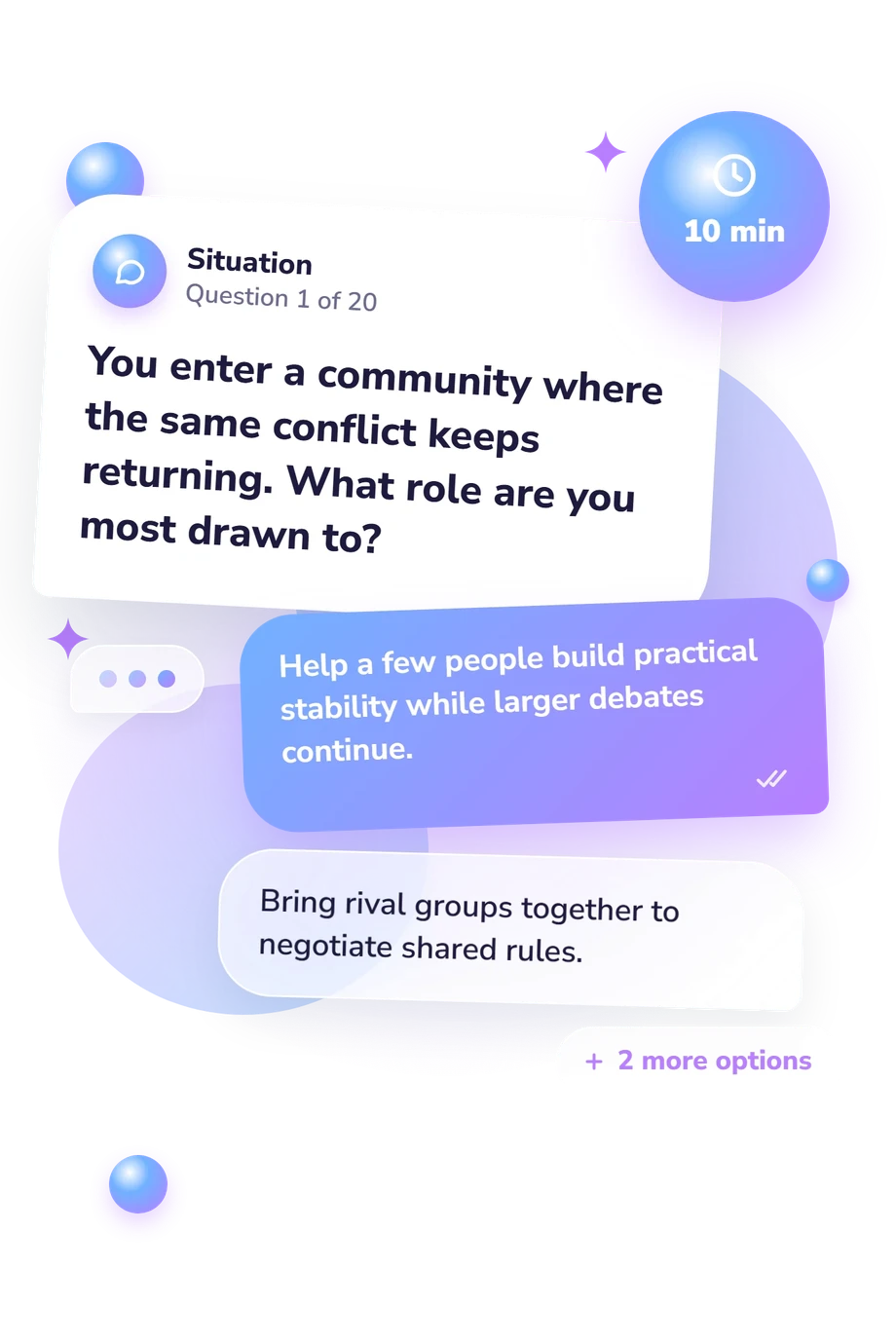
Each item presents a short scenario with four response options. The situations cover uncertainty, creativity, planning, loss, criticism, loyalty, conflict, leadership, and change. This format turns personal preferences into comparable character-affinity signals without a correct response.
Scoring treats the five profiles independently. Each option contributes to its assigned profile key, and the resulting range describes affinity strength. The highest profile leads; scores within one point are shown as a blend. Bands describe the style represented by a score, not a ranking.
The conceptual reference is Naruto character profiles (Kishimoto, 2012), which supplies the represented traits. Deviani and Mochtar (2021) adds thematic context around endurance, loyalty, sacrifice, authority, and strategy in Naruto. The questionnaire is conceptually consistent with these sources, not an adaptation or validation of either publication.
As an Akatsuki character test, it is an online self-report exercise with no published norms, reliability estimates, or diagnostic cutoffs. Mood, self-presentation, Naruto familiarity, and answer appeal can influence results; a leading profile is best used as a reflection prompt, while a close pair suggests blended characterization.
- Kishimoto, Masashi. Naruto: The Official Character Data Book. San Francisco, CA: VIZ Media, 2012. ISBN 978-1-4215-4125-9.
- Deviani, Jennisa Mayang, and Jenny Mochtar. "The Ideal Masculinity of Male Ninjas in Naruto and Naruto Shippuden Anime Series." Kata Kita: Journal of Language, Literature, and Teaching, 9(3), 2021, 340-347. 10.9744/katakita.9.3.340-347.
Updated: