
What Will Happen to Me Tomorrow Quiz
How the Scales are Structured
Who Usually Takes This Test?
See How You Compare
Below is a preview of how scores are typically distributed across each scale.
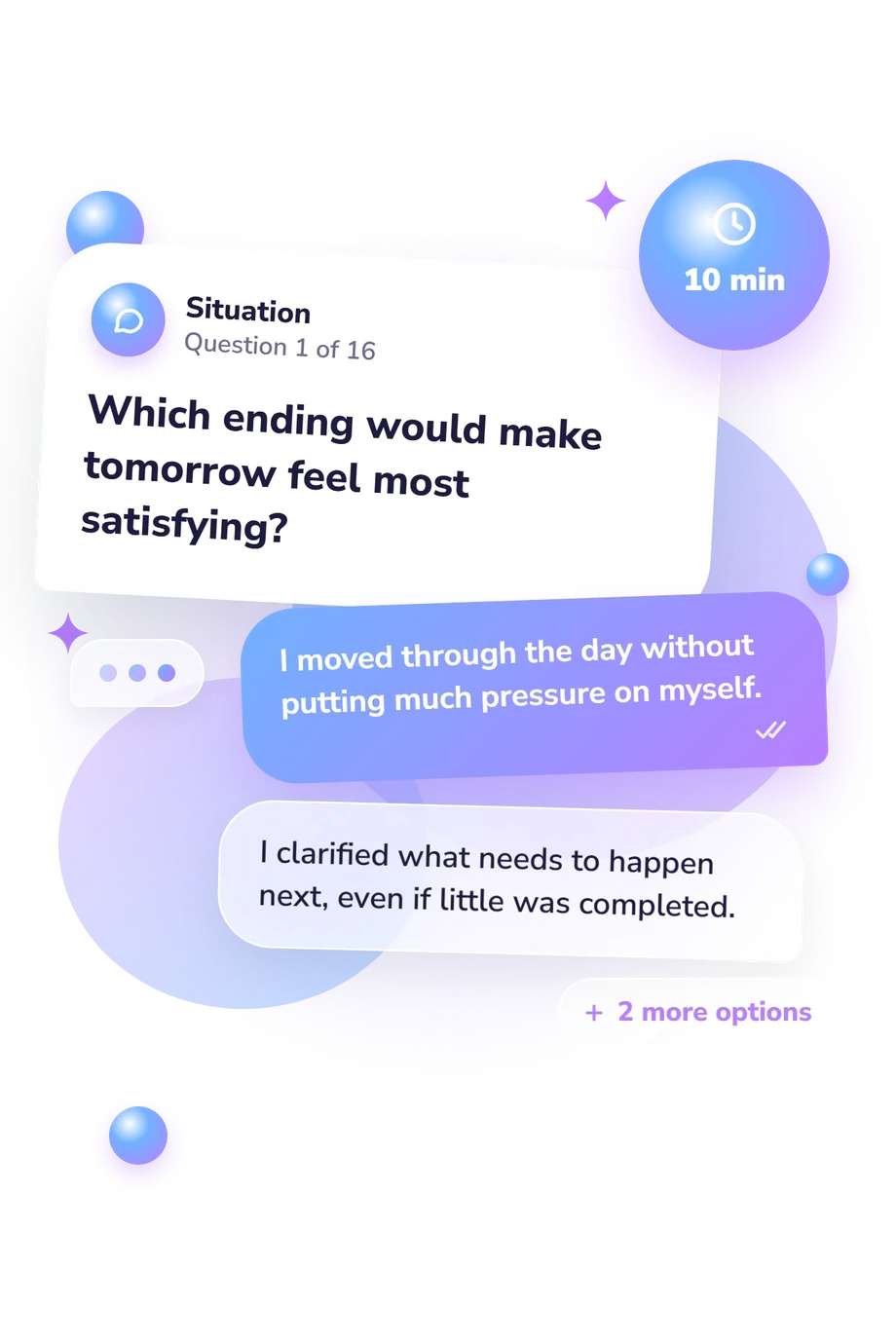
Example Questions From the Test
- Keep working or moving so I do not lose momentum.
- Take a quick break, then prepare for the next thing.
- Have an unhurried meal, walk, or other restorative pause.
- Fully step away from demands and use the whole hour to recharge.
- Leave it open so I can decompress or follow my mood.
- Organize my thoughts or prepare for something later.
- Make a useful start on a task, even if I cannot finish it.
- Use it to complete a specific item I have been meaning to handle.
- Spend it alone and enjoy the chance to recharge.
- Go somewhere with people around without arranging company.
- Message someone and see whether they are available to chat.
- Invite someone to meet or share the break with me.
What Will Happen to Me Tomorrow Quiz - Description and methodology of the test
People who want to think ahead without treating tomorrow as predetermined can use this questionnaire to examine how they might approach practical choices. The What Will Happen to Me Tomorrow Quiz turns imagined situations into a situational profile that can support flexible planning and self-reflection. For anyone wondering what will happen tomorrow, this quiz can clarify which priorities may shape their plans.
What This Assessment Explores
Questions present situations such as an open hour, a changed plan, a message from a friend, or an unfinished task. Your chosen response indicates the rhythm you may prefer, not an event that must occur. As a tomorrow self-reflection quiz, it suits anyone exploring how they may balance attention, energy, activity, and social time.
The four displayed themes describe these tendencies:
- Fresh Discovery (0-12) measures openness to novelty: Background Theme (0-4), Possible Theme (5-8), or Leading Theme (9-12).
- Productive Momentum (0-12) measures pull toward focused progress: Background Theme (0-4), Possible Theme (5-8), or Leading Theme (9-12).
- Restorative Reset (0-12) measures preference for recovery: Background Theme (0-4), Possible Theme (5-8), or Leading Theme (9-12).
- Social Connection (0-12) measures openness to interaction: Background Theme (0-4), Possible Theme (5-8), or Leading Theme (9-12).
Methodology and Evidence Base
Each prompt offers four responses about time, change, energy, or social contact. The format is situational: you select the option closest to your likely preference. The profile therefore reflects an anticipated rhythm, not observed behavior.
Separate scores summarize the response pattern, but the questionnaire does not specify how many points each answer contributes. It has no stated normative standardization or clinical cutoffs. As a tomorrow planning quiz, it is best read as a structured snapshot of current priorities, not a calibrated forecast.
Conceptually, the design has a broad parallel with the Day Reconstruction Method, which organizes reflection around concrete daily situations. Some choices also resemble themes discussed in the Recovery Experience Questionnaire, work on time management by Macan and colleagues, and Berlyne's account of exploratory preference. These are broad conceptual parallels, not evidence that the displayed scales measure the same constructs; this questionnaire is neither an adaptation nor a validation of those instruments.
Because it relies on imagined scenarios and self-report, results may shift with workload, energy, expectations, and self-awareness. They describe a present orientation rather than a fixed trait.
- Kahneman, Daniel, Alan B. Krueger, David A. Schkade, Norbert Schwarz, and Arthur A. Stone. “A Survey Method for Characterizing Daily Life Experience: The Day Reconstruction Method.” Science 306, no. 5702 (2004): 1776-1780. 10.1126/science.1103572
- Sonnentag, Sabine, and Charlotte Fritz. “The Recovery Experience Questionnaire: Development and Validation of a Measure for Assessing Recuperation and Unwinding from Work.” Journal of Occupational Health Psychology 12, no. 3 (2007): 204-221. 10.1037/1076-8998.12.3.204
- Macan, Therese Hoff, Comila Shahani, Robert L. Dipboye, and Amanda P. Phillips. “College Students’ Time Management: Correlations With Academic Performance and Stress.” Journal of Educational Psychology 82, no. 4 (1990): 760-768. 10.1037/0022-0663.82.4.760
- Berlyne, D. E. “Novelty and Curiosity as Determinants of Exploratory Behaviour.” British Journal of Psychology. General Section 41, no. 1-2 (1950): 68-80. 10.1111/j.2044-8295.1950.tb00262.x
Updated: