
What Spice Am I Quiz
How the Scales are Structured
Who Usually Takes This Test?
See How You Compare
Below is a preview of how scores are typically distributed across each scale.
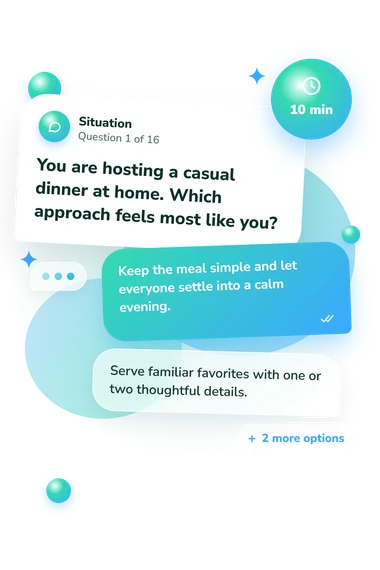
Example Questions From the Test
- Clean, restrained, and easy to take in.
- Practical and polished, with a few distinctive details.
- Layered with warm colors, texture, and atmosphere.
- Dramatic and vivid enough to make an immediate impression.
- Find one familiar person and focus on a quieter conversation.
- Observe the room first, then gradually begin mingling.
- Greet a small cluster and bring visible warmth to the exchange.
- Arrive with animated energy that noticeably lifts the room.
- Let the pause continue until someone develops a preference.
- Mention one possibility without pushing for a decision.
- Narrow the choices and ask the group to pick.
- Propose an immediate move and energize everyone around it.
What Spice Am I Quiz - Description and methodology of the test
For readers who want a playful lens on everyday choices, the What Spice Am I Quiz turns preferences into a compact self-portrait. This spice personality test suits people curious about how social energy, comfort habits, appetite for discovery, and expressive style combine. The result gives language for noticing recurring tendencies while leaving room for mixed traits and changing contexts.
What This Assessment Explores
Rather than assigning one fixed label, the profile shows which style is strongest and whether another is close behind. In practice, it is a quiz about what spice you are, reading everyday choices as four complementary patterns.
These are the result dimensions:
- Black Pepper (0-12) reflects brisk energy, candid expression, playful sharpness, and momentum: Gentle Seasoning (0-4), Noticeable Kick (5-8), Peppery Presence (9-12).
- Cinnamon (0-12) reflects intimate warmth, imagination, personal rituals, and meaningful comfort: Light Comfort (0-4), Cozy Spark (5-8), Cinnamon Heart (9-12).
- Cumin (0-12) reflects grounded curiosity, complexity, cultural exploration, and deeper stories: Familiar Ground (0-4), Curious Depth (5-8), Earthy Explorer (9-12).
- Smoked Paprika (0-12) represents expressive warmth, social color, atmosphere, and memorable flair: Quiet Glow (0-4), Warm Color (5-8), Smoky Radiance (9-12).
The highest total indicates your strongest affinity, while totals within one point create a blended result.
Methodology and Scientific Basis
Each item presents an everyday situation with four response choices. The options ask how you would act in contexts involving support, food, creativity, social entry, humor, exploration, and disagreement rather than asking you to rate a trait directly.
Answers form four totals. The strongest identifies the leading affinity, while a total within one point of it creates a blended result, allowing overlap rather than forcing one pure type.
This spice personality quiz offers a loose thematic and format comparison with the Big Five Inventory-2 (Soto and John, 2017), McCrae and Costa’s trait model, and situational judgment research reviewed by Lievens, Peeters, and Schollaert. These works offer comparison, not evidence for this questionnaire’s custom categories or scoring. They do not establish adaptation or validation for it. The questionnaire is an online profile with its own categories.
Read the result as self-reflection. The displayed bands are descriptive categories for the four spice affinities, rather than population-based norms or clinical cutoffs; self-report can shift with mood, self-awareness, and the wish to present oneself favorably, a response-bias issue examined by Gnambs and Kaspar.
- Soto, Christopher J., and Oliver P. John. 2017. The next Big Five Inventory (BFI-2): Developing and assessing a hierarchical model with 15 facets to enhance bandwidth, fidelity, and predictive power. Journal of Personality and Social Psychology, 113(1), 117-143. 10.1037/pspp0000096
- Lievens, Filip, Helga Peeters, and Eveline Schollaert. 2008. Situational judgment tests: A review of recent research. Personnel Review, 37(4), 426-441. 10.1108/00483480810877598
- McCrae, Robert R., and Paul T. Costa Jr. 1997. Personality trait structure as a human universal. American Psychologist, 52(5), 509-516. 10.1037/0003-066X.52.5.509
- Gnambs, Timo, and Kai Kaspar. 2017. Socially Desirable Responding in Web-Based Questionnaires: A Meta-Analytic Review of the Candor Hypothesis. Assessment, 24(6), 746-762. 10.1177/1073191115624547