
What Should My Name Be Quiz
How the Scales are Structured
Who Usually Takes This Test?
See How You Compare
Below is a preview of how scores are typically distributed across each scale.
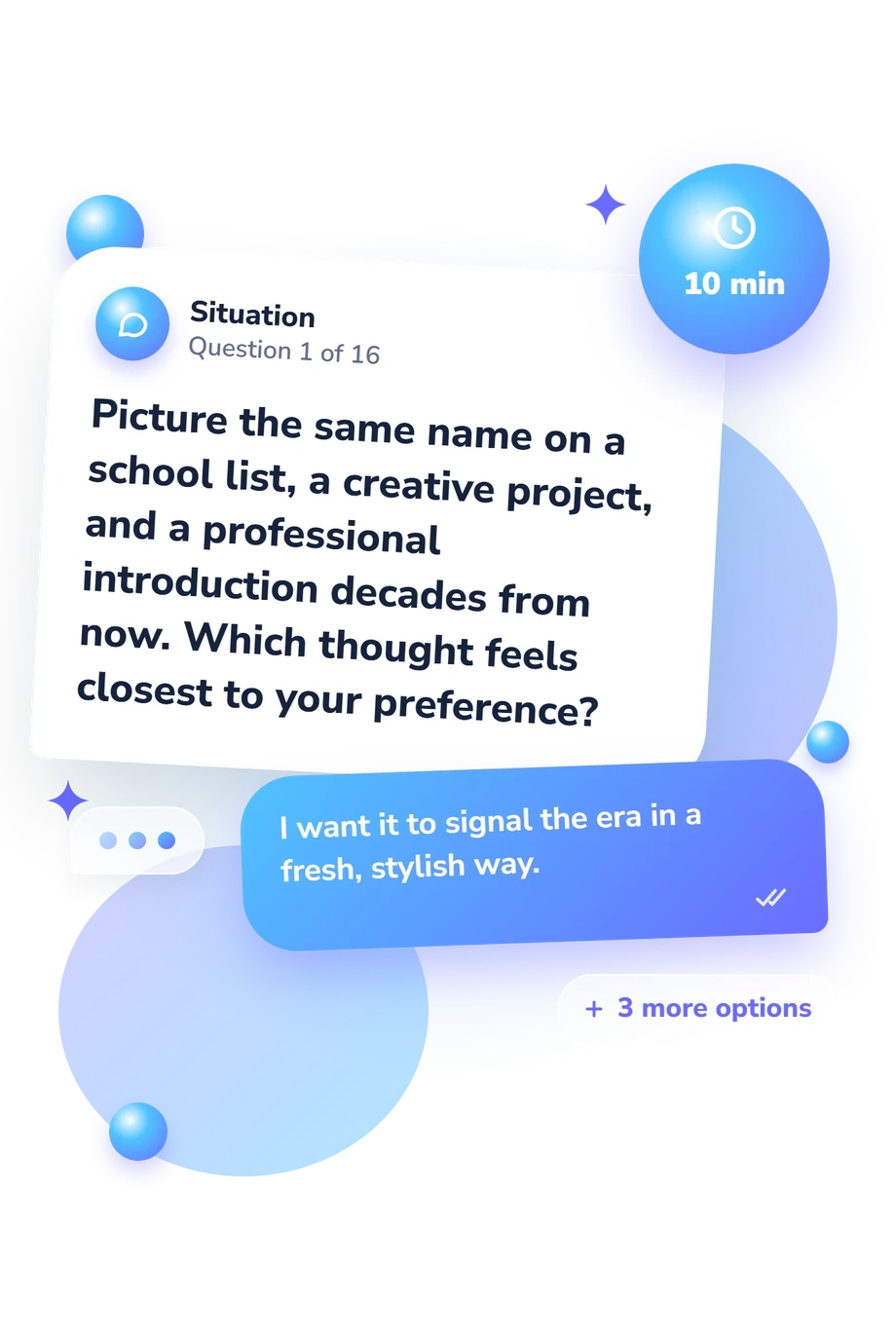
Example Questions From the Test
- Ornate or unexpected, even if people sometimes ask about it.
- Short, intuitive, and visually uncluttered.
- Conventional and preserved in its long-established form.
- Mostly simple, with one feature that makes it feel fresh.
- The familiar classic that has been used steadily for generations.
- The rare name that turns an introduction into a conversation.
- The clean, contemporary name that feels effortless to say.
- The updated variation that balances newness with familiarity.
- “That has a vivid, earthy feeling.”
- “That sounds polished and current.”
- “That is distinctive, though I have rarely heard it.”
- “That name fits naturally in almost any setting.”
What Should My Name Be Quiz - Description and methodology of the test
For people considering a different first name, this assessment offers a structured way to notice the social impression, sound, symbolism, or everyday usability they want to carry into daily life. The What Should My Name Be Quiz is useful for anyone weighing familiarity against novelty, symbolism, or current appeal. It can also serve as a new name quiz when a first-name decision feels personal, public, and difficult to settle.
What This Assessment Explores
Rather than naming one correct choice, the questionnaire maps the qualities that make a name feel convincing: familiarity, freshness, imagery, and distinctiveness. If you are wondering what your name should be, this quiz places that choice in contexts including introductions, spelling, family history, pronunciation, and social setting.
The four result dimensions are:
- Distinctive Storyteller Names (0-12) measures rare sound and narrative character; Familiarity First (0-4), Selectively Distinctive (5-8), Story-Rich Fit (9-12).
- Modern Minimalist Names (0-12) measures concise, current clarity; Different Direction (0-4), Modern Blend (5-8), Current and Clean (9-12).
- Nature-Spirited Names (0-12) measures landscape and living-world imagery; Abstract Preference (0-4), Grounded Blend (5-8), Nature-Spirited Fit (9-12).
- Timeless Classic Names (0-12) measures attraction to established tradition; Contemporary Lean (0-4), Classic Blend (5-8), Enduring Fit (9-12).
The highest score marks the strongest affinity; scores within one point indicate a blended direction.
Methodology and Scientific Basis
Each item presents a naming situation with four contrasting responses. Choices express recognition, contemporary simplicity, natural imagery, or unusual stories; four comparative scores are presented: the highest shows the strongest affinity, and scores within one point form a blended result.
Its themes are conceptually consistent with Virkkula (2014), which helps frame first-name choice as social taste and stylistic preference. Lieberson and Bell (1992) examine changing naming tastes; Twenge, Abebe, and Campbell (2010) address the pull between fitting in and standing out; and Kulig (2013) discusses perceived uniqueness. These studies offer context; this is an online self-reflection questionnaire, and they do not establish norms, validation, or adaptation for its scores.
If you are asking what should I change my name to, this quiz offers a pattern to explore: compare the leading direction with names you like, then test pronunciation, spelling, and daily fit. The bands are descriptive rather than normative, with no population norms or diagnostic cutoffs; self-report may shift with mood, identity, or imagined setting. Compare candidate names by sound, spelling, imagery, pronunciation, and everyday fit before deciding which direction feels natural.
- Virkkula, Johanna. First name choices in Zagreb and Sofia. Slavica Helsingiensia 44. Helsinki: University of Helsinki, Department of Modern Languages, 2014. 356 pp. ISBN 978-951-51-0093-1.
- Lieberson, Stanley, and Eleanor O. Bell. “Children’s First Names: An Empirical Study of Social Taste.” American Journal of Sociology 98, no. 3 (1992): 511-554. 10.1086/230048.
- Twenge, Jean M., Emodish M. Abebe, and W. Keith Campbell. “Fitting In or Standing Out: Trends in American Parents’ Choices for Children’s Names, 1880-2007.” Social Psychological and Personality Science 1, no. 1 (2010): 19-25. 10.1177/1948550609349515.
- Kulig, John W. “What’s in a Name? Our False Uniqueness!” British Journal of Social Psychology 52, no. 1 (2013): 173-179. 10.1111/bjso.12001
Updated: