
What Should I Be for Halloween Quiz
How the Scales are Structured
Who Usually Takes This Test?
See How You Compare
Below is a preview of how scores are typically distributed across each scale.
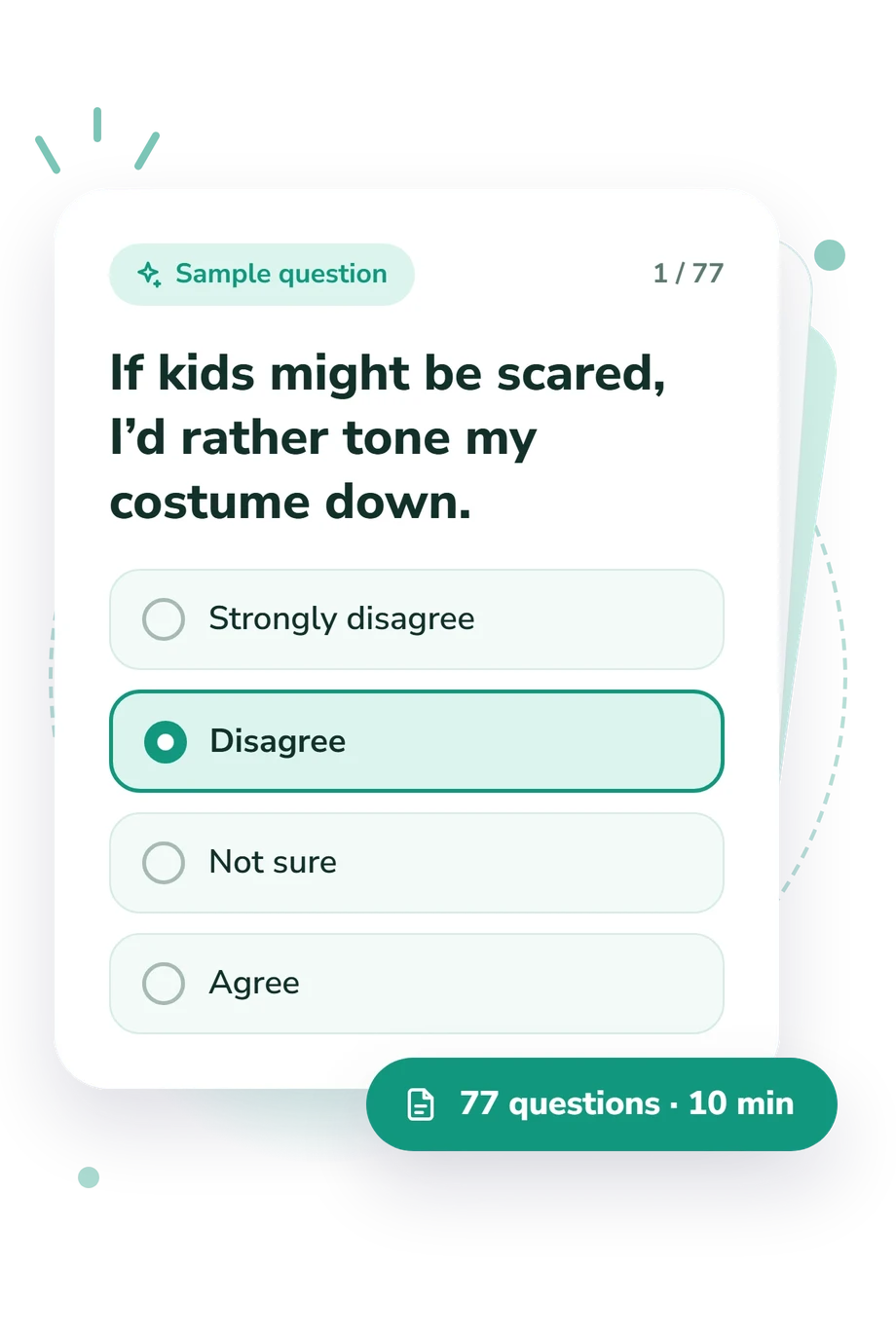
Example Questions From the Test
- Strongly disagree
- Disagree
- Not sure
- Agree
- Strongly disagree
- Disagree
- Not sure
- Agree
- Strongly disagree
- Disagree
- Not sure
- Agree
What Should I Be for Halloween Quiz - Description and methodology of the test
People who want Halloween costume ideas can use this assessment to turn a broad impulse into a more workable direction. The What Should I Be for Halloween Quiz is intended for anyone choosing a character, theme, or overall look and wanting to understand the preferences behind that choice. Its profile highlights the balance between originality, practicality, and the atmosphere you want to create.
What This Assessment Explores
This assessment works as a Halloween costume quiz by sorting preferences across creative involvement, practical tolerance, and emotional tone. Its statements address crafting, customization, wearability, preparation, humor, character presentation, and attraction to eerie or wholesome aesthetics. It suits anyone who wants a preference profile before choosing a look.
The three result dimensions are:
- DIY & Creativity (0-20) shows interest in building, customizing, improvising, and adding distinctive details; Low DIY 0-6, Some DIY 7-13, and High DIY 14-20.
- Effort & Comfort Preference (0-20) indicates tolerance for time, complexity, and minor discomfort; Low-effort & comfy 0-7, Balanced 8-14, and High-effort & elaborate 15-20.
- Spookiness Level (0-20) reflects preference for cute, lighthearted, eerie, or horror-oriented moods; Cute & Light 0-6, Playfully Spooky 7-13, and Full Spook Mode 14-20.
Together, the dimensions narrow possibilities without deciding the costume for you.
Methodology and Evidence Base
The questionnaire uses self-report statements about making, modifying, wearing, and performing in a costume. Respondents choose four ordered agreement choices; the direction varies between item formats, so the meaning of agreement depends on the wording. This format captures tendencies rather than a single right answer.
Responses form separate dimension scores, but the exact point contribution of each answer is not specified and should not be inferred from response labels or score spans. In practice, it functions as a costume style quiz, turning the profile into a starting point for choosing a character, construction method, and comfort level.
Smith-Glaviana and Shields (2026) offer the closest conceptual context for contemporary Halloween dress practices. Belk (1990) treats Halloween as an evolving consumption ritual, while Nezlek, Mochort, and Cypryańska (2019) connect clothing choices with self-presentational motives. These studies provide conceptual context but do not establish psychometric validation of this online questionnaire.
The questionnaire has no stated normative comparison, reliability estimate, or clinical cutoff. Mood, self-awareness, budget, and social setting can influence answers, so the result is best read as a flexible preference guide.
- Smith-Glaviana, Dina Cherise, and Delaney Shields. (2026). Fashion countdown to Halloween: a study of dress practices within American Halloween consumer culture. Research Journal of Textile and Apparel, 30(1), 17-35. 10.1108/RJTA-08-2024-0147
- Belk, Russell W. (1990). Halloween: An Evolving American Consumption Ritual. Advances in Consumer Research, 17, 508-517. Association for Consumer Research.
- Nezlek, John B., Emilia Mochort, and Marzena Cypryańska. (2019). Self-presentational motives and public self-consciousness: Why do people dress a certain way? Journal of Personality, 87(3), 648-660. 10.1111/jopy.12423
Updated: