
What Reptile Should I Get Quiz
How the Scales are Structured
Who Usually Takes This Test?
See How You Compare
Below is a preview of how scores are typically distributed across each scale.
Example Questions From the Test
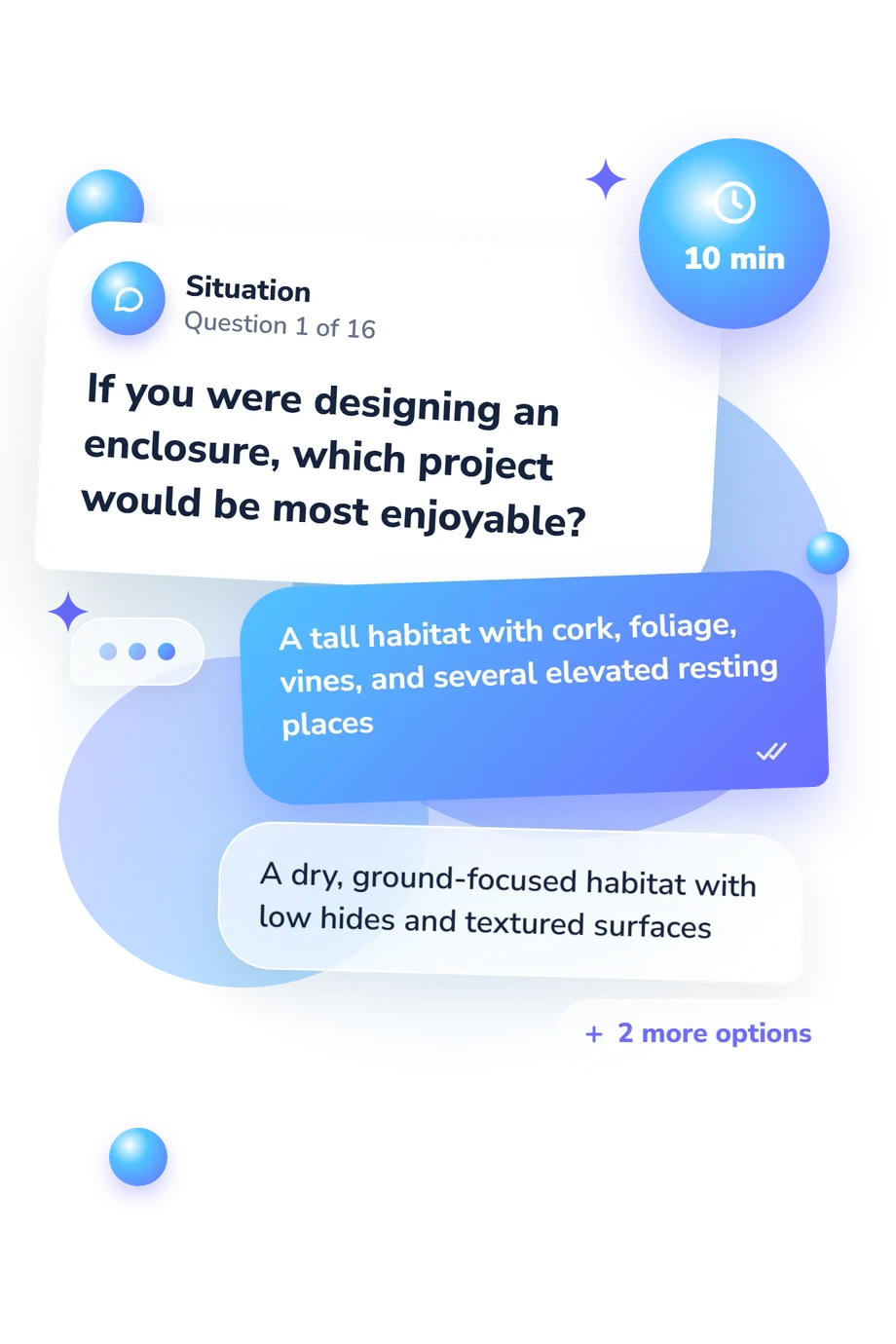
- A tall habitat with cork, foliage, vines, and several elevated resting places
- A dry, ground-focused habitat with low hides and textured surfaces
- A broad basking habitat with substantial open floor space
- A long, highly secure enclosure with routes for roaming and hiding
- Confirming that doors, vents, and cable openings are fully secured against escape
- Checking that misting has produced the intended humidity without stagnant air
- Reviewing the basking zone and preparing fresh greens
- Making sure ground-level hides and an evening warm area are ready
- A slender reptile steadily moving through my hands and exploring
- A small lizard sitting calmly for a brief period
- An arboreal gecko climbing and occasionally hopping
- A heavier-bodied daytime lizard resting against me
What Reptile Should I Get Quiz - Description and methodology of the test
People choosing a first reptile, or reconsidering a current plan, can use the What Reptile Should I Get Quiz to compare care preferences with household realities. It is designed for readers who want more than an appearance-based choice: the result connects enclosure space, activity timing, feeding routines, and handling comfort with four distinct reptile profiles. This makes it a practical reptile compatibility quiz for early planning.
What This Assessment Explores
The questionnaire works as a reptile care quiz by matching household routines with four profiles. Items cover enclosure setup, climate, activity timing, food, movement, and handling. The result suggests which pattern may suit you best.
The displayed profiles are:
- Bearded Dragon Fit (0-12) measures fit with a daytime lizard needing space, heat, light, and plant-and-insect food: Different direction (0-4), Possible match (5-8), Strong match (9-12).
- Corn Snake Fit (0-12) measures comfort with a secure, exploratory snake and thawed-rodent feeding: Different direction (0-4), Possible match (5-8), Strong match (9-12).
- Crested Gecko Fit (0-12) measures attraction to an arboreal, evening-active gecko needing humidity and climbing space: Different direction (0-4), Possible match (5-8), Strong match (9-12).
- Leopard Gecko Fit (0-12) measures preference for a terrestrial, evening-active lizard, insect feeding, and calm handling: Different direction (0-4), Possible match (5-8), Strong match (9-12).
Methodology and Scientific Basis
Each item uses four forced choices covering an enclosure, routine, feeding method, activity period, movement style, or handling preference. Choosing one signals the profile it resembles most closely. The questionnaire combines these choices into four scores, but it does not state each answer’s point value. Results within one point form a blended outcome.
Chan et al. (2024) provides the closest ownership-and-welfare context for comparing everyday reptile-care expectations. Howell and Bennett (2017) highlight how intended lizard care can differ from recommended practice, while Cargill, Benato, and Rooney (2022) examine housing and husbandry in relation to pet snake welfare. These studies support the practical themes; they do not validate this questionnaire or make it an adaptation of their instruments.
Use the outcome as a planning aid when considering the best reptile to get. Compare the suggested profile with available space, budget, schedule, feeding comfort, local rules, lifespan, ethical sourcing, hygiene, and access to reptile-experienced veterinary care. It is not presented with population norms, reliability statistics, or clinical cutoffs, and honest self-report, current circumstances, and limited species knowledge can shift the result.
- Chan, Sze-Wing; Fang, Wei-Ta; LePage, Ben; Wang, Shun-Mei. "Assessing the Current Landscape of Reptile Pet Ownership in Hong Kong: A Foundation for Improved Animal Welfare and Future Research Directions." Animals 14(12), 1767 (2024). 10.3390/ani14121767
- Howell, Tiffani J.; Bennett, Pauleen C. "Despite their best efforts, pet lizard owners in Victoria, Australia, are not fully compliant with lizard care guidelines and may not meet all lizard welfare needs." Journal of Veterinary Behavior 21, 26-37 (2017). 10.1016/j.jveb.2017.07.005
- Cargill, Ben; Benato, Livia; Rooney, Nicola J. "A survey exploring the impact of housing and husbandry on pet snake welfare." Animal Welfare 31(2), 193-208 (2022). 10.7120/09627286.31.2.004
Updated: