
What K-Drama Should I Watch Quiz
How the Scales are Structured
Who Usually Takes This Test?
See How You Compare
Below is a preview of how scores are typically distributed across each scale.
Example Questions From the Test
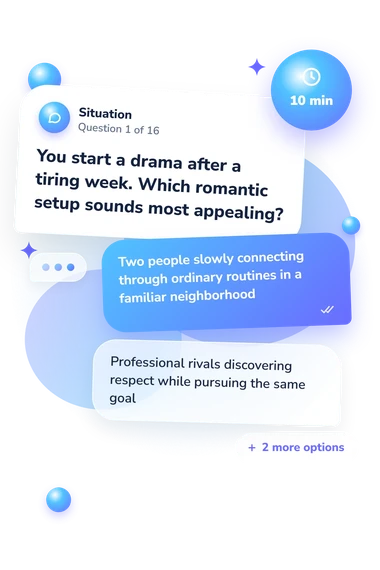
- Two people slowly connecting through ordinary routines in a familiar neighborhood
- Professional rivals discovering respect while pursuing the same goal
- Strangers relying on each other while far from their normal lives
- People from divided worlds falling in love despite danger and separation
- Simple comfort that confirms everything worked out as expected
- Curiosity about an unresolved event from the past
- Warmth mixed with grief for people and moments that could not remain unchanged
- Hopeful nostalgia emphasizing how early dreams shaped adult choices
- Mostly comforting comedy with conflicts that resolve gently
- Serious suspense relieved by occasional light character moments
- Sharp comedy woven through schemes, threats, and sudden action
- A tense crime story with a few eccentric side characters
What K-Drama Should I Watch Quiz - Description and methodology of the test
Viewers who feel torn between sweeping romance, courtroom warmth, youthful nostalgia, and stylish revenge can use the What Kdrama Should I Watch Quiz to turn a vague mood into a focused recommendation. It is designed for anyone choosing a Korean series and wanting a preference profile rather than a popularity ranking. The result helps answer which K-drama to watch by matching story ingredients to personal taste.
What This Test Measures
The items sample romance, danger, legal problem-solving, ambition, rivalry, workplace bonds, revenge, comedy, nostalgia, and ensemble support. Someone deciding which Korean drama to watch can see which profile fits.
These are the four result dimensions and their displayed bands:
- Crash Landing on You (0-12) reflects epic romance, separation, suspense, humor, and found-family warmth: Different Flight Path (0-4), Ready for the Landing (5-8), Strong Landing (9-12).
- Extraordinary Attorney Woo (0-12) reflects legal cases, observation, ethics, gentle romance, and supportive ties: Seeking Another Brief (0-4), Curious About the Cases (5-8), Strong Case Match (9-12).
- Twenty-Five Twenty-One (0-12) reflects youthful ambition, fencing, friendship, nostalgia, and bittersweet change: Present-Day Mood (0-4), Chasing the Moment (5-8), Full Youthful Spark (9-12).
- Vincenzo (0-12) reflects stylish antiheroes, dark comedy, schemes, retaliation, and moral ambiguity: Lighter Justice (0-4), Calculated Payback (5-8), Consigliere Energy (9-12).
Methodology and Evidence Base
Each prompt presents a viewing situation with four contrasting reactions or preferences. The choices sort taste by themes and emotional functions rather than one genre label. A person asking which Kdrama should I watch can read the result as a comparative profile: higher affinity indicates closer thematic fit.
Four separate affinity profiles receive displayed ranges and interpretive bands. These are recommendation categories, not population norms or diagnostic thresholds; they help compare the featured titles and notice why a premise appeals.
The framework is conceptually consistent with uses-and-gratifications theory from Blumler and Katz. Jiang and Leung (2012) connect television choices with lifestyles, gratifications, and narrative appeal. Ju (2020) adds attention to romance, identity, and transcultural engagement in Korean drama viewing, while Zillmann (1988) explains selecting media that regulates or complements mood. These sources support the interpretive lens, not validation of this exact online instrument.
Because answers are self-reported and context-sensitive, the profile is a flexible recommendation aid rather than a standardized psychological assessment.
- Jiang, Qiaolei, and Louis Leung. 2012. "Lifestyles, gratifications sought, and narrative appeal: American and Korean TV drama viewing among Internet users in urban China." International Communication Gazette 74(2): 159-180. 10.1177/1748048511432601.
- Ju, Hyejung. 2020. "Korean TV drama viewership on Netflix: Transcultural affection, romance, and identities." Journal of International and Intercultural Communication 13(1): 32-48. 10.1080/17513057.2019.1606269.
- Zillmann, Dolf. 1988. "Mood Management Through Communication Choices." American Behavioral Scientist 31(3): 327-340. 10.1177/000276488031003005.
- Blumler, Jay G., and Elihu Katz, eds. 1974. The Uses of Mass Communications: Current Perspectives on Gratifications Research. Beverly Hills, CA: Sage Publications.
Updated: