
What Is My Symbol Quiz
How the Scales are Structured
Who Usually Takes This Test?
See How You Compare
Below is a preview of how scores are typically distributed across each scale.
Example Questions From the Test
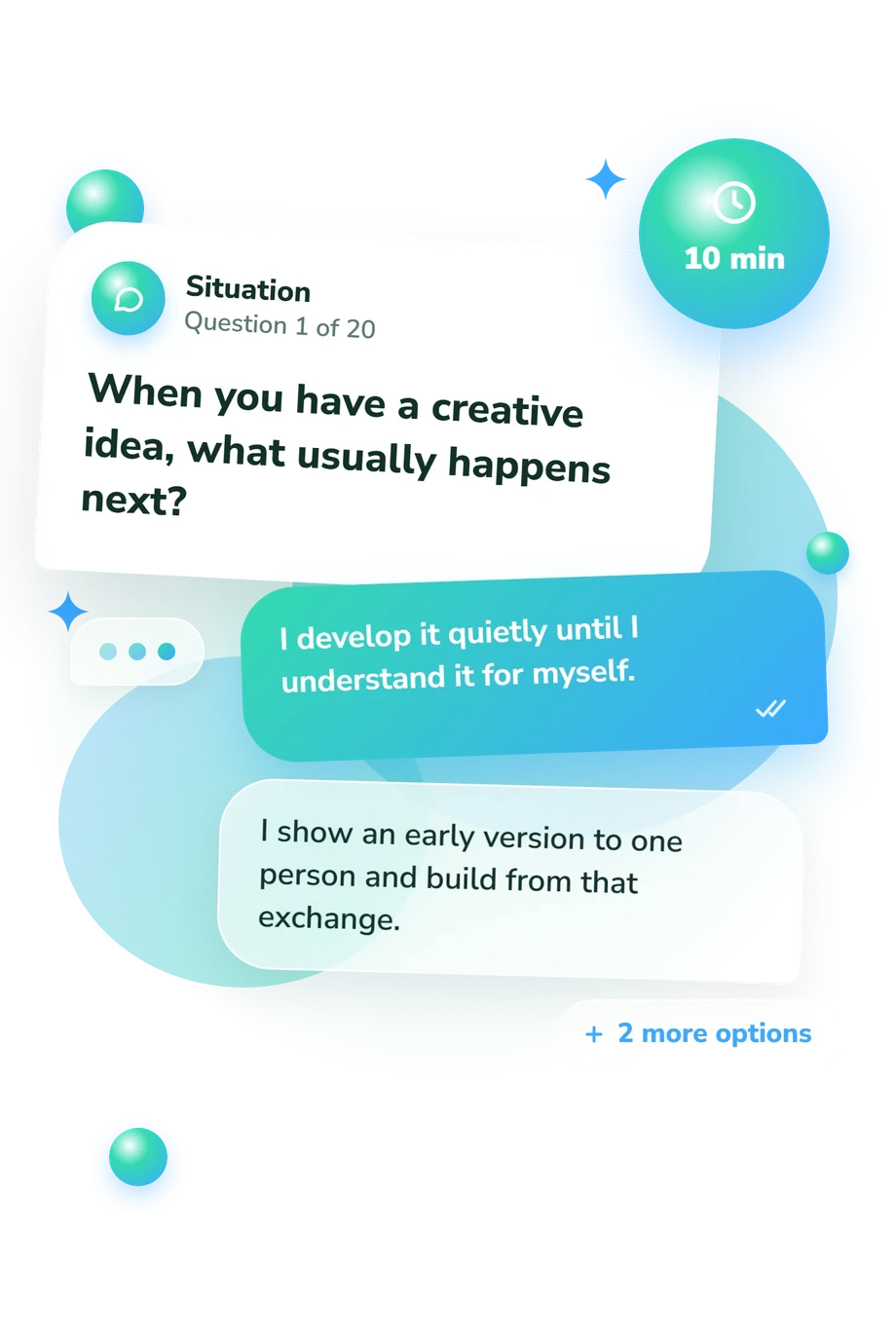
- I develop it quietly until I understand it for myself.
- I show an early version to one person and build from that exchange.
- I begin making it visible while my enthusiasm is fresh.
- I develop the main structure before sharing it with a wider group.
- A calm review of what happened before anyone rushes ahead.
- A hopeful message and an energetic idea for restarting together.
- A supportive conversation with the people most affected.
- A practical next step that gives the group something positive to pursue.
- I follow whichever one feels most interesting in the moment.
- I compare the immediate benefits and choose the stronger offer.
- I consider both future aims and current circumstances before deciding.
- I identify which path aligns most closely with the principles and direction I want my life to follow.
What Is My Symbol Quiz - Description and methodology of the test
People drawn to symbolic self-reflection can use the What Is My Symbol Quiz to notice how they respond to direction, uncertainty, expression, continuity, and change. The profile answers what's your symbol in this quiz through several affinities rather than forcing one identity. It suits readers who want a focused prompt for reflection, not a fixed personality label.
What This Assessment Explores
Five affinities link direction, inner experience, expression, continuity, and change. As a quiz about symbols that represent me, it covers relationships and uncertainty.
These dimensions are:
- Compass (0-12) reflects purpose, values, and meaningful direction: Curious Path (0-4), Finding North (5-8), Guiding Compass (9-12).
- Moon (0-12) reflects inward awareness, intuition, and subtlety: Clear Horizon (0-4), Twilight Awareness (5-8), Reflective Moon (9-12).
- Sun (0-12) reflects visible expression, warmth, and optimism: Quiet Glow (0-4), Emerging Radiance (5-8), Radiant Sun (9-12).
- Tree (0-12) reflects rootedness, development, continuity, and connections: Open Ground (0-4), Growing Roots (5-8), Rooted Tree (9-12).
- Wave (0-12) reflects adaptability, movement, and response to change: Steady Shore (0-4), Changing Tide (5-8), Flowing Wave (9-12).
The highest affinity and any near-equal blend appear.
Methodology and Scientific Basis
Each item presents a situation with four response options, so the respondent selects the statement that best matches a tendency. Scenarios touch creative work, social interaction, values, routine, emotional shifts, belonging, and changing conditions; together they compare how preferences appear across contexts.
Scoring yields five independent results. The highest score marks the strongest affinity, while any score within one point contributes to a blended result. The named bands are the questionnaire’s profile bands. People asking what is my life symbol can use this quiz as a starting point for reflection, with the leading affinity serving as a guide rather than a permanent identity.
Conceptually, this questionnaire is compatible with the Rich Culture Archetype Scale (Faber & Mayer, 2009), Jung’s archetypal framework, and Rosen, Smith, Huston, and Gonzalez (1991) on symbol-meaning links. It is not derived from or validated by those sources; its five-category scoring structure is its own.
Because answers are self-reported, current mood, self-awareness, and the wish to appear consistent can shape the profile. Responses also reflect the situations and meanings a person brings to each choice, so the result is best read as structured reflection rather than a diagnosis.
- Faber, Michael A., and John D. Mayer. 2009. "Resonance to archetypes in media: There's some accounting for taste." Journal of Research in Personality 43(3): 307-322. 10.1016/j.jrp.2008.11.003
- Jung, C. G. 1968. The Archetypes and the Collective Unconscious. 2nd ed. Translated by R. F. C. Hull. Princeton University Press. Collected Works of C. G. Jung, Vol. 9, Part 1.
- Rosen, D. H., S. M. Smith, H. L. Huston, and G. Gonzalez. 1991. "Empirical Study of Associations Between Symbols and Their Meanings: Evidence of Collective Unconscious (Archetypal) Memory." Journal of Analytical Psychology 36(2): 211-228. 10.1111/j.1465-5922.1991.00211.x
Updated: