
What Horror Movie Should I Watch Quiz
How the Scales are Structured
Who Usually Takes This Test?
See How You Compare
Below is a preview of how scores are typically distributed across each scale.
Example Questions From the Test
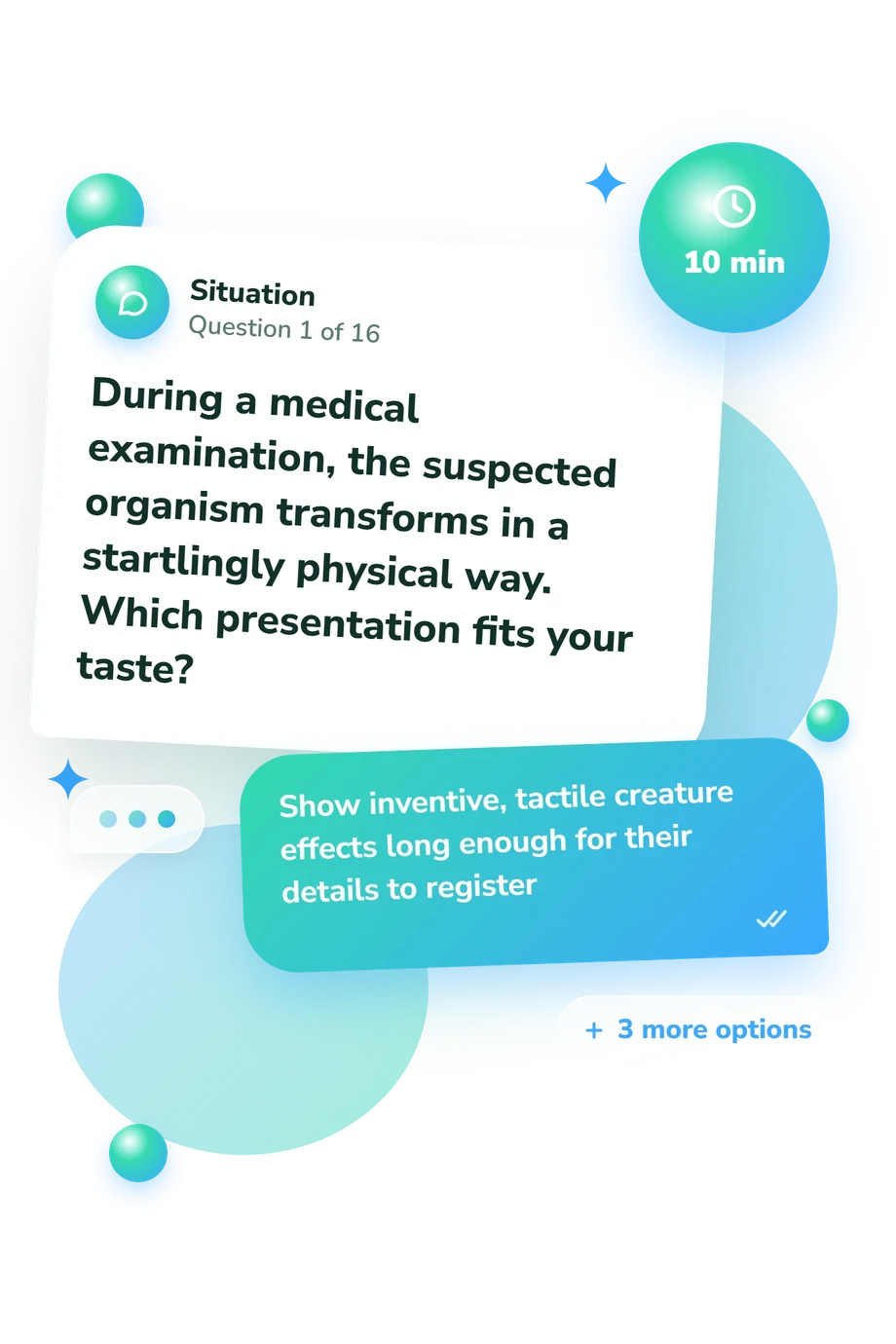
- Show inventive, tactile creature effects long enough for their details to register
- Reveal enough to establish the danger, then cut away from the worst of it
- Keep the transformation almost entirely off-screen and emphasize reactions
- Replace body horror with a cleaner, action-focused attack
- A lived-in family home where small disturbances gradually become frightening
- A striking old building used mainly as the backdrop for a fast-moving mystery
- An unusual property whose history matters more than its ghosts
- I would rather leave haunted houses behind and visit a city, suburb, or remote outpost
- One that exposes how ordinary politeness has concealed exploitation and control
- One that identifies a supernatural entity with clear rules
- One that reveals the killer through a trail of physical clues
- One that recontextualizes earlier conversations as well as the immediate threat
What Horror Movie Should I Watch Quiz - Description and methodology of the test
Choosing among very different kinds of fear is easier when the mood matters as much as the title. For viewers deciding between social unease, slasher mystery, haunted-house tension, and isolated creature horror, What Horror Movie Should I Watch Quiz helps them identify the closest film profile. It works as a What Scary Movie Should I Watch Quiz, turning a vague impulse into a practical choice.
What This Assessment Explores
Rather than rating bravery, the questionnaire maps four cinematic preferences: social subtext, slasher energy, paranormal suspense, and creature-driven paranoia. It suits viewers choosing by atmosphere, threat style, pacing, or the kind of discussion they want afterward. The result is a film profile that helps people choose a horror movie by mood.
The four result dimensions are:
- Get Out (0-12) reflects affinity for social unease and conspiracy: Different conversation (0-4), Intriguing possibility (5-8), or Strong match (9-12).
- Scream (0-12) reflects affinity for masked-killer suspense, mystery, and humor: Different thrill (0-4), Potential suspect (5-8), or Strong match (9-12).
- The Conjuring (0-12) reflects affinity for haunted-house atmosphere and family-centered paranormal suspense: Different mood (0-4), Possible haunting (5-8), or Strong match (9-12).
- The Thing (0-12) reflects affinity for isolation, mistrust, and creature horror: Warmer destination (0-4), Cautious expedition (5-8), or Strong match (9-12).
Methodology and Scientific Basis
Each prompt presents a horror situation, such as a transformation, haunted home, isolated station, masked caller, or supernatural threat. Four responses let you choose the tone, pacing, threat, and reveal you prefer.
The method does not specify answer weights. It presents four comparative affinity scores rather than one score: the highest is the strongest match, while scores within one point create a blended outcome. Results use descriptive bands, not population norms or clinical cutoffs.
Methodologically, the questionnaire is conceptually consistent with the Horror Themes Questionnaire (Gacek & Szczygieł, 2026), which distinguishes horror preferences by themes and threat presentation. It is not an adaptation; its film outcomes are a separate format. Clasen, Kjeldgaard-Christiansen, and Johnson’s threat-simulation account, plus Martin’s review, add context for suspense, uncertainty, isolation, controllability, and reactions to scary media.
For anyone using this as a horror movie taste quiz, the result is a snapshot of taste. Self-reported choices can shift with mood, familiarity, expectations, or appetite for intensity, so scores guide a viewing choice rather than define the viewer.
- Gacek, Michał, and Monika Szczygieł. “Fear, disgust, and pursuit of different types of horror: Introducing the Horror Themes Questionnaire.” Polish Psychological Bulletin, vol. 57, 2026, pp. 142-146. 10.24425/ppb.2026.153999.
- Clasen, Mathias, Jens Kjeldgaard-Christiansen, and John A. Johnson. “Horror, Personality, and Threat Simulation: A Survey on the Psychology of Scary Media.” Evolutionary Behavioral Sciences, vol. 14, no. 3, 2020, pp. 213-230. 10.1037/ebs0000152.
- Martin, G. Neil. “(Why) Do You Like Scary Movies? A Review of the Empirical Research on Psychological Responses to Horror Films.” Frontiers in Psychology, vol. 10, 2019, article 2298. 10.3389/fpsyg.2019.02298.
Updated: