
Urinal Quiz
How the Scales are Structured
Who Usually Takes This Test?
See How You Compare
Below is a preview of how scores are typically distributed across each scale.
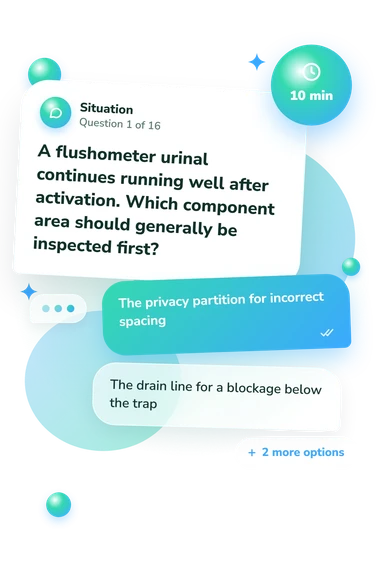
Example Questions From the Test
- To create a barrier against gases from the drainage system
- To fasten the fixture to its carrier
- To filter minerals from the incoming water
- To increase the pressure of each flush
- To support the fixture and carry its waste piping
- To provide visual privacy and separation between users
- To regulate water pressure at the flush valve
- To vent the drainage system into the restroom
- To release a controlled flush when activated
- To maintain the water seal inside the drain trap
- To grind solids before they enter the waste line
- To mix cleaning solution into every flush
Urinal Quiz - Description and methodology of the test
People planning, inspecting, maintaining, or learning about restroom fixtures can use the urinal quiz to check practical understanding rather than personal attitudes. It examines decisions involved in urinal testing, focusing on the systems and situations described in the questions. The result provides an educational knowledge profile for self-directed study, workplace preparation, or discussion with a qualified professional.
What This Assessment Explores
The questions cover urinal selection, installation, operation, maintenance, and troubleshooting. They include wall-hung and trough fixtures, conventional and waterless systems, flushometers, traps, rough-ins, splash control, privacy, accessibility, and tamper resistance. For learners and facility staff, the questions provide a practical way to identify technical gaps in fixture knowledge.
The result uses one educational scale: Urinal Knowledge, 0-16. Bands are Foundations to build (0-6), Developing knowledge (7-12), and Strong knowledge (13-16). The catalogue defines it through fixture types, traps, flush systems, installation drawings, operation, and troubleshooting.
The result draws on these topic groups:
- Configuration shows how mounting, bowl shape, partitions, and waterless designs affect use.
- Flushing and drainage cover valves, sensors, trap seals, waste connections, and gas barriers.
- Installation and accessibility address rough-ins, carriers, clearances, approach, and controls.
- Maintenance and troubleshooting concern odors, incomplete rinsing, running valves, and cleaner damage.
Methodology and Evidence Base
This fixed-response knowledge assessment presents plumbing or restroom scenarios with four answer choices, usually asking the respondent to identify the technically appropriate option. The items combine recognition with short troubleshooting decisions. Because the exact point allocation is not stated, interpretation should follow the displayed result and bands rather than an assumed per-answer formula.
As a quiz about urinal plumbing, it is conceptually consistent with Bristow, McClure, and Fisher (2006), especially their treatment of waterless urinals, cartridges, sealing systems, maintenance, and sewer-gas control, but it is not an adaptation of those publications. Installation and accessibility themes correspond to the International Code Council’s 2024 plumbing provisions and ICC A117.1 (2017).
Read the result as a focused learning profile: a higher band suggests broader recognition of the configurations and problems represented by the items, while a lower band identifies subjects for review in drawings, manufacturer instructions, code provisions, or supervised practice. The displayed bands are descriptive rather than norm-referenced and do not establish licensing competence; performance is a snapshot that may vary with wording, prior experience, and attention.
- Gary Bristow, James D. McClure, and David Fisher. "Waterless Urinals: Features, Benefits, and Applications." Journal of Green Building 1, no. 1 (2006): 55-62. 10.3992/jgb.1.1.55
- International Code Council. 2024 International Plumbing Code. Country Club Hills, IL: International Code Council, 2023.
- International Code Council. ICC A117.1-2017 with Supplement 1: Standard for Accessible and Usable Buildings and Facilities. Country Club Hills, IL: International Code Council, 2017.