
Transition Words Quiz
How the Scales are Structured
Who Usually Takes This Test?
See How You Compare
Below is a preview of how scores are typically distributed across each scale.
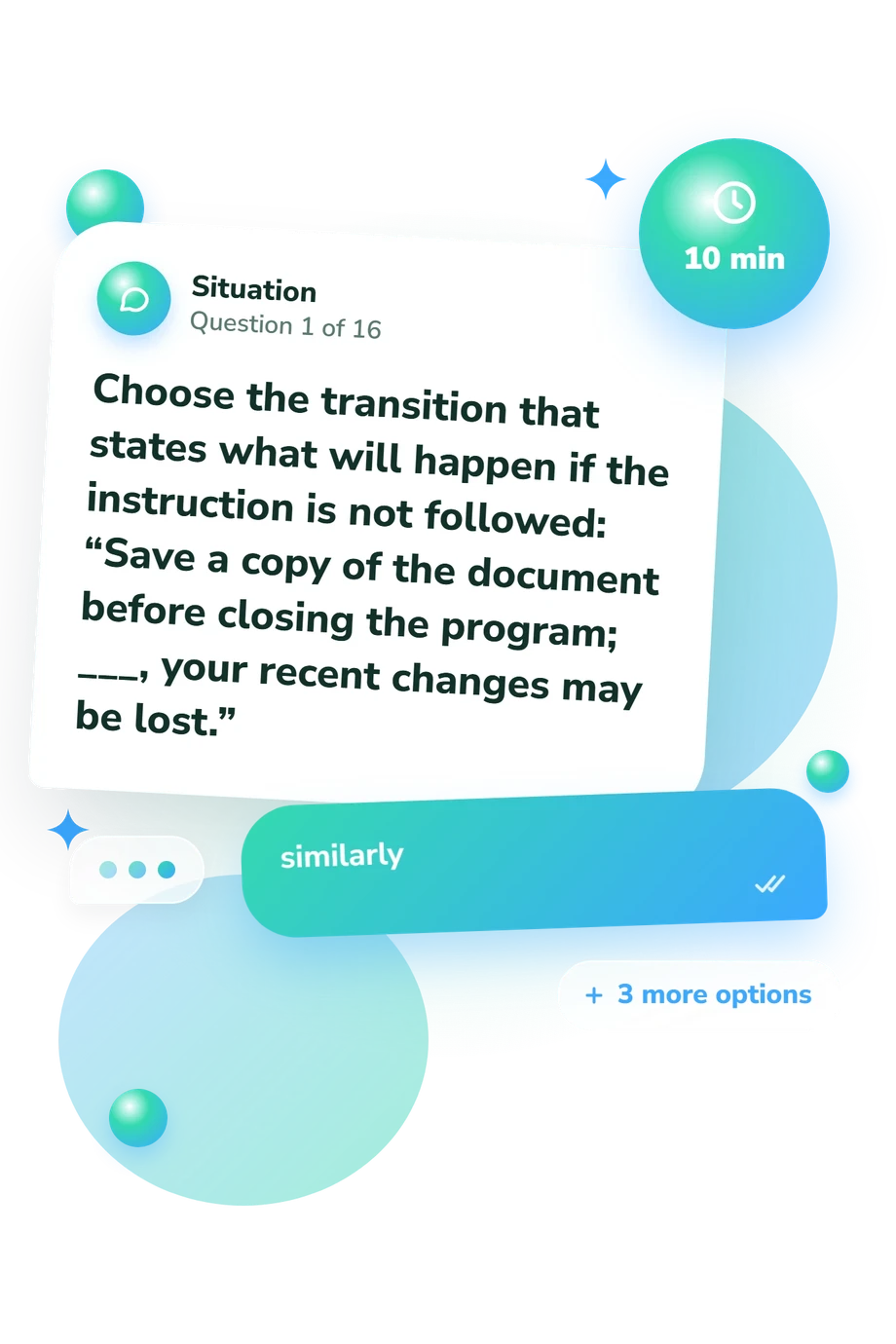
Example Questions From the Test
- Ultimately
- For example
- Meanwhile
- In contrast
- On the contrary
- In the meantime
- In summary
- Specifically
- Contrast between two alternatives
- Sequence of equally important steps
- Example supporting a general statement
- Reason for an action
Transition Words Quiz - Description and methodology of the test
Readers who want to sharpen their control of sentence relationships may find the transition words quiz useful when they need a focused check before revising writing. For learners, writers, and editors, the transitions quiz offers a practical way to judge overall proficiency and decide whether targeted grammar review would be worthwhile. Its result places performance in an overall proficiency band and offers a general guide for next steps.
What This Assessment Explores
At its core, the assessment examines whether you can infer the relationship between nearby ideas and choose an expression that makes that relationship clear. The items move beyond memorizing definitions: they ask you to read a sentence or short paragraph, notice its logic, and select the option that fits the intended meaning. The test therefore suits anyone refining academic, workplace, or everyday written communication.
The items in this transition words test focus on these connected abilities:
- Contrast and concession show how a writer sets one idea against another or acknowledges a concern before responding.
- Cause and effect indicate why an event occurs or what follows from it.
- Sequence and time place actions in order or show that events overlap.
- Addition and comparison connect related information or parallel developments.
- Example, restatement, summary, and emphasis clarify, reinforce, or condense a point.
Methodology and Evidence Base
Each item uses four answer choices. Some ask you to complete a sentence or paragraph; others test recognition of a relationship or punctuation with however. The surrounding context matters, so the task measures selecting transitions in context and recognizing their functions. The value of English transition practice lies in explaining why one option fits better than the others.
Scoring is direct: each correct answer adds one point, producing Transition Words Knowledge from 0-16. Results appear as Foundations to Build (0-6), Developing Command (7-12), or Strong Command (13-16).
The framework is consistent with Cohesion in English (Halliday and Hasan, 1976), which explains how cohesive resources link discourse. Fraser’s 1999 work clarifies how discourse markers guide interpretation, while Huddleston and Pullum provide grammatical grounding for conjunctive adverbs, coordination, and clause punctuation. The questionnaire is conceptually consistent with these works, but it is not an adaptation of them, and those sources do not validate this online version.
This version has no established norms, reliability estimate, or validation evidence, so its score is best interpreted as a focused learning snapshot rather than a general measure of language competence. Guessing, prior instruction, and familiarity with examples may influence performance.
- Halliday, M. A. K., and Ruqaiya Hasan. Cohesion in English. Longman, 1976. 10.4324/9781315836010
- Fraser, Bruce. "What are discourse markers?" Journal of Pragmatics, vol. 31, no. 7, 1999, pp. 931-952. 10.1016/S0378-2166(98)00101-5
- Huddleston, Rodney, and Geoffrey K. Pullum. The Cambridge Grammar of the English Language. Cambridge University Press, 2002. 10.1017/9781316423530
Updated: