
Therapeutic Communication Nursing Quiz
How the Scales are Structured
Who Usually Takes This Test?
See How You Compare
Below is a preview of how scores are typically distributed across each scale.
Example Questions From the Test
- “Have you told your family that?”
- “Your family may be more resilient than you expect.”
- “You’re worried about how the result could affect your family.”
- “Let’s wait until the results arrive before discussing that.”
- “Your family would be devastated if you did anything.”
- “You should focus on the people who need you.”
- “You don’t truly mean that, do you?”
- “Are you thinking about killing yourself or harming yourself?”
- “Medication changes often take time to adjust to.”
- “You should mention that when the prescriber visits.”
- “Do you mean you feel dizzy?”
- “When you say ‘strange,’ what are you experiencing?”
Therapeutic Communication Nursing Quiz - Description and methodology of the test
Students and practicing nurses who want to examine their judgment in patient conversations can use this therapeutic communication nursing quiz to review how therapeutic responses support expression, safety, collaboration, and boundaries. Viewed as a therapeutic communication techniques quiz, it is useful for study, refresher work, and self-reflection before scenario-based learning. The result offers an educational profile of communication knowledge.
What This Assessment Explores
The questionnaire asks you to choose responses that help patients express concerns, feel heard, participate in decisions, and remain safe. It suits learners reviewing nurse-patient communication, with scenarios involving teaching, distress, self-harm risk, psychotic experiences, anger, grief, language access, boundaries, and relationship endings.
The item themes show what the result asks you to recognize:
- Focusing, clarification, reflection, empathy, and listening show whether you can support expression without taking over.
- Safety and boundaries show whether you can ask directly about harm, preserve professional roles, and respond appropriately to distress.
- Therapeutic versus nontherapeutic choices show whether you can spot advice, false reassurance, judgment, or dismissal.
Together, these situations make the assessment a nursing communication quiz about applied recognition. A higher result indicates stronger identification of responses aligned with therapeutic principles, not overall interaction quality.
Methodology and Scientific Basis
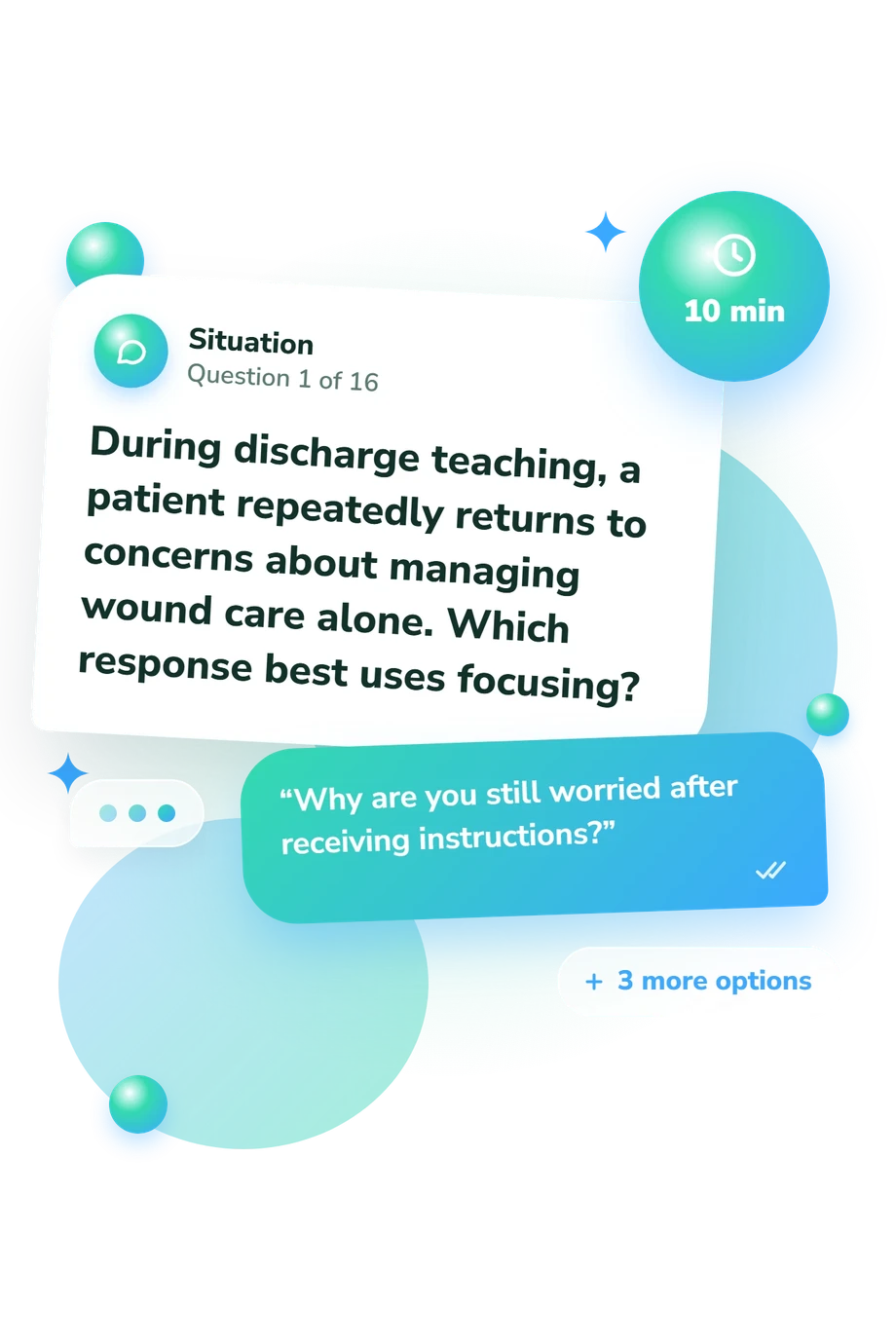
Each item presents a nurse-patient situation with four response options and asks for the best therapeutic action or explanation. The format tests communication principles in context, comparing tone, timing, directness, empathy, safety awareness, and professional boundaries. This makes it a therapeutic communication quiz with an applied focus.
The reported scale is Therapeutic Communication Nursing Knowledge, scored 0-16. Results appear as Foundation-building 0-6, Developing 7-12, or Strong knowledge 13-16. The score combines performance across the items, and no separate weighting rule for individual responses is stated.
Its conceptual reference point is the Therapeutic Communication Scale (Han et al., 2024), with Granados-Gámez et al. (2022) and Peplau’s interpersonal nursing framework providing related evidence and theory. This questionnaire is conceptually consistent with those works, not an adaptation of their published instruments. They support attention to empathy, listening, participation, therapeutic roles, and observable communication behaviors.
The displayed score is educational and is not a measure of clinical competence. This exact online questionnaire has no stated norms or clinical validation, so use the result as study guidance; performance may vary with prior training, wording, and current attention.
- Han, Soolgi, Jinhee Yoo, and Kyonghwa Kang. "Development and Validation of the Therapeutic Communication Scale in Nursing Students." Healthcare 12, no. 3 (2024): 394. 10.3390/healthcare12030394
- Granados-Gámez, Genoveva, Isabel M. Sáez-Ruiz, Verónica V. Márquez-Hernández, M. Carmen Rodríguez-García, Gabriel Aguilera-Manrique, Manuel Luís Cibanal-Juan, and Lorena Gutiérrez-Puertas. "Development and validation of the questionnaire to analyze the communication of nurses in nurse-patient therapeutic communication." Patient Education and Counseling 105, no. 1 (2022): 145-150. 10.1016/j.pec.2021.05.008
- Peplau, Hildegard E. Interpersonal Relations in Nursing: A Conceptual Frame of Reference for Psychodynamic Nursing. New York: G. P. Putnam's Sons, 1952.
Updated: