
Superpower Quiz
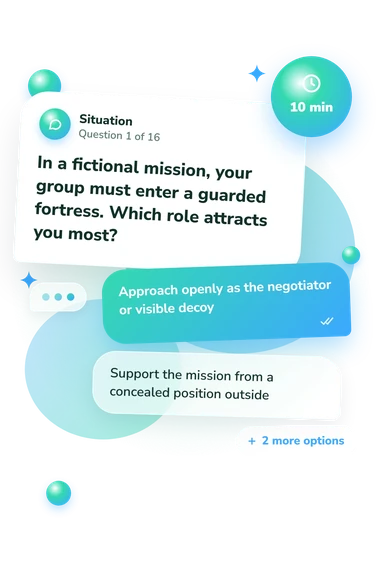
How the Scales are Structured
Who Usually Takes This Test?
See How You Compare
Below is a preview of how scores are typically distributed across each scale.
Example Questions From the Test
- Move the cabinet by hand or find a suitable tool
- Nudge the keys until they are within reach
- Guide the keys smoothly around the obstacles
- Lift the cabinet and retrieve the keys without touching either
- Stay visible and shift into a quieter conversation
- Stand at the edge of the room where there is less attention
- Become invisible briefly while finding a calm place
- Move unseen until I feel ready to rejoin the event
- Trust what they said and give them room to choose what to share
- Ask a few gentle questions and read their visible reactions
- Sense the emotional message they want you to understand
- Offer a direct mind-link so they can share thoughts beyond words
Superpower Quiz - Description and methodology of the test
People curious about how they would respond to unusual situations can use this assessment to explore hypothetical missions, social encounters, practical obstacles, and urgent tasks. The superpower quiz is suited to readers who enjoy exploring decisions when ordinary solutions compete with extraordinary options. Through hypothetical superpower choices, this fictional superpower test turns playful decisions into a profile of fictional preferences rather than a claim about real abilities.
What This Assessment Explores
Instead of testing powers, this super powers quiz examines attraction to four imagined ways of acting. It gives readers an imagined ability profile based on preferences for privacy, speed, remote control, and mental connection.
The dimensions are:
- Invisibility (0-12) ranges from Visible Presence (0-4), through Selective Vanishing (5-8), to Strong Invisibility Affinity (9-12), showing your pull toward privacy.
- Super Speed (0-12) ranges from Deliberate Pace (0-4), through Burst Accelerator (5-8), to Strong Super Speed Affinity (9-12), showing your pull toward rapid action.
- Telekinesis (0-12) ranges from Hands-On Preference (0-4), through Practical Mover (5-8), to Strong Telekinesis Affinity (9-12), showing your attraction to remote object control.
- Telepathy (0-12) ranges from Observable-World Preference (0-4), through Selective Mind-Link (5-8), to Strong Telepathy Affinity (9-12), showing your attraction to mental connection.
The highest score is the strongest affinity; scores within one point indicate a blend.
Methodology and Scientific Basis
Each item presents a fictional situation with four response options. Choices move from ordinary or hands-on solutions toward selective or extensive use of a power, while testing trade-offs involving privacy, speed, consent, and connection. This structure makes the fictional power-preference questionnaire a comparison of preferred approaches, not a ranking of abilities.
Scoring is dimension-based: responses contribute to separate power scores, compared independently. The highest score is strongest, while scores within one point form a blend. The displayed ranges do not specify how individual options are weighted, so item-level point values cannot be inferred.
The questionnaire is conceptually consistent with the supernatural-power preferences examined by Webster and Saucier (2023), but it is not an adaptation or validation of that study. Cohen et al. (2011) adds research on flight fantasies and transcendence, while Webster and Saucier (2011) offers context on individual differences in imaginative involvement. Together, these studies provide contextual evidence rather than validation of this exact online format.
As a self-report superpower assessment, the questionnaire is sensitive to mood, self-awareness, and response style, and the cited studies do not provide norms or clinical validation for its displayed scores.
- Webster, Russell J., and Saucier, Donald A. (2023). Up, Up, and Away: Individual Differences in Imaginative Involvement and Magical Beliefs Relate to Perceiving and Desiring Supernatural Powers. Imagination, Cognition and Personality, 43(2), 129-149. 10.1177/02762366231183626
- Cohen, Florette, Daniel Sullivan, Sheldon Solomon, Jeff Greenberg, and Daniel M. Ogilvie (2011). Finding everland: Flight fantasies and the desire to transcend mortality. Journal of Experimental Social Psychology, 47(1), 88-102. 10.1016/j.jesp.2010.08.013
- Webster, Russell J., and Saucier, Donald A. (2011). I Believe I Can Fly: Re-Examining Individual Differences in Imaginative Involvement. Imagination, Cognition and Personality, 30(4), 425-445. 10.2190/IC.30.4.F