
Summer Quiz
How the Scales are Structured
Who Usually Takes This Test?
See How You Compare
Below is a preview of how scores are typically distributed across each scale.
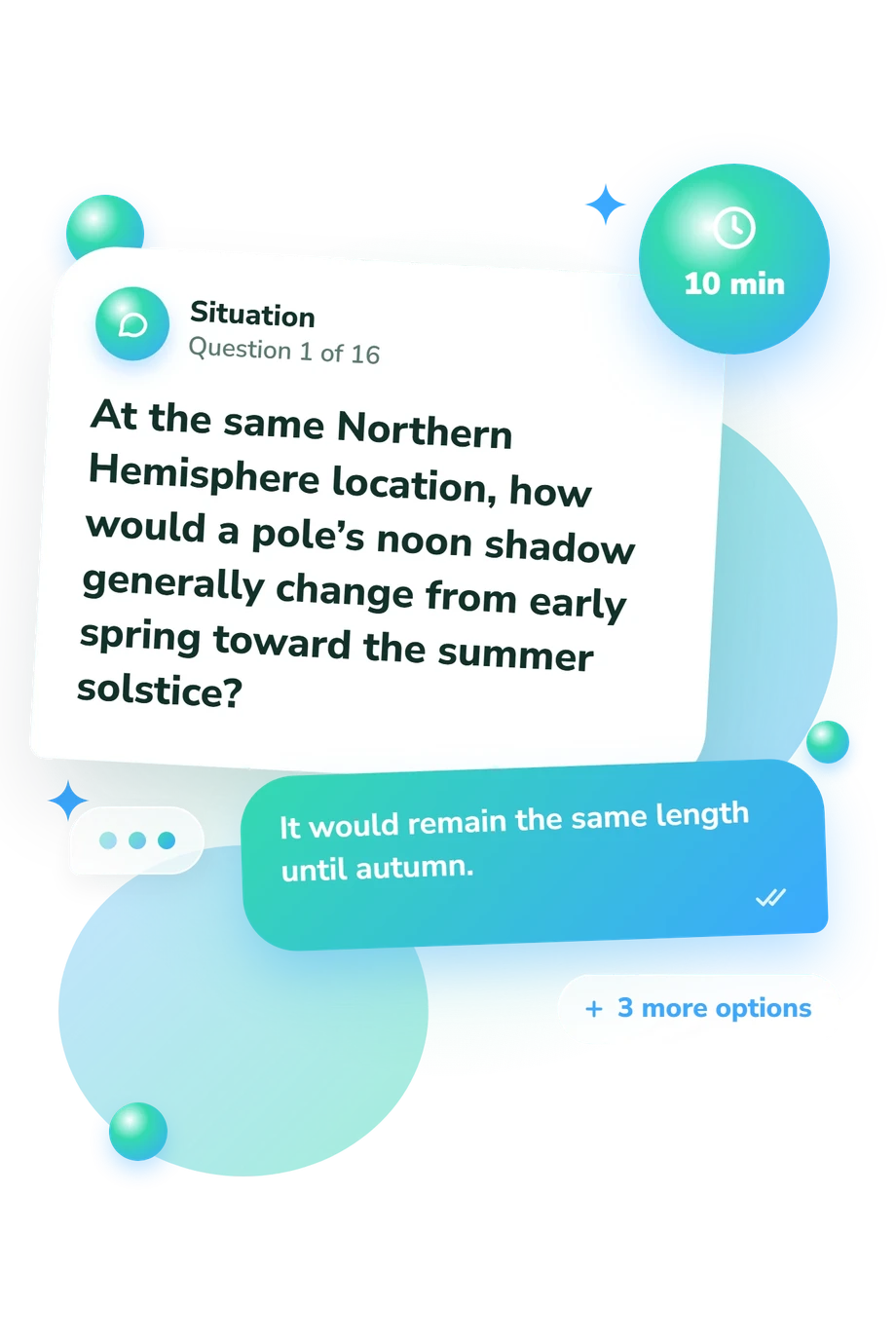
Example Questions From the Test
- Vega, Deneb, and Altair
- Betelgeuse, Rigel, and Bellatrix
- Polaris, Sirius, and Arcturus
- Antares, Spica, and Regulus
- The Sun is closest to Earth on that date.
- It is usually the hottest day of the year.
- It generally has the greatest amount of daylight.
- Day and night are approximately equal in length.
- Cirrus
- Stratus
- Cumulonimbus
- Altocumulus
Summer Quiz - Description and methodology of the test
For readers who enjoy explaining familiar warm-weather experiences, seasonal quiz questions offer a focused way to check factual understanding. It suits curious learners, students, and anyone seeking a compact check of factual understanding rather than a personality reading. This summer quiz connects ordinary observations with astronomy, weather, nature, traditions, and safety. The format gives an overall indication of familiarity with those tested topics.
What This Assessment Explores
At its core, the assessment measures factual understanding of seasonal science and traditions, not mood or personality. It links Earth’s tilt, daylight, heat transfer, atmospheric processes, astronomy, plant water balance, and lightning safety. Curious readers can use the result as a broad indication of familiarity with the tested material.
The single displayed scale is Summer Knowledge (0-16): Summer Starter (0-6) reflects basic recognition, Sunny Scholar (7-12) indicates developing to solid understanding, and Solstice Expert (13-16) signals strong, wide-ranging knowledge across the tested topics.
The result groups the material into these themes:
- Astronomy and seasons show understanding of solstices, hemispheric differences, daylight, and the Summer Triangle.
- Weather and local climate show whether thunderstorms, sea breezes, clouds, and urban heat can be explained.
- Heat, nature, traditions, and safety cover UV exposure, evaporation, plant responses, seasonal expressions, and lightning action.
The summer trivia covered here can suggest subjects for independent review, without presenting them as separate result dimensions.
Methodology and Scientific Basis
Each item presents four answer choices, and the respondent selects the best explanation. The score is the number of correct responses, and the displayed bands interpret that total. Together, the items show performance across the tested material without turning individual topics into separate result dimensions.
Methodologically, this is a four-option summer knowledge test that asks the respondent to select the best answer for each seasonal question. Ahrens and Henson (2021) support the meteorological material; Moche (2009) supports the astronomy content; Simpson (1994) explains sea-breeze mechanisms; and Oke (1982) supports the urban-heat-island explanation. The questionnaire is conceptually consistent with these works, not an adaptation of any one of them.
The score bands describe performance on these questions rather than ranking the respondent against a population. The result is best read as a broad snapshot of familiarity with the tested material. Guessing, wording, memory, current context, and recent learning can affect performance, so the result should not be treated as a measure of general intelligence or a clinical characteristic.
- Ahrens, C. Donald, and Robert Henson. Meteorology Today: An Introduction to Weather, Climate, and the Environment. 13th ed. Cengage, 2021.
- Moche, Dinah L. Astronomy: A Self-Teaching Guide. 7th ed. Wiley, 2009.
- Simpson, John E. Sea Breeze and Local Winds. Cambridge University Press, 1994.
- Oke, T. R. “The Energetic Basis of the Urban Heat Island.” Quarterly Journal of the Royal Meteorological Society, vol. 108, no. 455, 1982, pp. 1-24. 10.1002/qj.49710845502
Updated: