
Solar Energy Quiz
How the Scales are Structured
Who Usually Takes This Test?
See How You Compare
Below is a preview of how scores are typically distributed across each scale.
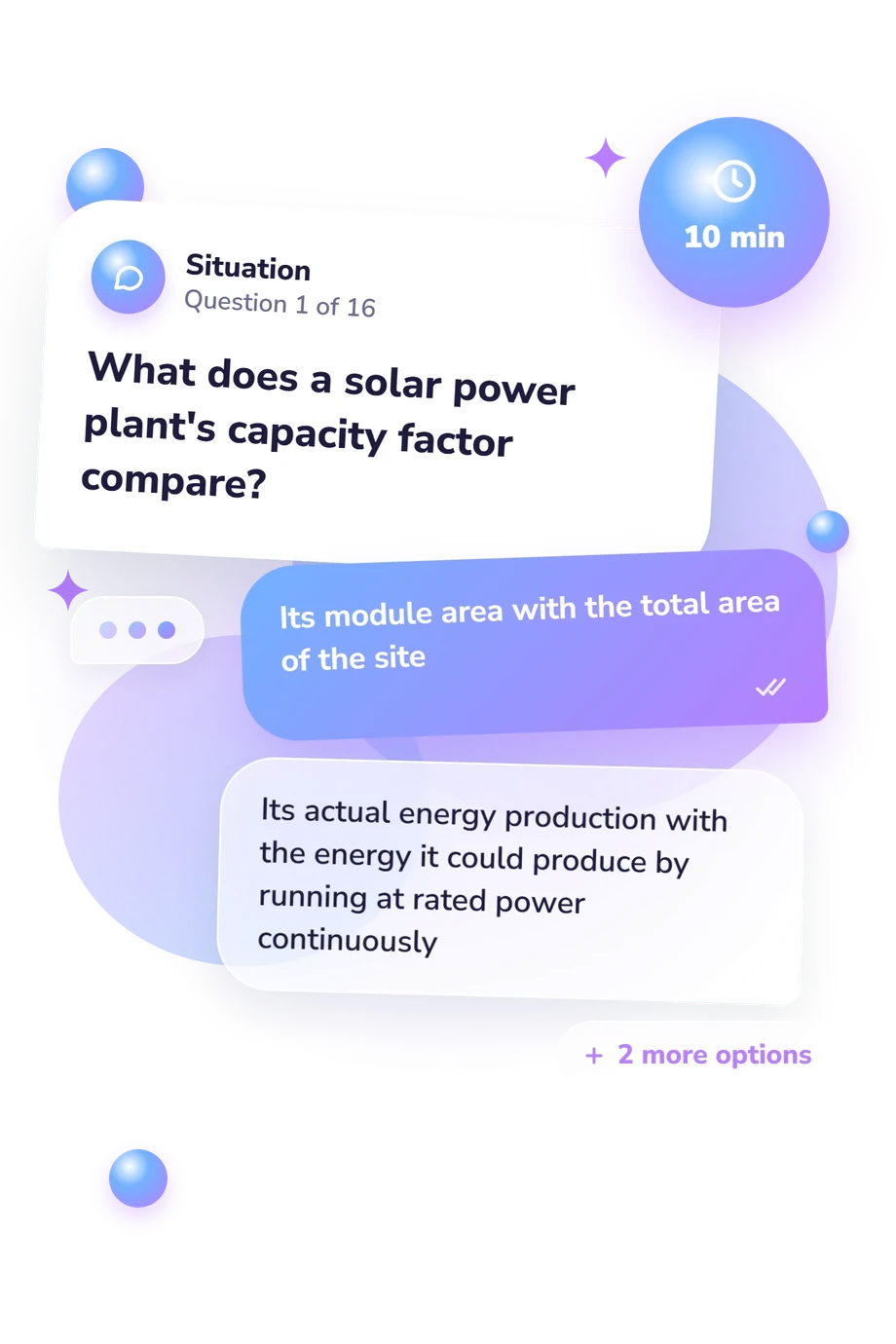
Example Questions From the Test
- Its module area with the total area of the site
- Its actual energy production with the energy it could produce by running at rated power continuously
- Its battery voltage with its inverter voltage
- Its installation cost with the retail price of electricity
- 1 kilowatt-hour
- 5 kilowatts per hour
- 5 kilowatt-hours
- 25 kilowatt-hours
- To store electrical energy for use at another time
- To increase the amount of sunlight striking each module
- To convert alternating current into sunlight
- To prevent the modules from warming in direct sun
Solar Energy Quiz - Description and methodology of the test
For learners, homeowners, and curious readers, the solar energy quiz offers a focused way to understand how photovoltaic systems behave in real-world conditions. Questions in this quiz about solar energy connect basic physics with power, shading, storage, and grid interaction, helping readers make sense of situations they may encounter in study, at home, or in everyday energy discussions. The result is an educational knowledge profile.
What This Assessment Explores
The assessment connects photovoltaic principles with system operation and everyday energy decisions. It covers sunlight-to-electricity conversion, string current, weather, temperature, tilt, orientation, inverters, batteries, outages, energy credits, and life-cycle context.
The solar-cell topics ask readers to recognize key mechanisms, apply basic relationships, and make practical calculations involving output, energy, and operating conditions. They also introduce photovoltaic system basics for learners, homeowners, and curious readers building foundational understanding.
The result uses the Solar Energy Knowledge scale, scored 0-16. Its bands are:
- Foundational (0-6) means some concepts are recognized, but links among components, units, and operating conditions need review.
- Developing (7-12) means many essentials are understood, with gaps in common applications.
- Strong (13-16) means the reader shows a well-rounded grasp of technologies, performance factors, and practical calculations.
This is an educational knowledge result, not professional certification.
Methodology and Scientific Basis
Each item offers four answer choices, and the respondent selects the best explanation or calculation. Coverage spans solar cell fundamentals, electrical quantities, components, operating conditions, and system behavior, so performance reflects breadth across connected concepts rather than mastery of one formula.
The four-choice format presents educational knowledge items: performance reflects the selected responses, while the answer choices do not establish how points are assigned. No item-weighting or point-assignment rule is specified.
The evidence base is conceptually consistent with Energy Literacy Survey (DeWaters & Powers, 2011), which treats energy literacy as broader than isolated factual recall. Later measurement and questionnaire-design studies by DeWaters and colleagues define or evaluate energy-literacy measurement. This questionnaire is conceptually related to that work, not an adaptation or validated version.
Examples involving output, irradiance, and operating conditions also align with the PVWatts model described by Dobos (2014). The online format has no stated standardization or normative sample for interpreting scores. Guessing, prior learning, item wording, attention, and current context can influence performance, so the result is best used as a snapshot for study.
- DeWaters, Jan E., and Susan E. Powers. "Energy Literacy of Secondary Students in New York State (USA): A Measure of Knowledge, Affect, and Behavior." Energy Policy, 39(3), 1699-1710, 2011. 10.1016/j.enpol.2010.12.049.
- DeWaters, Jan E., and Susan E. Powers. "Establishing Measurement Criteria for an Energy Literacy Questionnaire." The Journal of Environmental Education, 44(1), 38-55, 2013. 10.1080/00958964.2012.711378.
- DeWaters, Jan, Basil Qaqish, Mary Graham, and Susan Powers. "Designing an Energy Literacy Questionnaire for Middle and High School Youth." The Journal of Environmental Education, 44(1), 56-78, 2013. 10.1080/00958964.2012.682615.
- Dobos, Aron P. "PVWatts Version 5 Manual." National Renewable Energy Laboratory, NREL/TP-6A20-62641, 2014.
Updated: