
Revised Social Anhedonia Scale (RSAS) Test
How the Scales are Structured
Who Usually Takes This Test?
See How You Compare
Below is a preview of how scores are typically distributed across each scale.
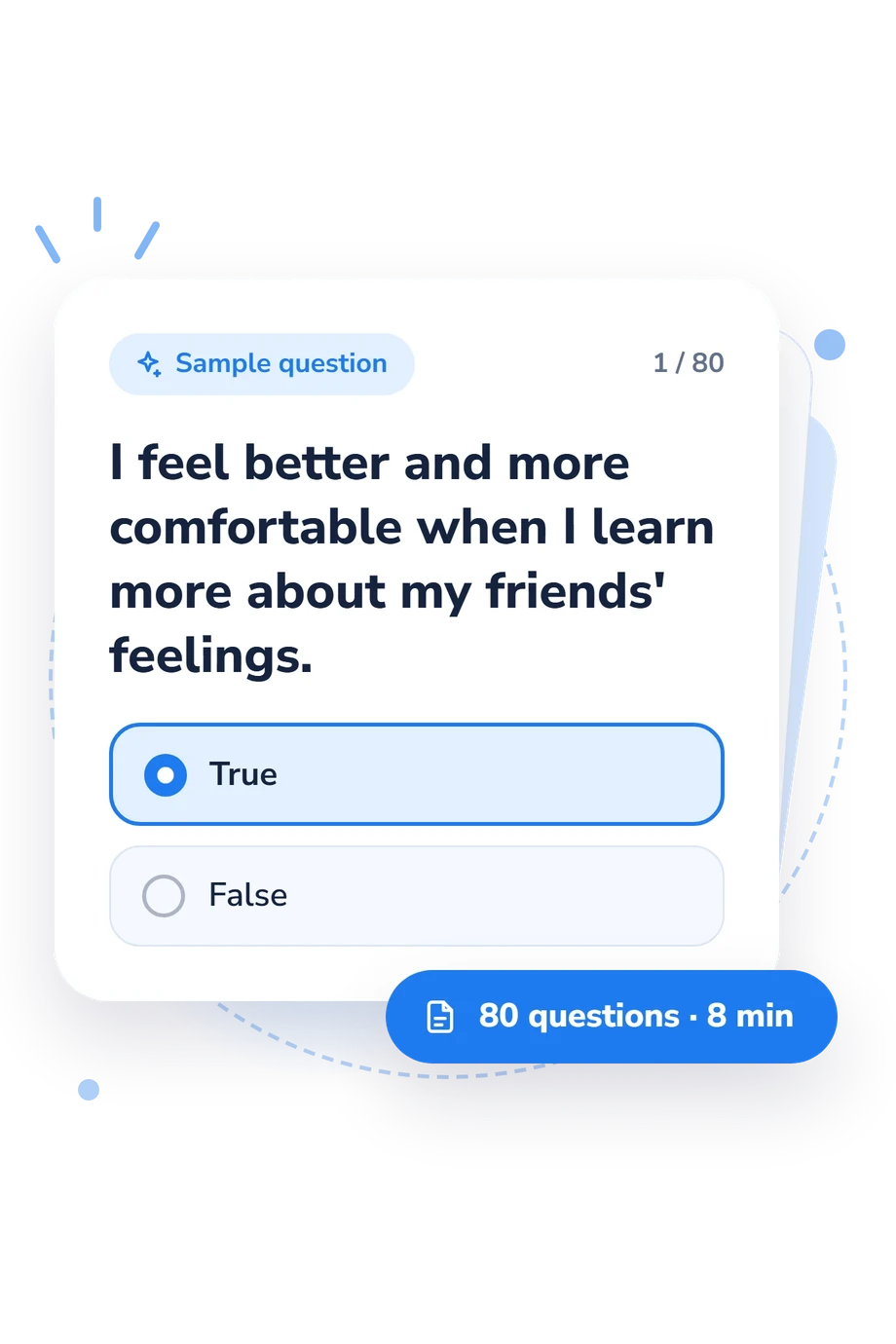
Example Questions From the Test
- True
- False
- True
- False
- True
- False
Revised Social Anhedonia Scale (RSAS) Test - Description and methodology of the test
People who want to understand their comfort with closeness, company, and solitude may use the Revised Social Anhedonia Scale (RSAS) Test as a focused self-report measure. This social anhedonia test examines whether interpersonal contact feels rewarding, effortful, or emotionally distant. The result can help readers reflect on relationship preferences and notice patterns that may deserve further personal or professional exploration.
What This Assessment Explores
As a self-report, the RSAS test focuses on social pleasure. Statements cover affection, attachment, conversation, friendship, shared leisure, reactions to others’ happiness, and the wish to be left alone. Together, they ask whether contact feels meaningful and energizing or tiring, unnecessary, or intrusive.
The item themes are:
- Enjoyment of shared activity shows whether hobbies, entertainment, travel, or singing become more rewarding with other people.
- Emotional closeness reflects how readily affection, attachment, safety, and pleasure in friends’ experiences are felt.
- Social initiative describes willingness to make friends, sustain conversations, and invest energy in relationships.
- Solitude preference indicates how strongly alone time or distance from others is favored.
The result is the Social Anhedonia Scale: 0-40. The catalogue labels scores Low 0-12 or Elevated 13-40. A higher result may indicate reduced pleasure in social interaction, difficulty maintaining relationships, and withdrawal or isolation.
Methodology and Scientific Basis
Each item uses a true-or-false response about a social experience. The statements include inviting and avoidant situations, so the result reflects the respondent’s overall pattern. The response format does not reveal how many points each answer contributes; that scoring rule should not be inferred from the choices.
The named source is Revised Social Anhedonia Scale (Eckblad et al., 1982). Mishlove and Chapman (1985) examined social anhedonia in relation to psychosis proneness, while Chapman, Chapman, and Raulin (1976) contributed work on physical and social anhedonia. These sources establish construct context, but they do not show that this online presentation has the same norms or validation.
Interpretation is dimensional: an elevated result suggests that social contact may be less rewarding or more effortful than it is for many people, while a low result suggests fewer endorsed signs of reduced social pleasure. Current mood, recent experiences, self-awareness, and candor can affect self-report, so the score belongs alongside circumstances and functioning rather than standing as evidence of a mental-health condition. This social anhedonia questionnaire is useful as a structured prompt for examining interpersonal experience.
- Eckblad, M. L., Chapman, L. J., Chapman, J. P., & Mishlove, M. (1982). The Revised Social Anhedonia Scale. University of Wisconsin, Madison, WI. Unpublished test.
- Mishlove, M., & Chapman, L. J. (1985). Social anhedonia in the prediction of psychosis proneness. Journal of Abnormal Psychology, 94(3), 384-396. 10.1037/0021-843x.94.3.384
- Chapman, L. J., Chapman, J. P., & Raulin, M. L. (1976). Scales for physical and social anhedonia. Journal of Abnormal Psychology, 85(4), 374-382. 10.1037/0021-843x.85.4.374
Updated: