
Ski Quiz
How the Scales are Structured
Who Usually Takes This Test?
See How You Compare
Below is a preview of how scores are typically distributed across each scale.
Example Questions From the Test
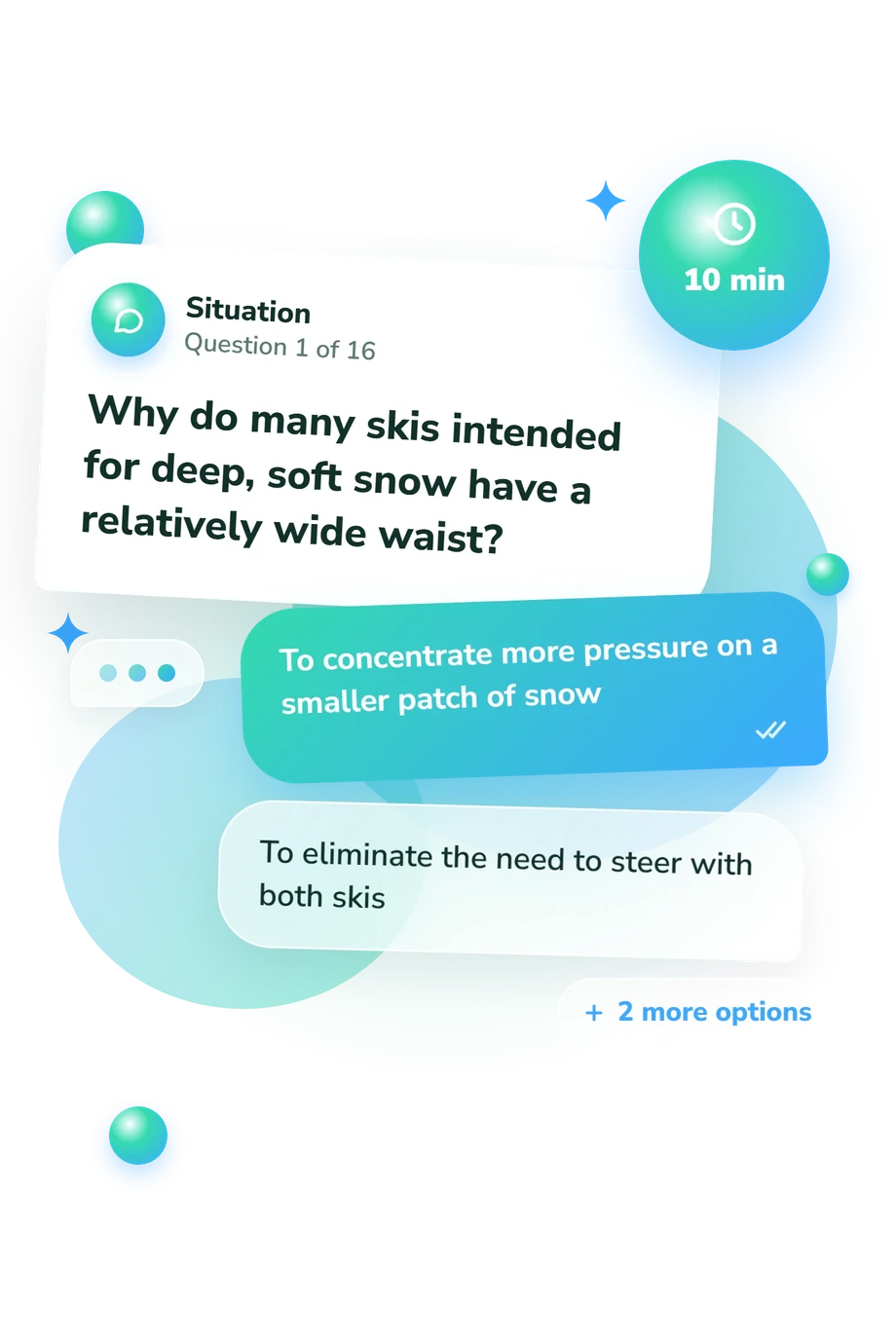
- To concentrate more pressure on a smaller patch of snow
- To eliminate the need to steer with both skis
- To provide more surface area and improve flotation
- To make the ski flex identically at every point
- To manage speed and begin changing direction
- To keep both ski bases completely flat at racing speed
- To prepare for jumping by loading both tails
- To glide uphill without removing the skis
- A fixed upper body that never moves with the terrain
- Enough lift to unweight both skis for the full turn
- Extra braking by dragging both baskets behind the skis
- Rhythm, timing, and commitment into the next turn
Ski Quiz - Description and methodology of the test
People can use this ski quiz to see which skiing concepts they understand and which topics need review. Equipment questions make the result useful for a what skis should I buy quiz without recommending a model, while helping a skier identify subjects needing attention. The intended reader may be a beginner building fundamentals or a recreational skier refreshing everyday knowledge before returning to the slopes.
What This Assessment Explores
Rather than measuring athletic performance, the questionnaire checks practical knowledge for informed decisions on snow. It works as a skiing knowledge check across equipment, technique, clothing, visibility, slope conduct, fatigue, and companion avalanche rescue. It suits skiers who want to identify gaps before applying advice in real conditions.
Because it does not collect personal fit, terrain, or preference information, the result cannot deliver the personalized answer sought in a best skis for me quiz.
These topics produce one educational scale, Ski Knowledge (0-16), with three displayed bands:
- Foundation Builder (0-6) indicates some essential knowledge and points to core topics for review.
- Developing Knowledge (7-12) indicates familiarity with everyday principles while leaving less familiar areas to strengthen.
- Strong Ski Knowledge (13-16) indicates broad practical knowledge but does not certify skiing ability or safety.
Methodology and Scientific Basis
The questionnaire presents skiing situations or concepts with four answer choices. Items cover equipment such as ski width, sidecut, boot fit, wax, and binding settings; technique including edging, pole timing, fatigue management, and outside-ski pressure; plus slope etiquette, visibility, and companion-rescue principles. They require judgment and recall, while the result remains a knowledge indicator rather than a measure of skill.
Selected responses in the ski knowledge quiz produce the bounded educational result described above. It is an unvalidated educational score and does not certify skiing ability or safety. Use it as a learning profile for prioritizing study or instructor questions.
Content is conceptually consistent with the manual by Coffey, Foster, and Sogard, the National Ski Areas Association’s responsibility code, ASTM F939-19 for alpine binding release torque selection, and AIARE companion-rescue guidance. The questionnaire is neither an adaptation nor a validation of these sources.
Guessing, memory, current experience, and unfamiliar situations can affect responses. Conditions and local rules vary: binding-setting questions belong with a certified binding technician, while avalanche-rescue decisions require trained avalanche professionals or instructors.
- Coffey, Kelly, Ellen Post Foster, and Rob Sogard. Alpine Technical Manual. American Snowsports Education Association, 2014. ISBN 9781882409396.
- National Ski Areas Association. Your Responsibility Code. 2022.
- ASTM International. Standard Practice for Selection of Release Torque Values for Alpine Ski Bindings, ASTM F939-19. 2019. 10.1520/F0939-19.
- American Institute for Avalanche Research and Education. Companion Rescue., n.d.
Updated: