
Sister Quiz
How the Scales are Structured
Who Usually Takes This Test?
See How You Compare
Below is a preview of how scores are typically distributed across each scale.
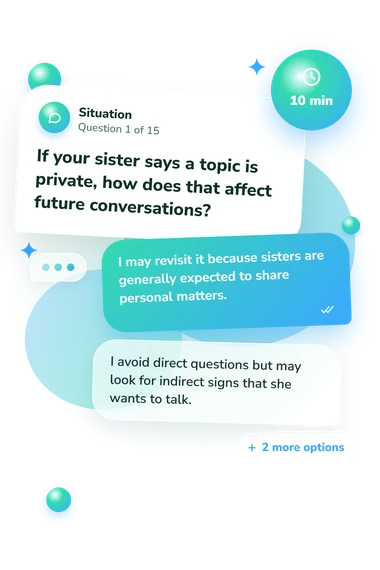
Example Questions From the Test
- I may revisit it because sisters are generally expected to share personal matters.
- I avoid direct questions but may look for indirect signs that she wants to talk.
- I leave the topic alone unless there is a clear reason to check in.
- I respect the limit and let her decide whether, when, and how to reopen it.
- I give her room and trust her to contact me if she wants something.
- I acknowledge it warmly, then follow her lead on whether to continue.
- I ask what kind of contact or help would feel useful.
- I check what she needs and follow up later in a way that respects her answer.
- We mostly handled changes through separate people, routines, or coping styles.
- We occasionally connected, depending on the particular change.
- We often offered each other familiarity during major changes.
- We consistently experienced each other as an important source of continuity.
Sister Quiz - Description and methodology of the test
For adults reflecting on a close family bond, this sister quiz provides a structured way to examine how connection and independence coexist. Rather than testing trivia, the sister-focused quiz questions examine privacy, support, disagreement, celebration, and memories that give everyday closeness a clearer shape. The result offers language for noticing strengths, tensions, and conversations that may deserve more attention.
What This Assessment Explores
Taken together, the assessment describes how sisters stay connected while remaining separate people. It suits anyone reflecting on a sister bond across distance, life changes, or uneven contact. As a quiz about how well you know your sister, it examines what you notice about her boundaries, needs, decisions, and memories rather than testing biographical recall.
The three result dimensions are:
- Closeness and Individuality (0-15) measures room for privacy, difference, and independent choices within connection: Closely intertwined (0-5), Flexible separation (6-10), or Distinct yet connected (11-15).
- Present-Day Mutual Support (0-15) measures how support, celebration, and repair currently flow: Limited availability (0-5), Dependable moments (6-10), or Active mutual support (11-15).
- Shared Childhood Connection (0-15) measures how shared memories and routines still shape the bond: Separate histories (0-5), Meaningful threads (6-10), or Strong shared story (11-15).
They describe patterns, not a family ideal.
Methodology and Evidence Base
Each item describes a concrete situation and offers four response options, so the task is self-report rather than factual recall. The most useful answer is the one that resembles your usual response, not the most flattering one.
Privacy, help, important news, different choices, celebration, comparison, repair, routines, transitions, disagreements, and memories connect the item groups. Present-day prompts emphasize support and contact. In practical terms, whether you know your sister is explored through these patterns.
The closest reference is the Lifespan Sibling Relationship Scale (Riggio, 2000). This questionnaire is conceptually consistent with its attention to adult sibling attitudes, but is not presented as an adaptation. Stocker, Lanthier, and Furman (1997) support attention to warmth, conflict, rivalry, and companionship. Bascoe, Davies, and Cummings (2012) add a boundary perspective in which separation and connection are related.
Responses form the displayed results, but no item-by-item weighting formula is specified, so points should not be reverse-engineered. There are no stated population norms or standardization. Contact, memory, expectations, and self-awareness can shift results, making them a contextual profile rather than a fixed verdict.
- Riggio, H. R. (2000). Measuring Attitudes toward Adult Sibling Relationships: The Lifespan Sibling Relationship Scale. Journal of Social and Personal Relationships, 17(6), 707-728. 10.1177/0265407500176001
- Stocker, C. M., Lanthier, R. P., & Furman, W. (1997). Sibling Relationships in Early Adulthood. Journal of Family Psychology, 11(2), 210-221. 10.1037/0893-3200.11.2.210
- Bascoe, S. M., Davies, P. T., & Cummings, E. M. (2012). Beyond Warmth and Conflict: The Developmental Utility of a Boundary Conceptualization of Sibling Relationship Processes. Child Development, 83(6), 2121-2138. 10.1111/j.1467-8624.2012.01817.x