
Science Quiz for Kids
How the Scales are Structured
Who Usually Takes This Test?
See How You Compare
Below is a preview of how scores are typically distributed across each scale.
Example Questions From the Test
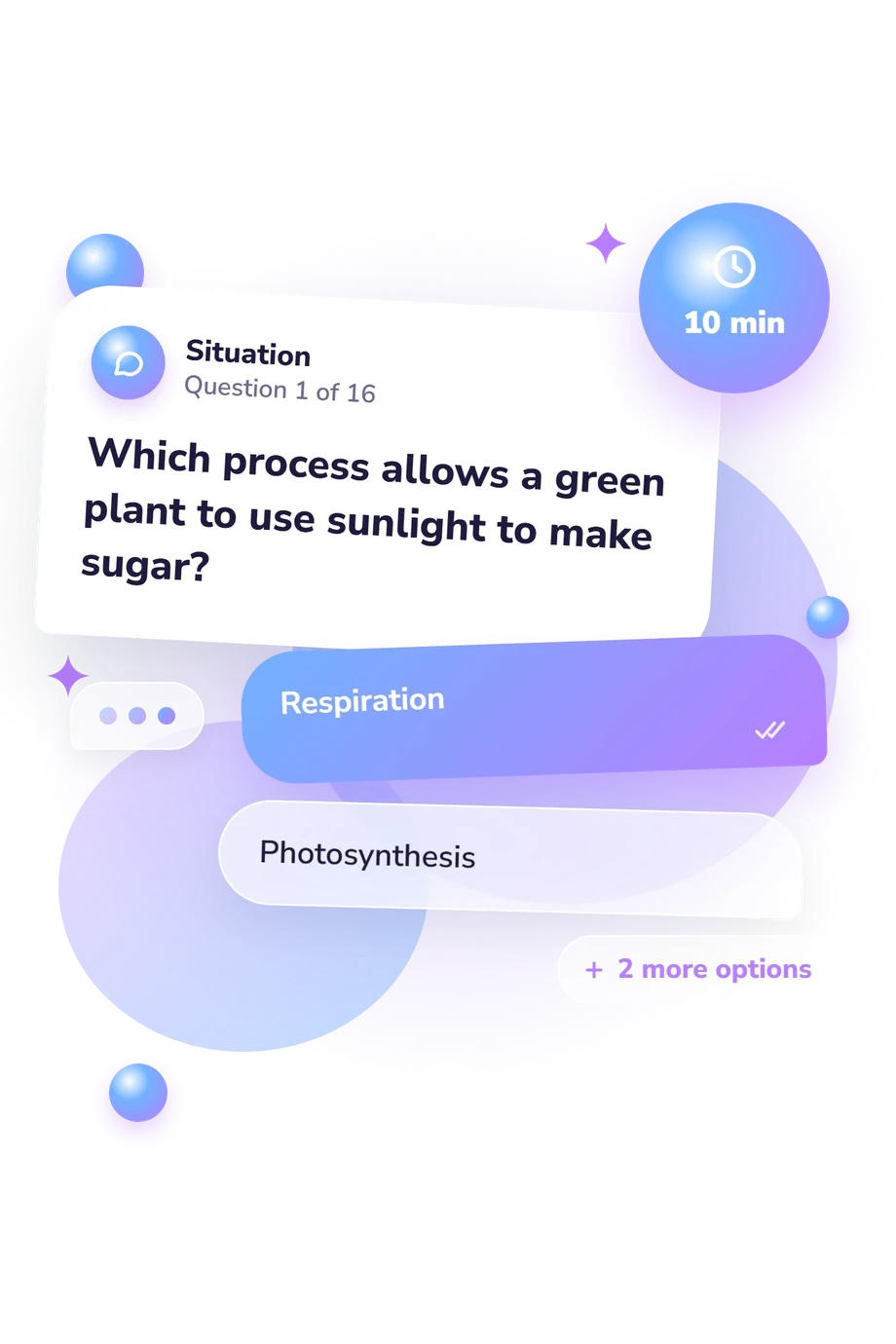
- Respiration
- Photosynthesis
- Transpiration
- Germination
- Gravity
- Sunlight
- The planets’ rotation
- Magnetism
- Pouring the mixture through filter paper
- Freezing the whole mixture
- Using a magnet
- Stirring the mixture faster
Science Quiz for Kids - Description and methodology of the test
For families, teachers, and young learners who want a clear snapshot of foundational science understanding, this assessment offers a focused way to explore how confidently a child applies familiar ideas. The science quiz for kids emphasizes school-relevant reasoning rather than memorization alone. A result can highlight topics for curiosity, review, or classroom discussion. Presented as a science quiz for children, it keeps the emphasis on learning rather than labels.
What This Assessment Explores
Questions span living systems, matter, forces, energy, Earth, space, and simple investigation. Learners apply concepts to everyday situations, interpret changes, and choose explanations that fit the evidence. This suits a primary school science quiz while rewarding basic reasoning.
The main result themes are:
- Life science shows how the learner recognizes plants, body systems, organisms, and food webs.
- Physical science indicates understanding of forces, heat, sound, light, particles, and materials.
- Earth and space science reflects knowledge of rocks, fossils, water processes, planets, and the Moon.
- Scientific practices show whether the learner can identify a fair test and reason from evidence.
Results appear on the Kids’ Science Knowledge scale (0-16). Each correct answer earns one point. Emerging Explorer (0-6), Developing Scientist (7-12), and Strong Science Thinker (13-16) describe increasing mastery of the sampled material. The labels summarize this quiz, not a formal academic level.
Methodology and Evidence Base
Each item offers four answer choices and presents a concept or short situation. The science quiz questions for kids use examples involving shadows, mixtures, ecosystems, fair tests, and heat. One option is the best fit for the concept being tested, so the format combines recall with simple transfer.
Scoring is transparent: each correct response adds one point to a total interpreted through the descriptive bands in the first section. The format may resemble elementary science quiz bee questions and answers, but the items sample connected school concepts rather than a competition set.
Conceptually, the questionnaire is consistent with Lens on Science (Greenfield & Penfield, 2009), the Science Learning Assessment (SLA) (Samarapungavan et al., 2009), Zucker et al.’s (2016) science measure, and the National Research Council’s (2012) K-12 framework. It is not an adaptation, normed version, or validation study of those sources.
Interpret scores narrowly: performance can reflect reading comprehension, guessing, prior instruction, and attention, so a lower result points to topics for practice rather than fixed ability.
- Greenfield, D. B., & Penfield, R. (2009). Lens on Science: Development and Validation of a Computer-Administered, Adaptive, IRT-Based Science Assessment for Preschool Children (IES Grant R305A090502). University of Miami, Institute of Education Sciences.
- Zucker, T. A., Williams, J. M., Bell, E. R., Assel, M. A., Landry, S. H., Monsegue-Bailey, P., Crawford, A., & Bhavsar, V. (2016). Validation of a brief, screening measure of low-income pre-kindergarteners’ science and engineering knowledge. Early Childhood Research Quarterly, 36, 345-357. 10.1016/j.ecresq.2015.12.018
- Samarapungavan, A., Mantzicopoulos, P., Patrick, H., & French, B. (2009). The Development and Validation of the Science Learning Assessment (SLA): A Measure of Kindergarten Science Learning. Journal of Advanced Academics, 20(3), 502-535. 10.1177/1932202X0902000306
- National Research Council. (2012). A Framework for K-12 Science Education: Practices, Crosscutting Concepts, and Core Ideas. Washington, DC: The National Academies Press. 10.17226/13165
Updated: