
Road Trip Quiz
How the Scales are Structured
Who Usually Takes This Test?
See How You Compare
Below is a preview of how scores are typically distributed across each scale.
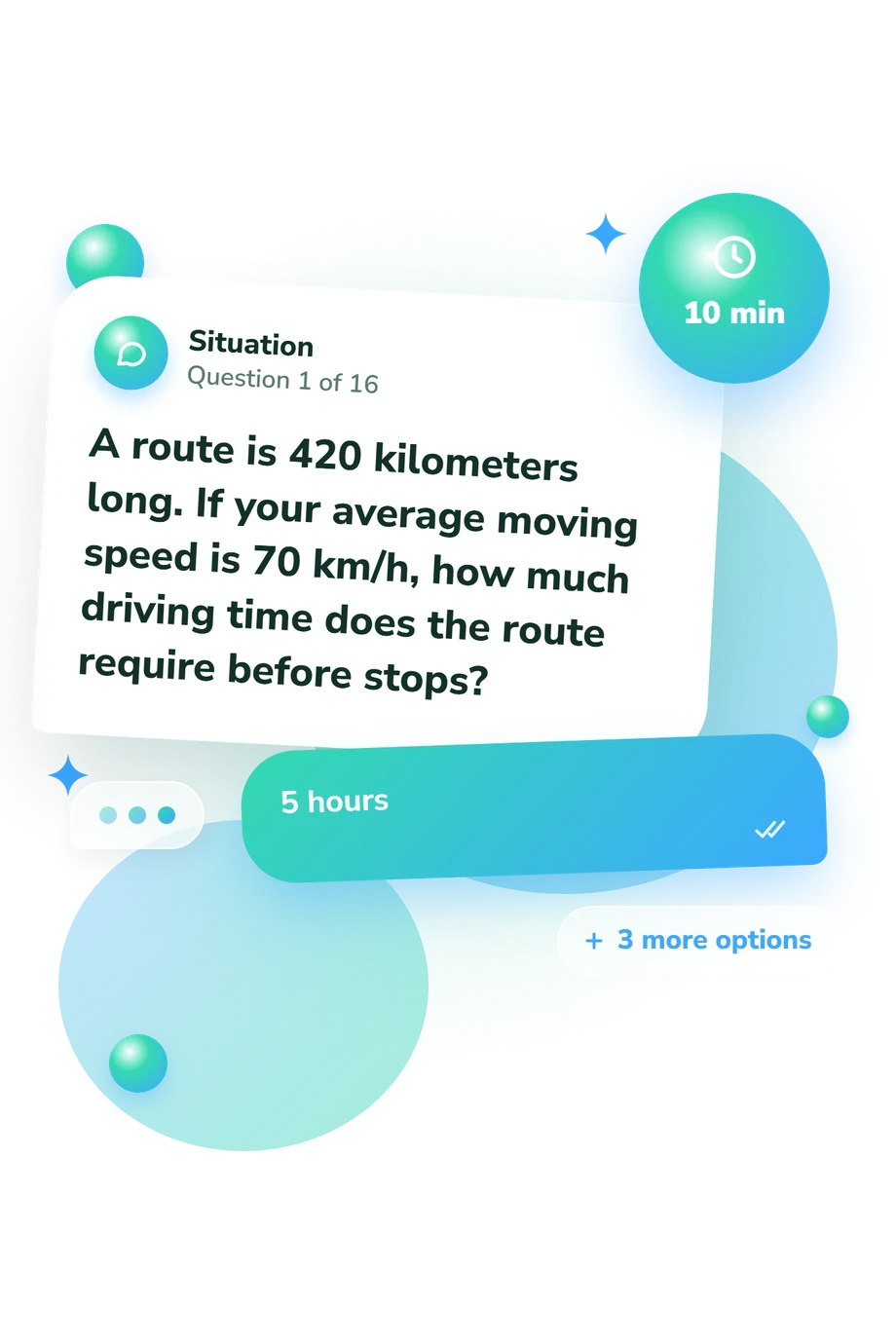
Example Questions From the Test
- Feeling bored with the current playlist
- Repeated yawning and difficulty keeping the car centered
- Noticing that the road has become repetitive
- Wanting a drink at the next planned stop
- Coast in neutral so the engine does not resist the car
- Select a lower gear so engine braking helps control speed
- Switch off the engine and use only the brakes
- Hold the brake pedal down continuously for the entire descent
- 5 liters
- 26 liters
- 8 liters
- 8 liters
Road Trip Quiz - Description and methodology of the test
People preparing for an independent journey can use this assessment to judge which road decisions need further review. The road trip quiz checks how a respondent handles practical scenarios without asking about personality or travel preferences. Its result can direct attention to areas where a refresher may be useful before setting out. This roadtrip quiz offers a focused check of readiness.
What This Assessment Explores
Questions cover route and fuel calculations, fatigue, vehicle warnings, braking, weather, luggage, breakdowns, and missed exits. The questionnaire uses a car journey quiz format to test applied recognition: the respondent selects a safe action or calculates a result rather than describing personality.
The items represent these practical groups:
- Route planning shows use of speed, distance, fuel, map scale, and time zones.
- Driver readiness indicates recognition of fatigue, hydroplaning, and overheated brakes.
- Vehicle care reflects understanding of tire pressure, load placement, warning signs, and mechanical follow-up.
- Emergency decisions show whether safer responses are chosen for stalls, missed exits, and roadside problems.
Results are reported on the Road Trip Knowledge scale, 0-16: Foundations to build (0-6), Capable traveler (7-12), or Strong road trip command (13-16). These bands describe educational performance, not driving qualification.
Methodology and Evidence Base
Each item presents a road situation with four answer choices. The respondent selects the most appropriate action, calculation, or interpretation, so the method emphasizes applied recognition rather than open-ended explanation. The response format keeps the assessment focused on the respondent's choices in each situation.
Veling's work on measuring driving knowledge provides the closest conceptual anchor: safety-relevant knowledge can be treated as measurable. Prohn and Herbig offer a related example from driver-training research, and the National Highway Traffic Safety Administration's compendium supplies historical highway-safety questionnaire content. This questionnaire is conceptually consistent with those works, not presented as an adaptation of their instruments.
The questionnaire functions as a driving knowledge assessment, and the catalogue presents its bands as practical educational interpretations. Results may reflect guessing, memory, familiarity with local rules, and current attention. A strong score indicates useful familiarity with the tested situations, while real decisions still require local law, vehicle instructions, and appropriate assistance.
- Veling, Ipe H. (1982). Measuring driving knowledge. Accident Analysis & Prevention, 14(2), 81-85. 10.1016/0001-4575(82)90074-4
- Prohn, Maria J., & Herbig, Britta. (2022). Traffic safety knowledge gain of ambulance drivers after simulator-based training. BMC Medical Education, 22, 216. 10.1186/s12909-022-03279-w
- United States. National Highway Traffic Safety Administration. (1980). Compendium of Highway Safety Questionnaire Items. DOT-HS-805-579. 10.21949/1525005
Updated: