
Punnett Square Quiz
How the Scales are Structured
Who Usually Takes This Test?
See How You Compare
Below is a preview of how scores are typically distributed across each scale.
Example Questions From the Test
- Only A, because it is written first
- Either A or a
- Aa together in every gamete
- AA or aa
- 1/4
- 3/4
- 1/2
- 1
- 1/4
- 1/2
- 3/4
- 1/16
Punnett Square Quiz - Description and methodology of the test
Students reviewing classical genetics, teachers checking core concepts, and curious learners can use this punnett square quiz to examine how they reason about inheritance. It is intended for readers who want to connect allele combinations with predicted outcomes rather than memorize isolated ratios. The questions keep attention on those relationships, and this Punnett square practice quiz places performance in a broad knowledge band.
What This Assessment Measures
Punnett squares represent possible allele combinations, not guaranteed outcomes for an actual family. The questions examine probability, independent conceptions, complete dominance, codominance, incomplete dominance, sex-linked inheritance, and genotype-phenotype distinctions. They also test whether the learner understands the model’s limits, including environmental effects on trait expression.
This assessment focuses on applying rules across connected inheritance problems. When learners use this punnett square online quiz as a study check, the result is organized as Punnett Square Knowledge, scored from 0-16:
- Building Foundations (0-6) indicates that core allele and probability concepts need review.
- Developing Understanding (7-12) indicates competence with common crosses, with more practice useful for complex patterns.
- Strong Understanding (13-16) indicates accurate application in standard heredity scenarios and awareness of the model’s limits.
The score summarizes quiz knowledge, not clinical-genetics expertise.
Methodology and Evidence Base
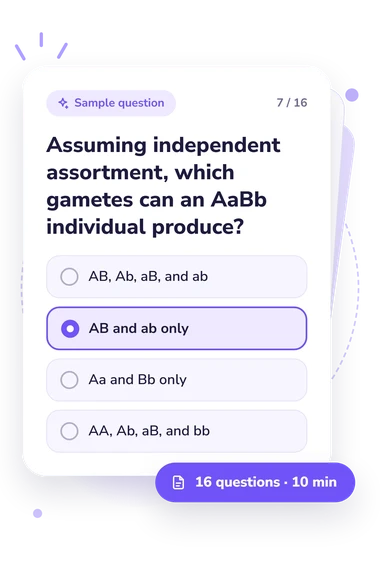
Each item uses selected-response format: a genetics scenario or concept is followed by alternatives, and the learner chooses the answer that best matches the inheritance rule. The set moves from identifying possible gametes and a square’s purpose to calculating genotype or phenotype probabilities in one- and two-gene crosses. Other items address codominance, incomplete dominance, X-linked inheritance, independent outcomes, and model limits.
Scoring is reported as a total knowledge result interpreted through the displayed bands. Because it does not state how many points each answer contributes, no finer rule should be inferred from the range. The displayed bands describe performance on this quiz rather than a comparison with a population.
Content is conceptually consistent with Punnett’s Mendelism, which explains inheritance prediction, and with Abbott and Fairbanks’ analysis of Mendel’s experimental evidence. These works support the Mendelian probability principles covered in several items but do not establish the questionnaire as a validated adaptation of either work. Used as a Punnett square assessment, the quiz lets learners check understanding, although guessing, misunderstanding, or prior genetics knowledge can affect the result.
- Punnett, Reginald Crundall. Mendelism. 3rd ed. New York: The Macmillan Company, 1911. 10.5962/bhl.title.61797
- Abbott, Scott, and Daniel J. Fairbanks. Experiments on Plant Hybrids by Gregor Mendel. Genetics, 204(2), 407-422, 2016. 10.1534/genetics.116.195198
Updated: